






Manila Bulletin
 Spotlight Features
Filipino food in space? This Filipina analog astronaut says it's possible
Spotlight Features
Filipino food in space? This Filipina analog astronaut says it's possible
Spotlight Features
Filipino food in space? This Filipina analog astronaut says it's possible
Filipino food in space? This Filipina analog astronaut says it's possible
By AJ Gomez
Published May 6, 2026 04:36 pm


For 10 days, four astronauts recently orbited the Moon aboard NASA’s Artemis II—the first crewed mission under its human deep space exploration program—and worked in space, relying on meals that are nutritious and easy to prepare such as rehydrated shrimp cocktail, brisket, mac and cheese.
But this raises an interesting question: Can Filipino food make it to space, too?
According to Kristine Jane Atienza, the answer is yes—definitely.
Food in space—and why it matters
Manila Bulletin sat down for a one-on-one interview with Atienza, 34, who made history as the first Filipino analog astronaut after completing a mission at HI-SEAS in Hawaii. There, she managed food inventory and oversaw the crew’s diet.
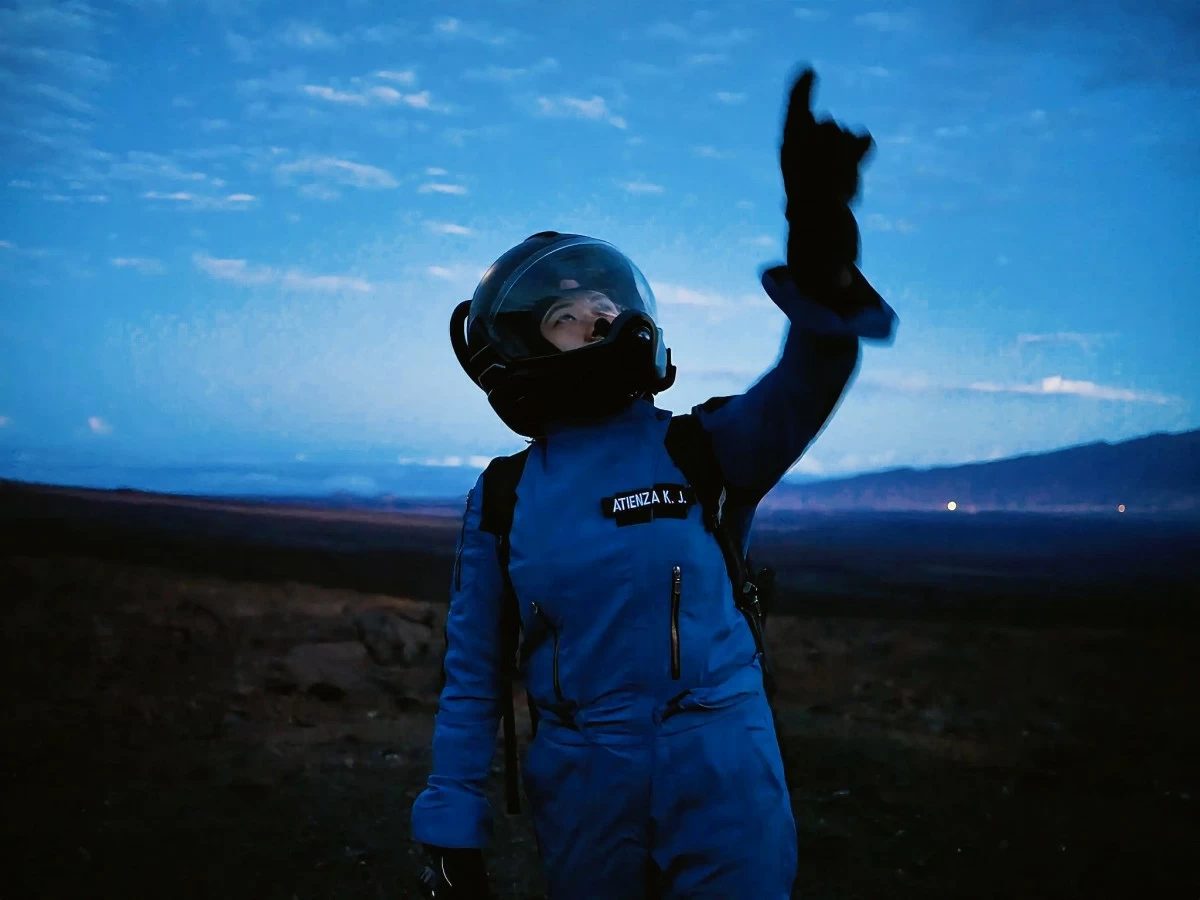
FIRST FILIPINO ANALOG ASTRONAUT— Kristine Atienza points to the sky while wearing her analog mission suit during HI-SEAS in Hawaii.
Analog missions are Earth-based experiments conducted in environments that mimic space conditions.
“For my study, I compared our dietary intake with our physical activity during the mission,” she said.
“I think the mission really highlighted the importance of food—not just for energy or physical health, but also for camaraderie and mental well-being,” she shared.
Adobo, dried mangoes, ube, and laing—in space?
During the mission, Atienza even cooked meals for her crew, including pancakes. She even cooked our very own pancit for them.
So, can Filipino food actually go to space? Atienza said yes, although there are technical requirements and limitations, it’s entirely possible.
In fact, she is currently working on a project with the Philippine Nuclear Research Institute and University of the Philippines Diliman to bring one of the country’s favorite snacks, dried mangoes, into space.
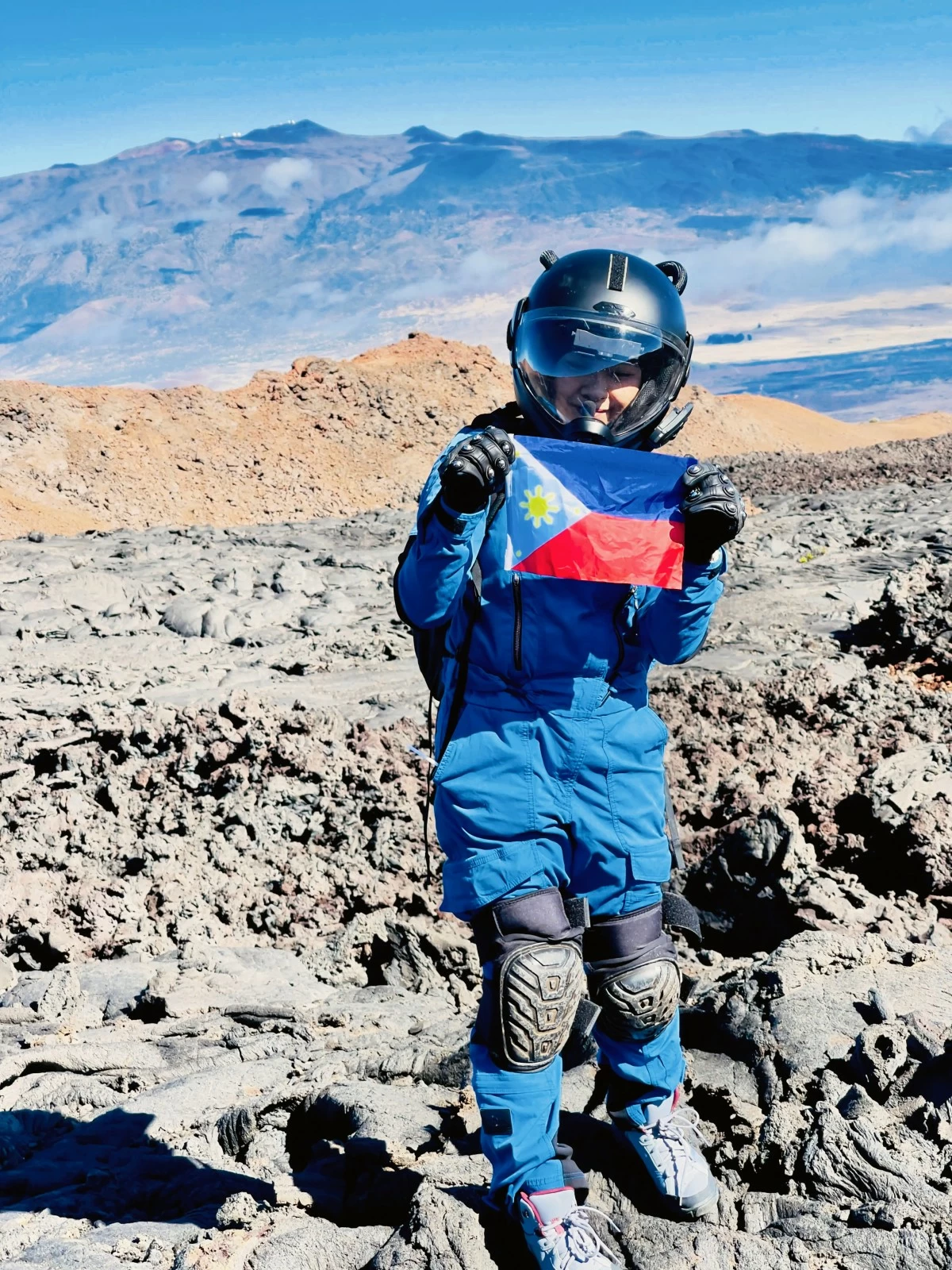
PINOY PRIDE—Kristine Atienza proudly displays the Philippine flag during her analog mission.
She also hopes to bring a Filipino classic: adobo. “One step is to conduct sensory evaluation in an analog mission to see how it performs in that environment,” she explained.
Another collaboration is already underway with Mark Angelo Cabrera Purio of Adamson University, who will bring Filipino food to his own analog mission in Poland.
“We’re partnering with him to bring different Filipino foods to his mission, including ube, dried mangoes, adobo, and I think laing as well,” Atienza said.
A nutritionist’s path to space
If you’re wondering how Atienza became deeply involved in space nutrition, it all started with her career as a nutritionist. Before becoming an analog astronaut, she actually started as a nutritionist supporting astronauts.
“Before they went on missions, I provided nutrition counseling. If not for nutrition, I wouldn’t have become an analog astronaut,” she said.
Beyond the recognition for completing her analog mission, Atienza saw an opportunity to advocate for a field still largely unfamiliar in the Philippines: space nutrition.
In early 2025, Atienza founded the Space Nutrition Network—a growing international community now composed of more than 50 members from 23 countries. The network brings together professionals, scientists, and enthusiasts working toward safe, sustainable, and healthy human life in space.
The universe was always the dream
At just five years old, Atienza discovered her love for astronomy through an old encyclopedia and became fascinated by how vast the universe is. Determined to get closer to her dream, she applied for Applied Physics at University of the Philippines Diliman, but failed the first exam.
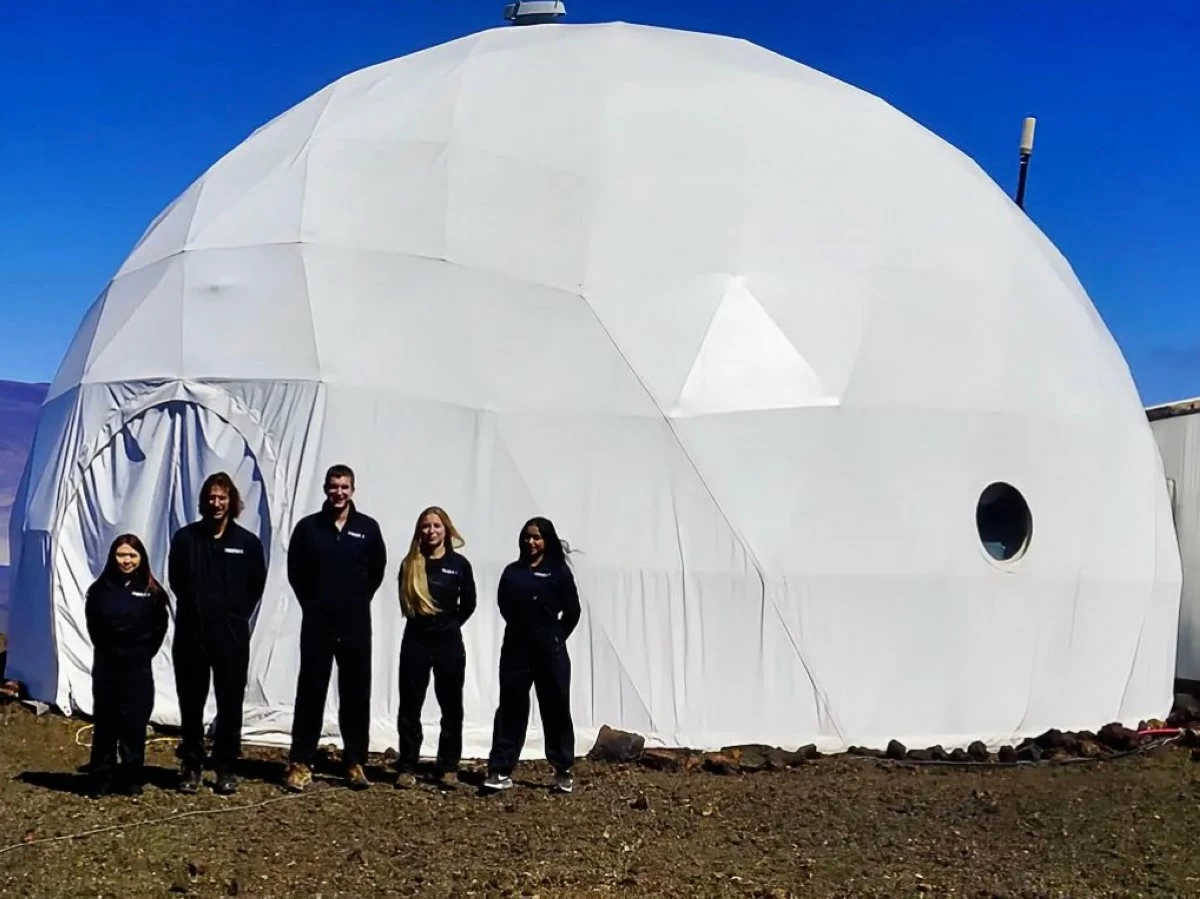
HI-SEAS ANALOG MISSION—Kristine Atienza with her fellow crew members during their HI-SEAS mission in Hawaii.
“In my hometown in Bataan, I was always an honor student. It may seem small, but at that age—when you’ve always been one of the best—it’s hard to suddenly feel below average,” she shared.
She eventually shifted to Nutrition and Dietetics, thinking it would be easier. But even then, she joined the UP Astronomical Society to stay connected to astronomy.
Bridging agriculture, nutrition, and space
After graduating, Atienza worked as a volunteer with the United Nations, where she found her calling in public health.
Today, she wears multiple hats as a public health nutritionist—working on programs such as school feeding, nutrition in emergencies, and food fortification.
Through the Scaling Up Nutrition Business Network, she also collaborates with farmers and agricultural groups, helping develop sustainable food systems for initiatives like homegrown school feeding.
“In the Philippines, we’re still an emerging space nation, and we’re still figuring out our niche. I think what we can offer the world is our expertise in climate resilience,” she said.
“In space, resources are limited. It’s actually very similar to what we experience during humanitarian work. There’s a lot that space programs can learn from those experiences.”
A mission bigger than herself
From a child dreaming about the universe to a Filipino representing the country in space simulations, Atienza’s path shows how different disciplines can intersect in powerful ways.
As one commenter wrote on her social media: “A humanitarian worker as the first Filipino analog astronaut sends a powerful message to the world.” (Photos courtesy of Kristine Jane Atienza)