







Slips of time
Published May 1, 2026 07:54 pm


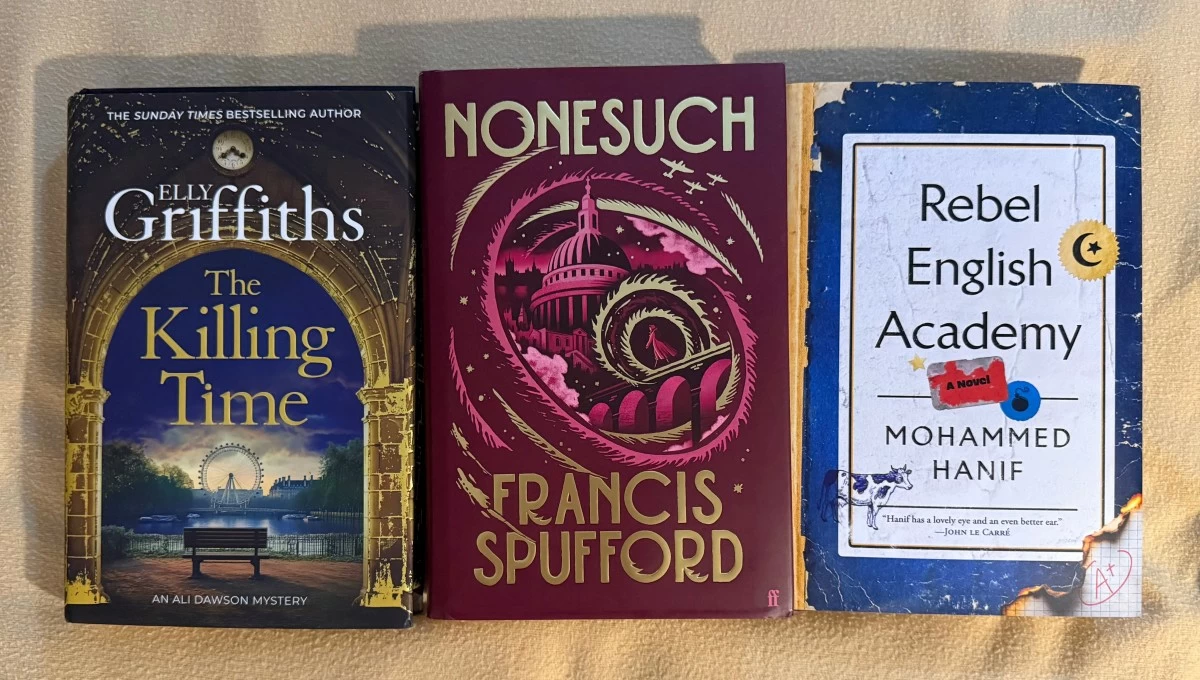
"The Killing Time," "Nonesuch," and "Rebel English Academy"
The three novels today play with the notion of time and/or alternative histories in imaginative ways. Griffiths explores the concept via time travel blended with crime fiction, while Spufford reimagines 1939 and the London Blitz. Hanif revisits 1979 Pakistan, struggling under martial law.
"The Killing Time" by Ely Griffiths
Here is the second in the series that Griffiths recently began with The Frozen People, where she introduced us to Ali Dawson, a time-travelling detective. Dawson heads a London police unit that investigates very cold cases. So cold that traveling to the distant past to solve them was a viable and attractive option. Their technical head, Serafina Pelligrini Jones, handled the time-traveling aspect, and in the first book, it worked - but was still experimental, and not that controlled. Such that Jones had to return to 1850 to allow Ali to return to 2023, and was stranded in the 19th century. The case in this new installment starts off with the suicide of a young adult, Luke, who was convinced by the psychic medium, Barry Power, that he could fly. Luke was also obsessed with Klaus Kramer, a spiritualist from the 19th century and disciple of Franz Mesmer, who practically invented hypnotism; hence the word, mesmerized.
Due to the inexplicable disappearance of her Siamese cat, Terry, Ali defies orders and time-travels again. The two faces of modern London and Victorian London once again vie for our attention, and we are rewarded. The mysterious Cain Templeton, Victorian gentleman, reappears, and it seems he is smitten with Ali. Serafina Jones reconnects with Ali in 1850 London, and when we’re in 2024 London, there’s a serial murderer who would seem to have some strange connection to Ali and the people who surround her. So much unfinished business is taken up in the course of this novel, and the fact that the characters are generally familiar to us from the first instalment only adds to the pleasure. Whats truly been utterly compelling and charming about the series is the mix of the very personal, and the human, along with the crime-solving and the Science Fiction/Fantasy elements.
"Nonesuch" by Francis Spufford
We’re in London, and it’s the summer of 1939, right before World War II commences. Iris Hawkins works in a stock brokerage in the City as a secretary, and via a mutual friend gets to meet a couple, Eleanor and Miles, who move in more moneyed and bohemian circles. Brought to a speakeasy, she makes the acquaintance of a group that works at the newly formed television unit of the BBC. Among them is a gangly, young man/technical whiz named Geoff Hale, and a beauty/Fascist who goes by the name of Lall. Iris spends the night with Geoff, and it’s a connection that brings with it a number of repercussions and consequences. Geoff lives with his father, Cyprian, and Cyprian is the librarian for an occult group that goes by the name of the Order. An otherworldly creature guards this house, and now sees a threat in Iris - so it follows her to the City.
If Philip Dick’s "Man in the High Castle" offered an alternative history for England, a ‘what if’ the Axis Powers had won, this Spufford leap of imagination sticks to events that occur in 1939 and 1940, where time bends, spirits are summoned, and Lall is the fanatic seeking a bridge to this parallel Nonesuch world, with a gun and a bevy of bad intentions. A lot of real history is mixed up in the proceedings to allow a more credible suspension of disbelief. With Nazi planes flying overhead, statues that come to magical life, and a plucky, working-class heroine, there is much to like and admire in this fantasy-suspense story. There are even digs at how, in the 1940’s, women could not enjoy the status of a stockbroker, as that was reserved only for men, so we sympathize and admire how Iris practically runs the company at a certain point in time, but cannot be credited for doing so. A fascinating start to a series of adventures.
"Rebel English Academy" by Mohammed Hanif
Set in Pakistan in 1979, this novel examines the aftermath of the hanging of then Prime Minister Zulfikar Ali Bhutto - and the repercussions that occurred in OK Town, where his loyalists were awaiting his resurrection. The title refers to a tuition center for those seeking to learn English, run by a Sir Baghi, himself with a complex and checkered past. He’s a former dissident, an atheist, who had been arrested, but now lives his life as a tutor of English. The local police chief idolizes him, saying his transformation from poor potter’s son to Police Officer is thanks to the English lessons he had at the Academy. Then there’s a Captain Gul, who was present during Bhutto’s hanging, but had failed to give the military junta what they wanted, and has now been ‘punished’ and reassigned to OK Town as the Field Intelligence Officer. He’s there to quell protestors, who claim that Bhutto still lives.
The power of language, the tests of friendship, and the recourse to protest during times of political turmoil are just among the themes explored in this book. It’s super powerful as the gentle humor can suddenly turn into horrific scenes of persecution, torture, and murder. The unexpected visit by a former pupil named Sahiba is the plot device for how violent and passionate the storyline becomes. Her husband has died in a house fire, and she is the primary suspect for said death. She seeks refuge at the academy via Molly, a friend of Baghi who leads the local Muslim temple. Instructed by Baghi to write down her story as homework, a lifetime of secrets is slowly revealed. At once a narrative of interconnected characters at the small town level, it tells how this becomes a tale of new independence, of Third World tragedy, and the desperate need of the public for heroes.