






Manila Bulletin
 Business
The Stock Market
Stocks retreat as BSP's 6.4% inflation forecast dents sentiment
Business
The Stock Market
Stocks retreat as BSP's 6.4% inflation forecast dents sentiment
Business
The Stock Market
Stocks retreat as BSP's 6.4% inflation forecast dents sentiment
Stocks retreat as BSP's 6.4% inflation forecast dents sentiment
Published Apr 30, 2026 05:04 pm


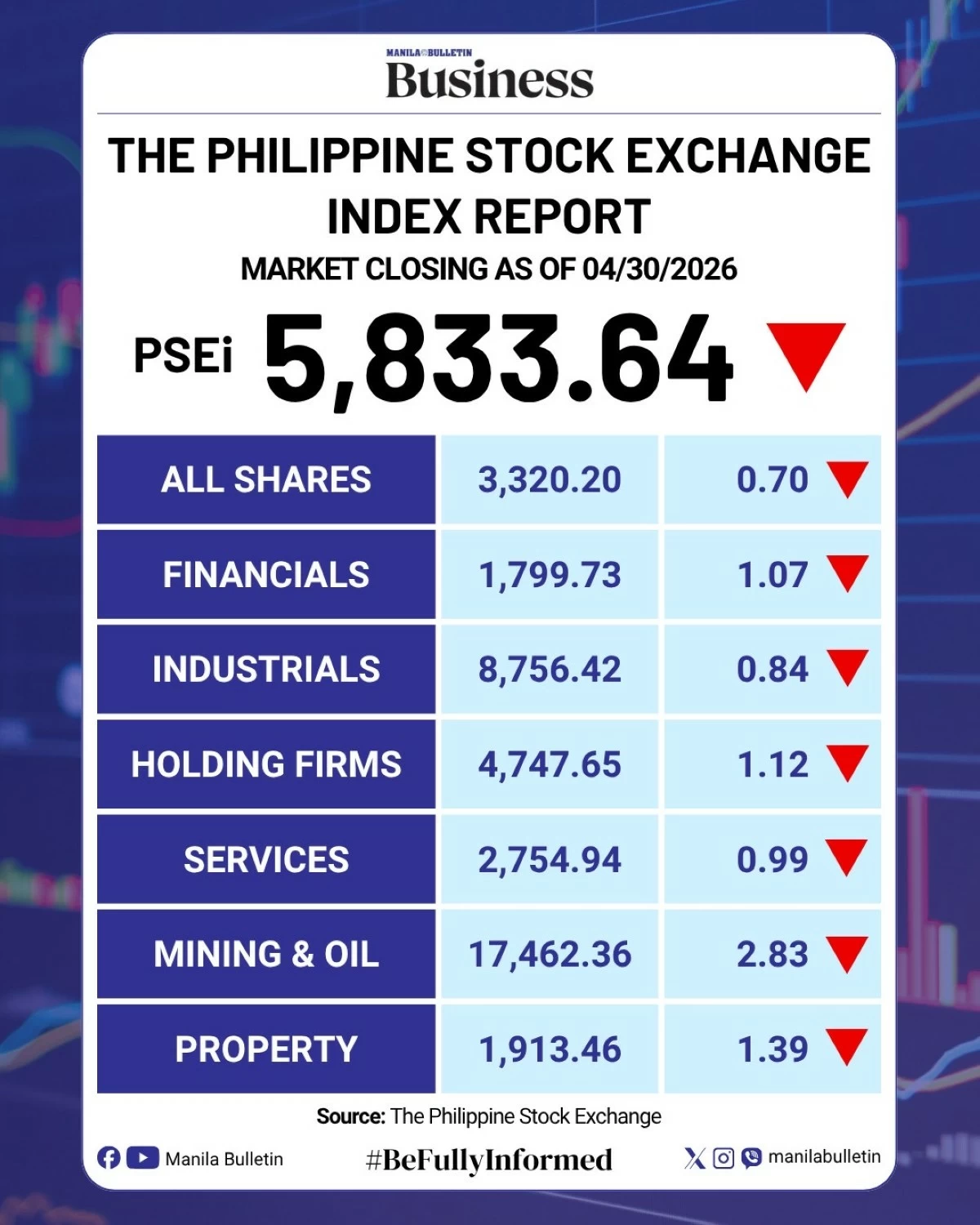
The Philippine Stock Exchange index (PSEi) retreated to end a shortened trading week as investors weighed the compounding risks of surging energy costs, persistent inflation, and a weakening local currency.
The benchmark PSEi fell 74.25 points, or 1.26 percent, to close at 5,833.64 on Thursday, April 30. The mining sector led the decline among sub-indices as broader market sentiment soured. Trading remained active with 943 million shares changing hands, valued at ₱7.65 billion.
Decliners outnumbered advancers 113 to 74, while 58 issues remained unchanged.
Market participants grew increasingly defensive following a projection from the Bangko Sentral ng Pilipinas that headline inflation could accelerate to as high as 6.4 percent for April. The forecast reinforced expectations that the central bank may need to maintain a restrictive monetary stance for longer than previously anticipated.
Luis Limlingan, managing director at Regina Capital Development Corp., noted that the local bourse tracked the cautious tone of regional peers as traders assessed the central bank’s upcoming policy trajectory.
Concerns regarding the Philippine peso’s continued depreciation also stifled risk appetite. The currency has faced renewed pressure in recent sessions, complicating the inflation outlook by raising the cost of imported commodities.
Japhet Tantiangco, research manager at Philstocks Financial, said the market was forced to digest a “negative tone” driven by a confluence of domestic and international headwinds.
He cited uncertainty within the US Federal Reserve, where officials appear divided over the future path of interest rates, alongside a downbeat assessment from Economic Planning Secretary Arsenio Balisacan.
Balisacan recently signaled that the domestic economy is unlikely to hit its growth target for the year, further dampening investor confidence in a quick recovery.
External pressures were exacerbated by volatility in the energy markets. Global oil prices surged as the US prepared for a potential extended blockade of the Strait of Hormuz, a critical maritime chokepoint.
Michael Ricafort, chief economist at Rizal Commercial Banking Corp., observed that the PSEi’s decline tracked a spike in Nymex crude oil prices, which hit three-week highs. At $107 per barrel, crude is trading near its highest levels since July 2022, threatening to widen the Philippines’ trade deficit and exert further upward pressure on consumer prices.