







Sailing on sunlight
Four engineering students from Eastern Visayas built a solar-powered boat for P40,000. On the Golden River of Basey, Samar, it may be one of the most practical ideas anyone has had in years.
Published Apr 30, 2026 12:30 pm


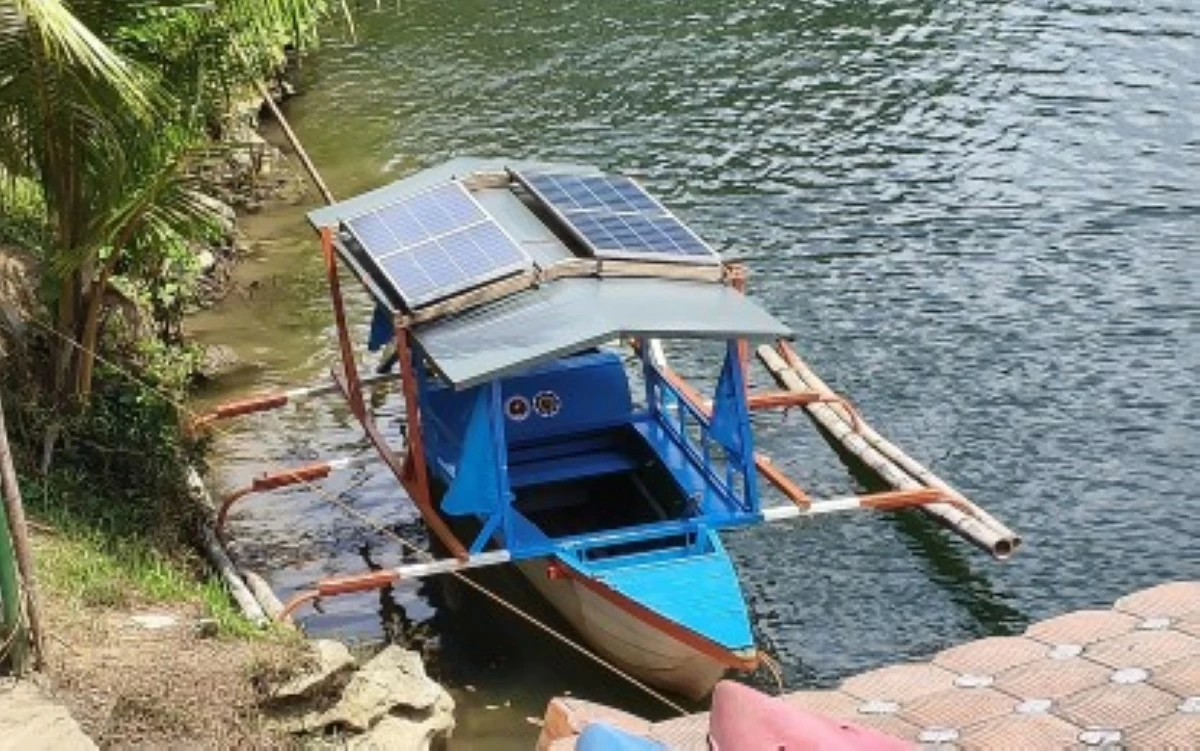
The solar-powered electric pump boat in Basey, Samar as seen on Saturday (April 18, 2026). Graduating engineering students from the Eastern Visayas State University in Tacloban City developed the pump boat that could reshape eco-friendly transport for tourists along the town’s Golden River. (Contributed photo/Jon Torreros, OJT, https://www.pna.gov.ph/)
Innovation does not have to mean something no one has ever seen before. It doesn't have to be fancy or stuffed with AI. Innovation can stem from the simpler things. It has, and should have always been, a solution to real problems. And right now, we have problems, one of them is the energy crisis that many countries are managing, including the Philippines.
In Basey, Samar, that idea of innovation floats on the Cadac-an River, also known as the Golden River for the warm amber hue, which have been the result of siltation over the years. And that idea runs on sunlight.
Four graduating students of Bachelor of Science in Electrical Engineering from the Eastern Visayas State University (EVSU) in Tacloban City built a solar-powered boat, a prototype that is ferrying tourists along the Golden River. These students are: Antonio Adorza Jr., Mac Jandy Guintadcan, Brian Jeffrey Reyno, and Richard Reynada.
The engineering behind the boat cost about P40,000. It is built with four 100-watt solar panels, which are connected to a 48-volt battery system, powering a 1,500-watt motor. How long it can run when fully charged has not been specified, but, on paper, as long as sunlight is available the panels will keep generating energy. In a hot summer with plenty of sunshine, the Philippines seems to benefit over this project.
For a project that cost P40,000, the outcome is not bad to look at. Carbon-free, making it eco-friendly, requires no fuel, and frees operators the burden of refueling, a cost that is taking a toll on everyone as fuel prices remains higher than it was a couple of months ago.
This is not the first solar-powered boat in the Philippines. In 2023, Coron, Palawan received the Adlao Azul, a solar-powered boat developed by Oceantera alongside Orkney-based Aquetera and the Philippine branch of OceanPixel, with funding from USAID. The technologies are different in scale and origin, but the same logic is applied: Use the sun and cut fuel costs.
In 2024, the Department of Science and Technology launched their own solar-powered boat called SESSY, which serves for inter-island transportation for locals and tourists. This project was developed from Mapua University and co-funded by the DOST, Department of Energy (DOE), and the Maritime Industry Authority (MARINA).
Last year, UP Diliman launched M/B Dalaray, though not fully solar-powered, it is equipped with two 50-kilowatt electric motors. This is used to ferry passengers across the Pasig River. This was developed by UPD Electrical and Electronics Engineering Institute (EEEI) for the DOST-Philippine Council for Industry, Energy, and Emerging Technology Research and Development (PCIEERD), with along with the MMDA and MARINA.
What made the EVSU project stand out is its accessibility. This was built by four students with a budget of around P40,000. While it remains a prototype, it is capable in transporting tourists along one of Samar's most distinct waterways.
The implications extend well beyond Basey. With further funding and institutional support, solar-powered boats like this one could be developed and distributed across the archipelago, helping fishermen reduce operating costs, opening new possibilities for coastal and tourism, and offering communities a practical path away from fossil fuel dependence.
The students, Adorza Jr., Guintadcan, Reyno, and Reynada have done the hardest parts. They proved it works. It would be interesting to see how this will continue to develop with the resources and the scaling it needs, not just for Basey, Samar, but in other regions throughout the country.