






Manila Bulletin
 Philippines
National
Philippines, Singapore ink major carbon credits agreement for climate cooperation
Philippines
National
Philippines, Singapore ink major carbon credits agreement for climate cooperation
Philippines
National
Philippines, Singapore ink major carbon credits agreement for climate cooperation
Philippines, Singapore ink major carbon credits agreement for climate cooperation
Deal under Paris Agreement Article 6 is set to channel climate finance, expand carbon markets, and drive sustainable development and job creation in the Philippines
Published Apr 30, 2026 06:31 pm


The Philippines and Singapore signed a landmark implementation agreement on carbon credit collaboration under the Paris Agreement on Thursday, April 30, marking a significant step in bilateral climate cooperation and green investment.
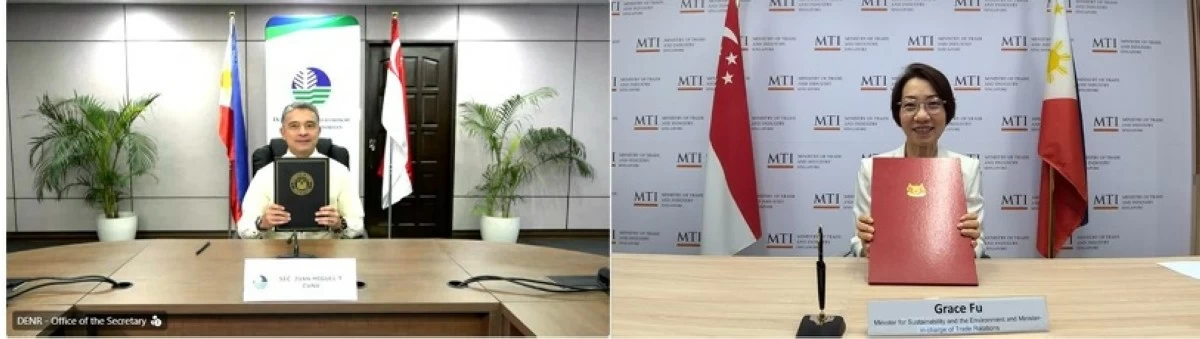
The Philippines and Singapore signed a landmark carbon credits deal under Article 6 of the Paris Agreement during ASEAN Climate Week in Manila, boosting climate finance, green investment, and regional cooperation. The agreement, inked by DENR Secretary Juan Miguel T. Cuna of the Philippines and Singapore’s Sustainability Minister Grace Fu, marks a major step forward in advancing bilateral climate action.
The agreement was formalized during ASEAN Climate Week in Manila, with the Philippines’ Department of Environment and Natural Resources (DENR) Secretary Juan Miguel T. Cuna and Singapore’s Minister for Sustainability and the Environment and Minister-in-charge of Trade Relations, Grace Fu, leading the virtual signing ceremony.
Legally binding carbon credits framework
The implementation agreement establishes a legally binding framework for both countries to collaborate on the generation and transfer of high-integrity carbon credits—certificates representing the reduction or removal of greenhouse gases.
These credits are produced from mitigation projects or initiatives that actively reduce emissions, aligned with Article 6 of the Paris Agreement, which sets guidelines for cross-country cooperation on climate action.
This framework enables project developers to create carbon credit initiatives that meet international standards, ensuring projects demonstrate measurable, verified reductions in emissions. It also enables cross-border transfer mechanisms, allowing credits to be traded or used by other countries to support emissions-reduction targets and climate commitments.
Cuna noted that the agreement reflects “rigorous technical work” and a shared commitment to climate action.
“The signing of our Implementation Agreement marks a significant step forward in our shared pursuit of a low-carbon and climate-resilient future for our region,” Cuna said.
“To our partners from Singapore: this moment reflects the completion of rigorous technical work and the strength of a partnership built on trust, transparency, and a shared ambition to operationalize high-integrity climate cooperation under the Paris Agreement,” he stressed.
“For the Philippines, entering into this Implementation Agreement under Article 6.2 is a strategic decision—one grounded in our national priorities, development aspirations, and commitment to global climate action,” he added.
Boost for climate finance, jobs, and green growth
Officials said the deal is expected to channel climate finance into the Philippines, support sustainable development, and generate employment opportunities in local communities.
The collaboration is also seen as a catalyst for innovation in the growing carbon market ecosystem, while enhancing energy security and reducing environmental pollution through funded mitigation projects.
Singapore has committed to allocating five percent of proceeds from authorized carbon credits to climate adaptation efforts in the Philippines, along with canceling two percent of credits at issuance to ensure a net reduction in global emissions.
Strengthening bilateral and regional cooperation
Singapore Ambassador Constance See described the agreement as a “new chapter” in bilateral ties, highlighting the Philippines’ strong potential in the global carbon market, driven by its rich biodiversity and natural capital.
“The Philippines is one of the most mega-biodiverse countries in the world,” See said. “It is richly endowed with natural capital, and the Philippine government has shown clear leadership and commitment to climate action,” she added.
See also noted that the Philippines is “exceptionally well-positioned” to become a major player in the global carbon market.
“We are seeing strong interest from Singapore companies, and we look forward to working closely with Philippine partners to bring quality projects and investment to market,” she said.
She added that the signing is “especially meaningful” as it took place during the Philippines’ ASEAN chairmanship, which “underscores the country’s leadership on climate action and the region’s growing focus on practical cooperation in sustainability and resilient growth.”
Moreover, Fu emphasized that the partnership will deepen regional collaboration and unlock business opportunities.
“Singapore and the Philippines share a strong and longstanding partnership and, as fellow ASEAN Member States, are working closely on regional and bilateral initiatives,” she said.
Important milestone
The signing of the Implementation Agreement during ASEAN Climate Week, Fu said, is an “important milestone” in the countries’ bilateral relations.
“This agreement will deepen collaboration between our two countries, channel climate finance toward impactful projects in the Philippines, and unlock new opportunities in carbon markets for businesses and local communities,” Fu said. “Together, ASEAN can lead the way in building a low-carbon future that delivers tangible benefits across the region,” she added.
The agreement also underscores the Philippines’ leadership in sustainability during its ASEAN chairmanship, signaling a broader regional push toward low-carbon and climate-resilient growth.
It positions both countries at the forefront of international carbon markets, with ASEAN increasingly seen as a key player in global climate solutions.
The collaboration is expected to help both countries achieve their climate goals by channeling financing into projects that unlock greater mitigation potential in the Philippines.
Under this Implementation Agreement, authorized carbon mitigation initiatives will drive sustainable development and deliver concrete benefits to local communities—creating jobs, strengthening energy security, and reducing environmental pollution.
Specific details on project authorization and eligible carbon credit methodologies will be announced in the coming months.