







Stocks snap five-day slump as bargain hunters emerge
Published Apr 29, 2026 06:37 pm


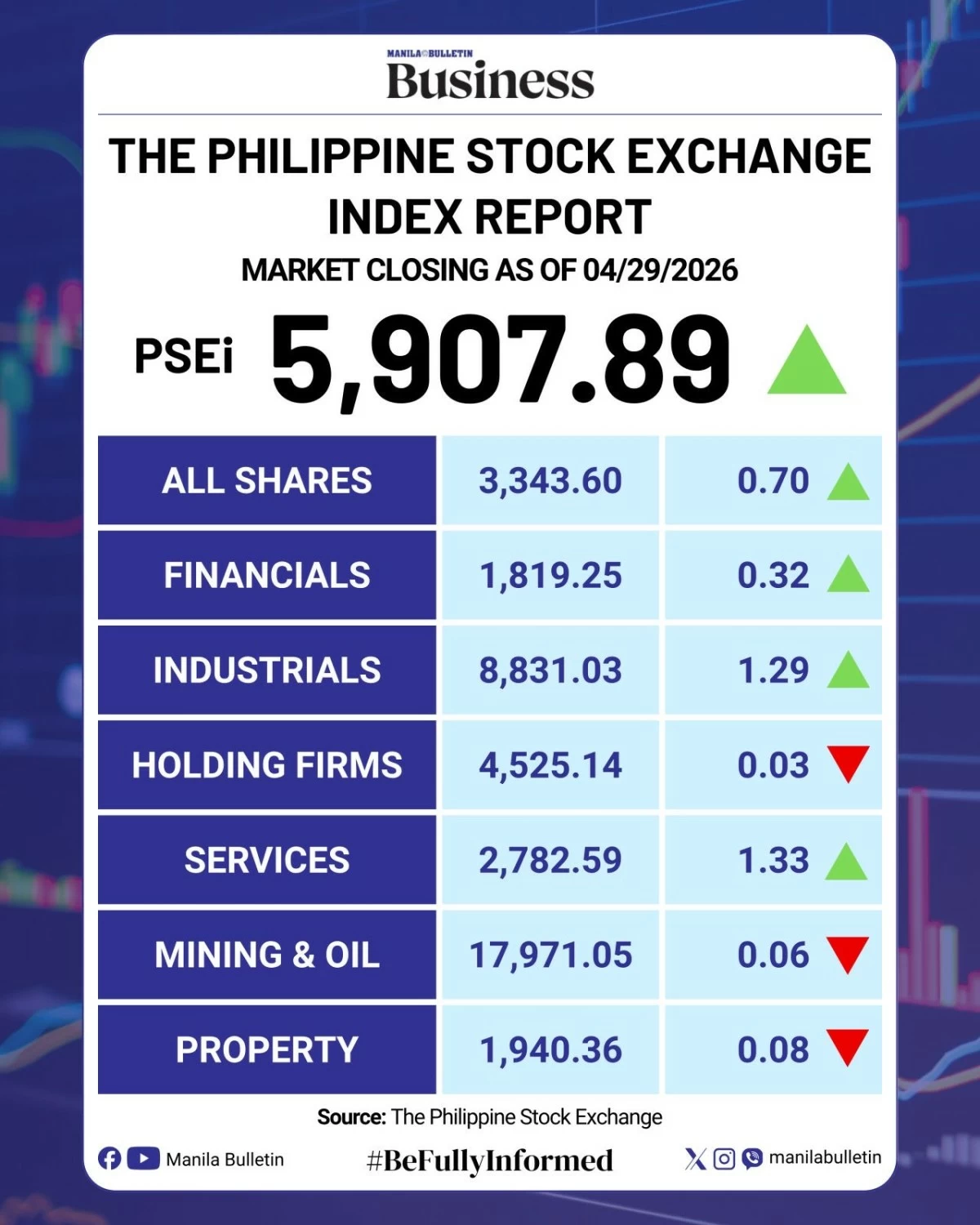
The Philippine Stock Exchange index (PSEi) snapped a five-day losing streak on Wednesday, April 29, as investors engaged in bargain hunting despite continued depreciation of the local currency.
The benchmark PSEi gained 41.1 points, or 0.7 percent, to settle at 5,907.89. The Industrial and Services sectors led the advance, providing enough momentum to offset marginal losses in half of the exchange’s six sectoral gauges.
Trading activity remained robust even as volume dipped slightly to 1.34 billion shares valued at ₱7.72 billion. Market breadth was positive, with 105 issues advancing against 78 decliners, while 54 stocks remained unchanged.
Market analysts attributed the rebound to a corrective move following a period of sustained selling pressure as Regina Capital Development Corp. Managing Director Luis Limlingan noted that the emergence of bargain hunters helped stabilize the market after it hit levels that appeared oversold to many participants.
Limlingan added that the market reacted positively to news regarding the United Arab Emirates’ decision to exit the Organization of the Petroleum Exporting Countries.
The move sparked expectations of a potential increase in global oil supply, which could lead to lower fuel prices. For a country like the Philippines, which is a net importer of oil, any prospect of cheaper energy helps soothe persistent concerns over inflation and provides a necessary tailwind for equity prices.
In addition to energy-related developments, regional market participants are shifting their focus toward global monetary policy. Rizal Commercial Banking Corp. Chief Economist Michael Ricafort said the local index trended higher as traders anticipated the upcoming Federal Reserve rate-setting meeting. Market consensus currently leans toward a pause in interest rate hikes by the US central bank, a scenario that typically relieves pressure on emerging market assets.
Despite the recovery in equities, the Philippine peso remained under pressure, continuing its recent trend of weakness. Typically, a softening currency can deter foreign investment, but domestic buyers appeared willing to overlook foreign exchange volatility in favor of discounted stock valuations.
The interplay between a looming Fed decision and local inflationary pressures remains the primary driver for the exchange as it attempts to maintain its position above the 5,900 psychological threshold.