







Brawner credits 'Tabak' Division for post-Marawi recovery
Published Apr 29, 2026 01:52 pm


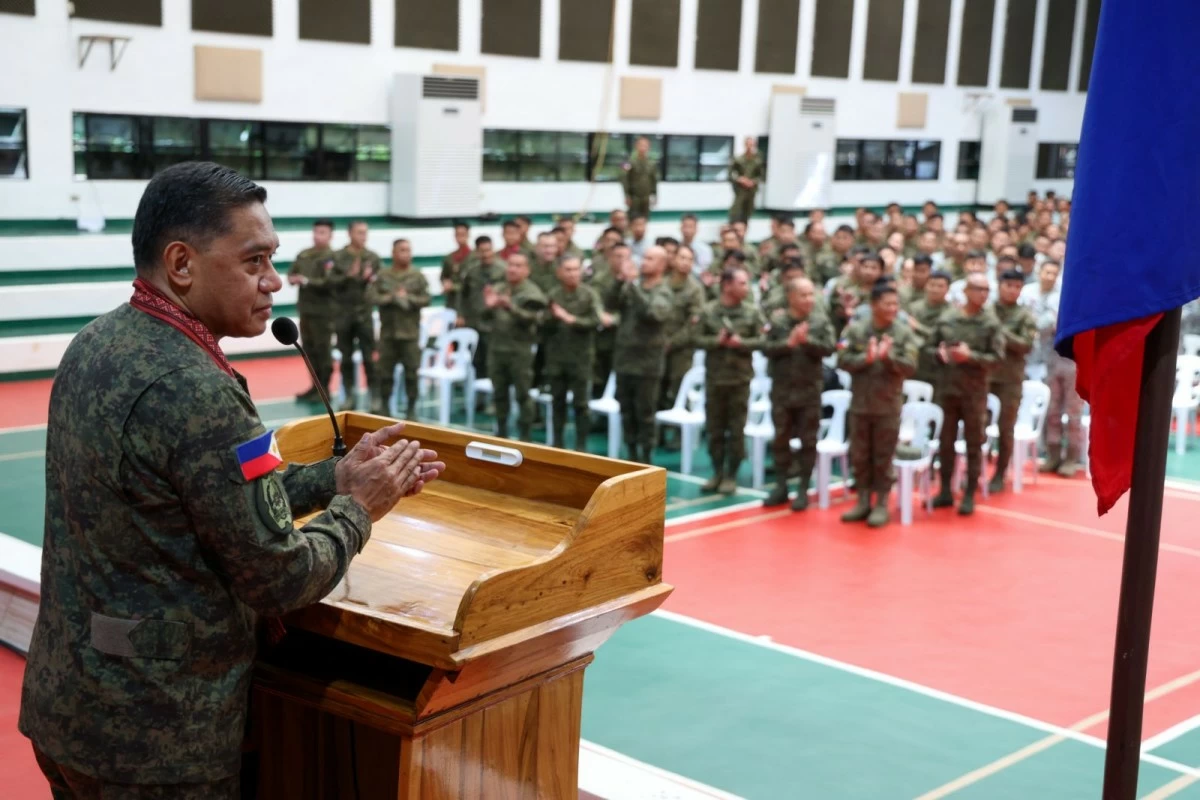
Armed Forces of the Philippines (AFP) Chief, General Romeo S. Brawner Jr. delivers his message before the troops during his visit to the headquarters of the 1st Infantry Division, Philippine Army at Camp Major Cesar L. Sang-an in Labangan, Zamboanga del Sur on April 28, 2026. (Photo: AFP)
General Romeo S. Brawner Jr., Chief of Staff of the Armed Forces of the Philippines (AFP), attributed the successful stabilization and reconstruction of Mindanao following the devastating conflict in Marawi in 2017 to the frontline efforts of the 1st Infantry “Tabak” Division.
During a visit to the division’s headquarters at Camp Major Cesar L. Sang-an in Labangan, Zamboanga del Sur on Tuesday, April 28, the military chief reflected on the unit’s pivotal role in the years following the Marawi siege.
Major General Yegor Rey P. Barroquillo Jr., commander of the 1ID, received the AFP chief during the visit.
“During my time in 1ID, PA, I witnessed the true dedication and professionalism that define each of you,” Brawner told the assembled troops.
“More than the achievements we have attained, I am honored to have had the opportunity to lead our troops and be part of the region's reconstruction, normalization, and unity,” he stated.
Brawner previously served as the deputy commander of Joint Task Force Ranao and the brigade commander of the 103rd Infantry “Haribon” Brigade.
Both units operated under the 1ID’s jurisdiction during the height of the Marawi crisis and its subsequent recovery phase.
To recall, a five-month-long urban battle erupted in the Islamic City of Marawi between government troops and Islamic State (ISIS)-linked Maute Group (MG) and Abu Sayyaf Group (ASG) militants from May to October 2017.
More than 1,000 local terrorists were killed while around 160 government forces also paid the ultimate sacrifice. More than 80 civilians were also killed while around 300,000 individuals were displaced.
The city center was leveled to the ground and the 1ID led much of the clearing operations and subsequent peace-building initiatives.
Brawner underscored the resilience shown by soldiers during the difficult aftermath of that siege.
He noted that the military’s work shifted from combat to advancing long-term stability and development in the region.
During his visit, Brawner also honored outstanding troops by presenting distinguished military medals. He will retire in July, capping off 37 years in the uniformed service, including three years as the military chief.