







Stocks sink to five-month low as peso hits new record low
Published Apr 28, 2026 05:30 pm


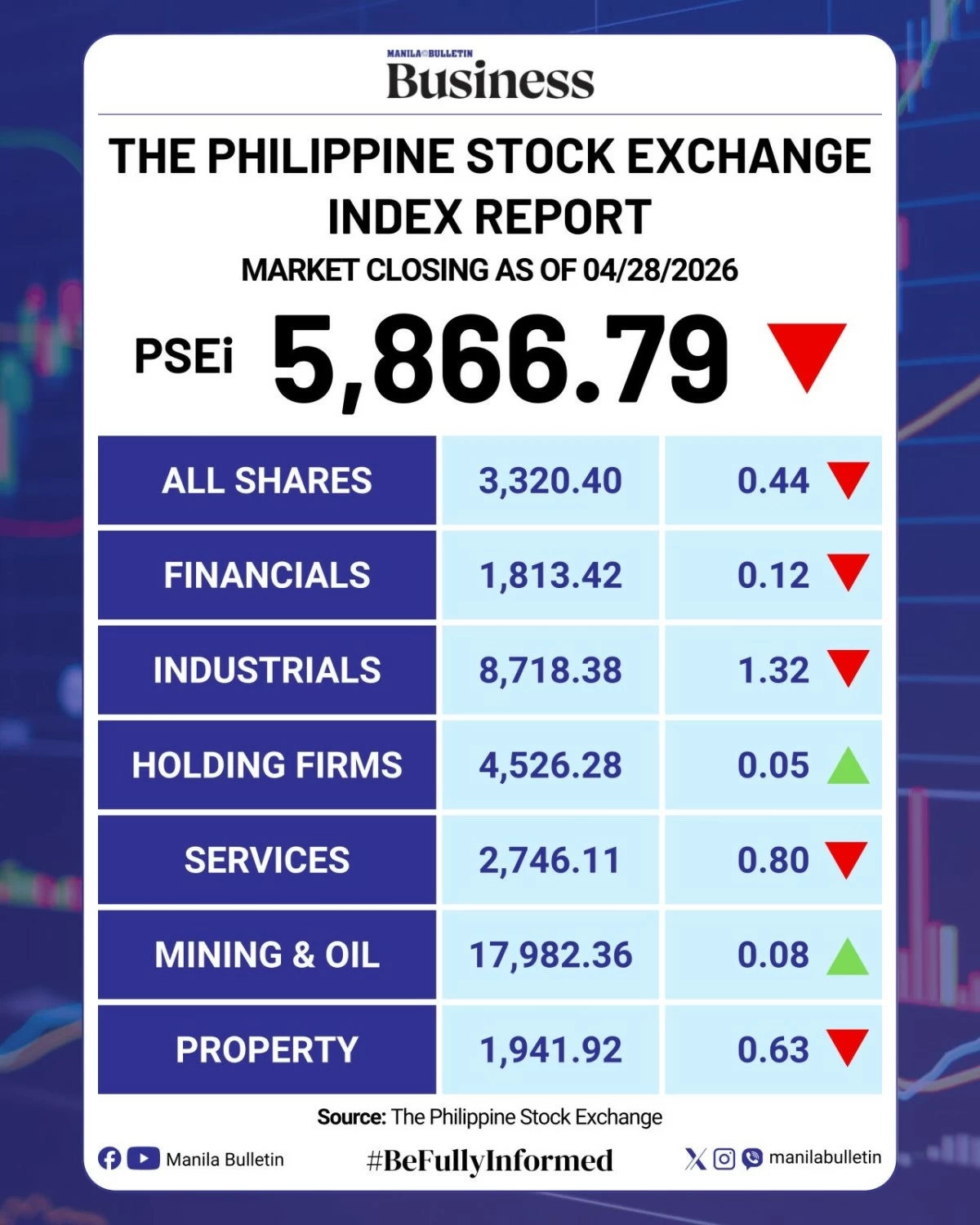
Local stocks retreated to their lowest level in five months as the peso’s plunge to a fresh record fueled anxiety that persistent inflationary pressures will force borrowing costs to stay higher for longer.
The Philippine Stock Exchange index (PSEi) declined 34.36 points, or 0.58 percent, to close at 5,866.79. The drop was the fifth consecutive day of losses for the equity gauge, which is increasingly sensitive to the currency’s volatility amid a geopolitical deadlock in the Middle East.
While industrial shares led the retreat, mining companies and conglomerates showed resilience, managing to decouple from the broader selloff.
Trading remained active as volume rose to 1.52 billion shares valued at ₱8.04 billion. Market breadth was negative, with 117 individual stocks declining against 68 advances, while 58 remained unchanged.
The primary catalyst for the downturn was the local currency’s breach of the 61-per-dollar psychological barrier. The peso hit a record low of 61.30, a level that analysts said complicates the central bank’s efforts to anchor inflation expectations.
A weaker currency typically inflates the cost of imported fuel and commodities, creating a ripple effect across the consumer-heavy economy.
"The Philippine market ended lower as selling pressure continues to weigh on equities, driven by the peso’s depreciation to a fresh record," said Luis Limlingan, managing director at Regina Capital Development Corp.
Limlingan noted that the currency’s weakness has heightened concerns regarding future policy moves, prompting fund managers to reduce risk exposure ahead of critical economic data releases.
Regional tensions are also weighing on sentiment. Investors are closely monitoring the standoff between the United States (US) and Iran, which remains unresolved. Japhet Tantiangco, research manager at Philstocks Financial, said the lack of a diplomatic breakthrough is keeping markets on edge as traders price in the likelihood of a sustained inflationary environment.
The corporate outlook is also beginning to reflect the macroeconomic strain as Michael Ricafort, chief economist at Rizal Commercial Banking Corp., observed that several of the nation’s largest blue-chip firms have started trimming their capital expenditure budgets.
This defensive posturing suggests that businesses are bracing for a period of cooling consumer demand as high interest rates begin to bite. With the index now hovering at the 5,800 level, the focus shifts to whether technical support will hold or if the currency’s slide will trigger further outflows.