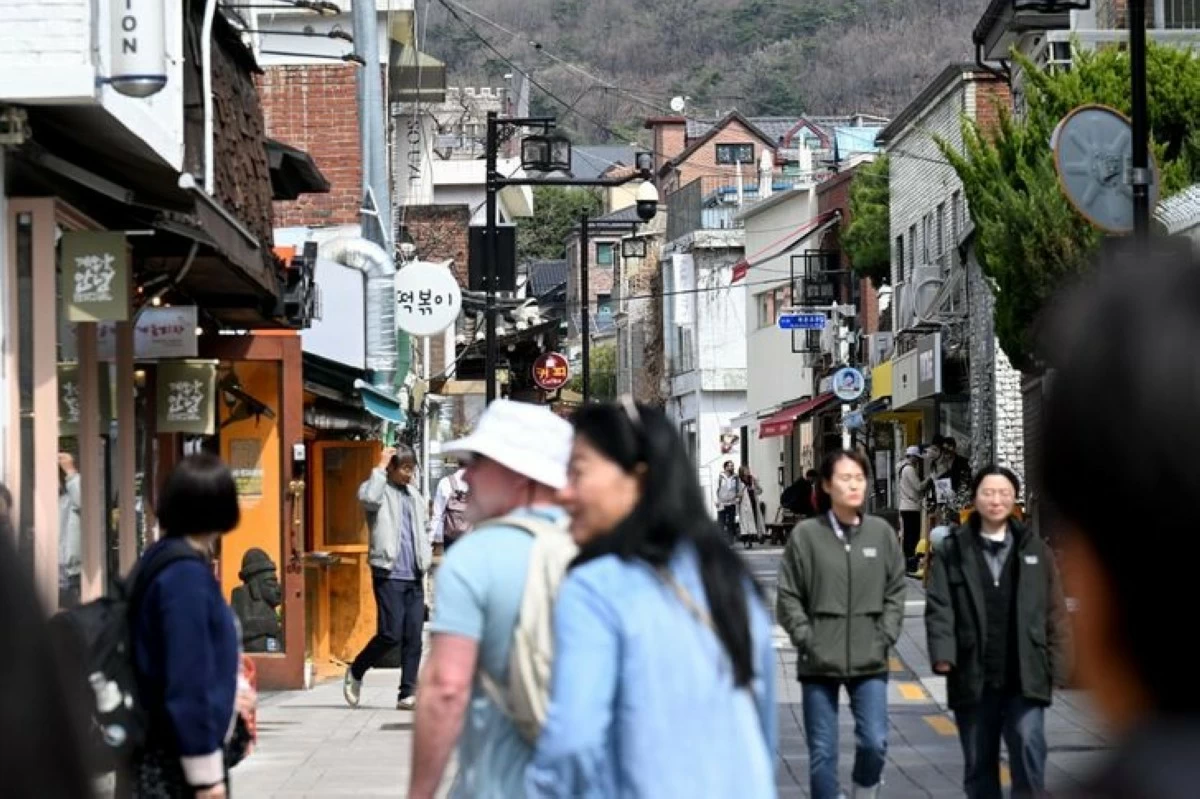
April, when cherry blossoms reach full bloom, marks the peak of spring in Korea. In central Seoul, where skyscrapers dominate the skyline, those in search of a quieter, more tranquil landscape often head to Bukchon.
Set between Gyeongbok Palace and Changdeok Palace, with Mount Bukak in the background, Bukchon has become a familiar stop for foreign tourists dressed in hanbok and posing for photos against palace walls. Long lines outside popular restaurants have also become part of the scene.
Chun Kyung-hwan, head of the architecture firm Thescape, opened a hanok architecture office in Bukchon. He said he often asks himself why the neighborhood’s scenery never seems to lose its appeal.
Now, as an “architecture docent” who has been guiding visitors through Bukchon’s hidden charms since June 2022, he shared his answer while leading one of his walking routes.
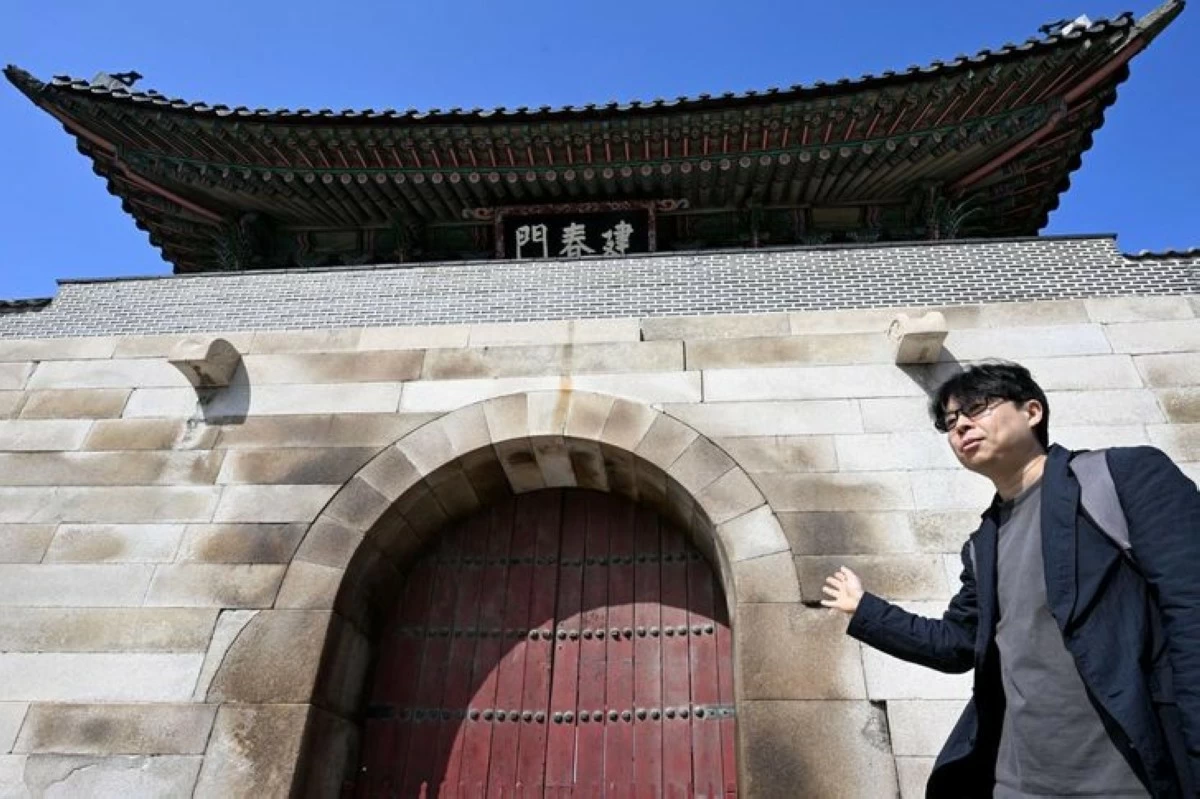
Chun Kyung-hwan speaks about Bukchon’s topographical character in front of Geonchunmun, the east gate of Gyeongbok Palace, on March 31. (Photo: The Korea Times, Park Ji-yeon)
Geonchunmun, the east gate of Gyeongbok Palace
His architectural journey begins at Geonchunmun. The reason, he explains, is that the gate makes it immediately clear that Bukchon, unlike other areas whose boundaries are drawn for administrative convenience, is a place defined by the physical presence of the palaces and the mountain.
Their enduring presence, he said, has helped shape Bukchon’s distinctive atmosphere.
Gyeongbok Palace long served as the primary palace of the Joseon Dynasty (1392-1910) and the symbolic center of the Korean Peninsula. Its presence continues to influence urban planning in the Bukchon area to this day.
“What kind of attitude should a building take toward the palace, and how should it express that?” Chun said. “That is the most important question in determining a building’s overall design concept, and a window into the architect’s philosophy and mindset.”
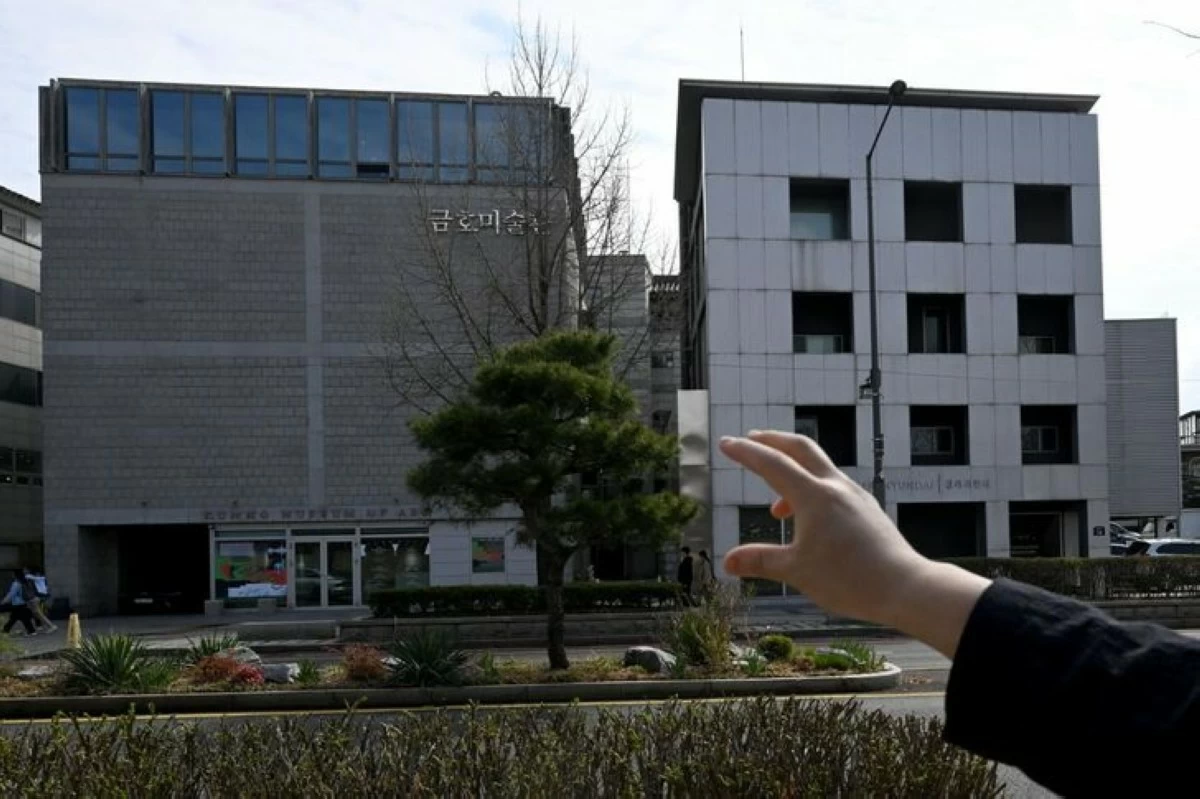
Architect Chun Kyung-hwan speaks about the differences between Gallery Hyundai and the Kumho Museum of Art in Seoul’s Jongno District on March 31. (Photo: The Korea Times, Park Ji-yeon)
Kumho Museum of Art and Gallery Hyundai
A look at the dynamic between buildings draws the eye to two Bukchon landmarks facing Gyeongbok Palace: the Kumho Museum of Art and Gallery Hyundai. Standing side by side and completed in 1996 and 1995, respectively, the two present strikingly contrasting exteriors.
The Kumho Museum projects a restrained, dignified presence through its granite facade, while Gallery Hyundai uses aluminum panel walls punctuated by window openings to create a lighter, livelier impression.
Though they may appear mismatched at first glance, Chun said both buildings engage with the palace in their own way. The Kumho Museum’s granite facade, for instance, recalls the dressed stone blocks of Gyeongbok Palace’s walls. Even the square openings in Gallery Hyundai’s seemingly freewheeling outer wall, on closer inspection, neatly conceal the mismatched windows of the original building behind it. The silvery panels themselves also project a calm, restrained impression.
One striking detail is that when Gallery Hyundai underwent renovation in the 1990s, the paneling was applied only to the building’s front facade. From the side, the original structure is still plainly visible. The choice was deliberate, Chun said, as it meant to let the building’s history unfold naturally through its current form.
“The materials a building uses, and the way they are handled, also reflect the era in which it took shape,” he said.
National Museum of Modern and Contemporary Art
A similar effort to harmonize traces of the past with a modern sensibility can also be seen at the National Museum of Modern and Contemporary Art (MMCA). One example is the red-brick building that now serves as the main entrance. Built in 1933 as the Japanese Imperial Army’s Capital Hospital, it was later used as the headquarters of the Defense Security Command until 2008.
During the renovation process, traces of the building’s white plaster walls were deliberately left intact rather than fully removed, a choice that goes beyond mere restoration of the original form to allow the building’s history to emerge naturally.
The neatly proportioned square courtyard evokes those of Gyeongbok Palace and Changdeok Palace, making it well suited to Bukchon.
Chun described it as a “living courtyard,” one that serves as an open space for exhibitions, events and rest, and pointed to the National Museum of Korea as a comparable example. In his view, the larger the building, the more breathing room it needs to function properly.
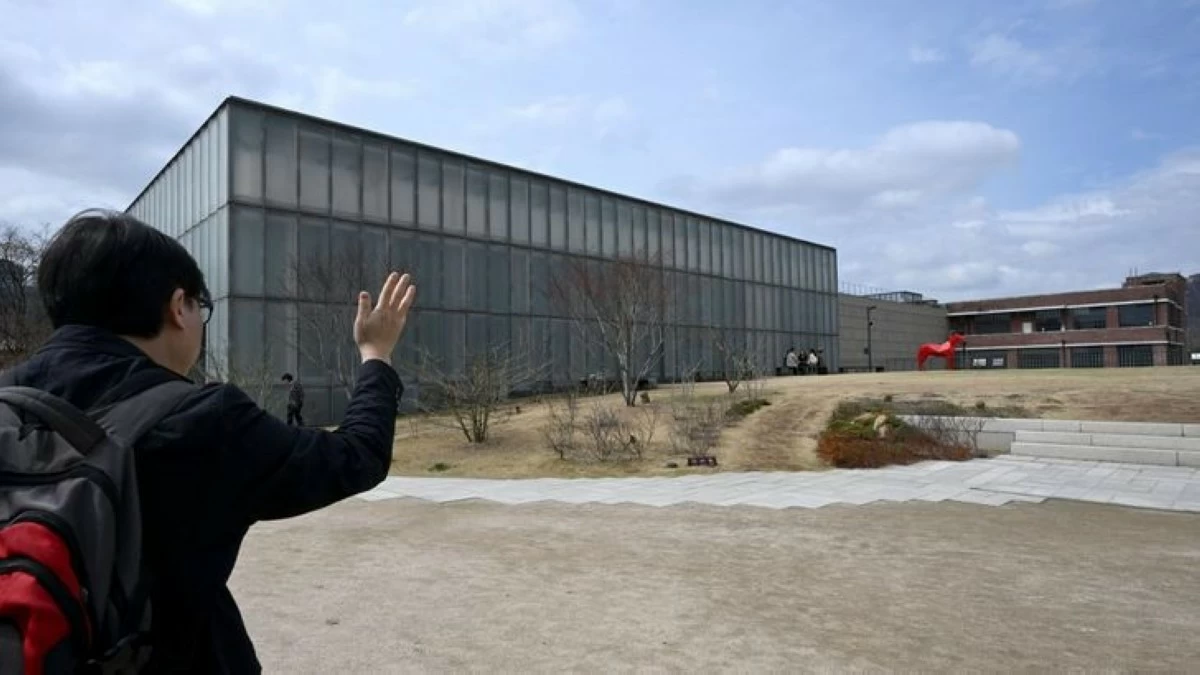
Architect Chun Kyung-hwan speaks about the layout of the National Museum of Modern and Contemporary Art in Seoul’s Jongno District, March 31. (Photo: The Korea Times, Park Ji-yeon)
On the opposite side, the Joseon-era Office of Royal Genealogy serves as a point of connection between the MMCA and the surrounding residential neighborhood. The museum, built along a hillside, also has the rare virtue of blending softly into its surroundings from any direction without ever feeling out of place.
Chun said the entrance was not artificially cut off, allowing the building to fit naturally into the daily lives of nearby residents and office workers.
Hong-Hyun Bukchon Information Center and Facilities
Made up mainly of four buildings, Hong-Hyun Bukchon Information Center and Facilities offers a glimpse into how the use of brick has changed over time. The Seoul Museum of Education, housed in what was once an annex of Gyeonggi High School, reveals intricate brick patterns rarely seen in brick-finished buildings today.
Custom-made bricks in unusual shapes were used on wall corners and window sills, while each mortar joint was slightly raised, giving the building an overall sense of precision and fine detail.
The brick patterns on the more recently built exhibition hall are much simpler. Its mortar joints are rougher as well, since the building was originally constructed with a reinforced concrete frame and later clad in brick.
The brick walls of the public restroom are also more decorative in function, though their patterned brickwork still adds an aesthetic touch. The cluster of buildings, each different in appearance, brought life to what was once a somewhat sparse and empty hillside.
That, in turn, raises a broader question: What value lies in reusing modern architectural legacies such as the former Defense Security Command headquarters and the old Gyeonggi High School building? Some might argue that heritage is better preserved in its original form.
Chun said it was difficult to say definitively which approach was better. But in his view, buildings come alive when they are used.
“There is more that can be done than simply sealing off a building and leaving it as a time capsule,” he said.
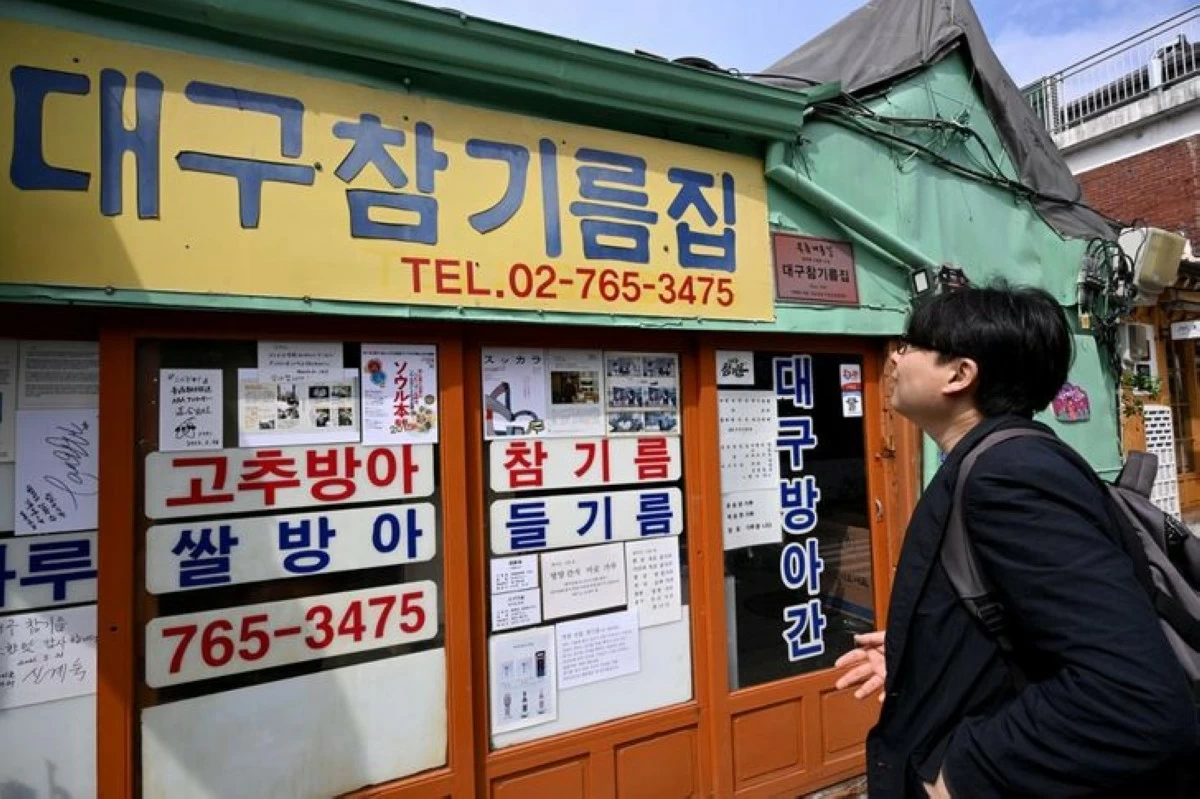
Architect Chun Kyung-hwan speaks about the history of the oldest store on Gyedong-gil in Seoul’s Jongno District, March 31. (Photo: The Korea Times, Park Ji-yeon)
Gyedong-gil
Until late last year, Gyedong-gil was part of Chun’s daily commute. Now, as he prepares to move his office, he has fewer chances to walk the street, but it remains the place in Bukchon he feels most attached to.
“Gyedong-gil does not run in a straight line like streets in a planned urban area. It follows the valley, growing steeper the farther in you go,” Chun said. “It has the feel of a narrative, with a beginning, development, turn and conclusion.”
Here, single-story hanoks, or traditional Korean residences, stand alongside three- and four-story buildings. The area’s current streetscape took shape in the 1990s, when eased regulations in the hanok village triggered a development boom, which in turn quickly provoked a shared sense of crisis and led to tighter controls against overdevelopment. Today, a subtle balance between shops serving local residents and those catering to tourists helps keep the street lively.
Even Gyedong-gil, however, has not been untouched by the wave of commercialization that first swept through nearby Samcheong-dong and Gahoe-dong. Chun recalled an independently run craft beer pub that was later replaced by a franchise restaurant.
“It is very sad to see places that used to be small workshops, intricately tied to the life of the neighborhood, disappear, only to be replaced by larger stores selling mass-produced goods,” he said, shaking his head.
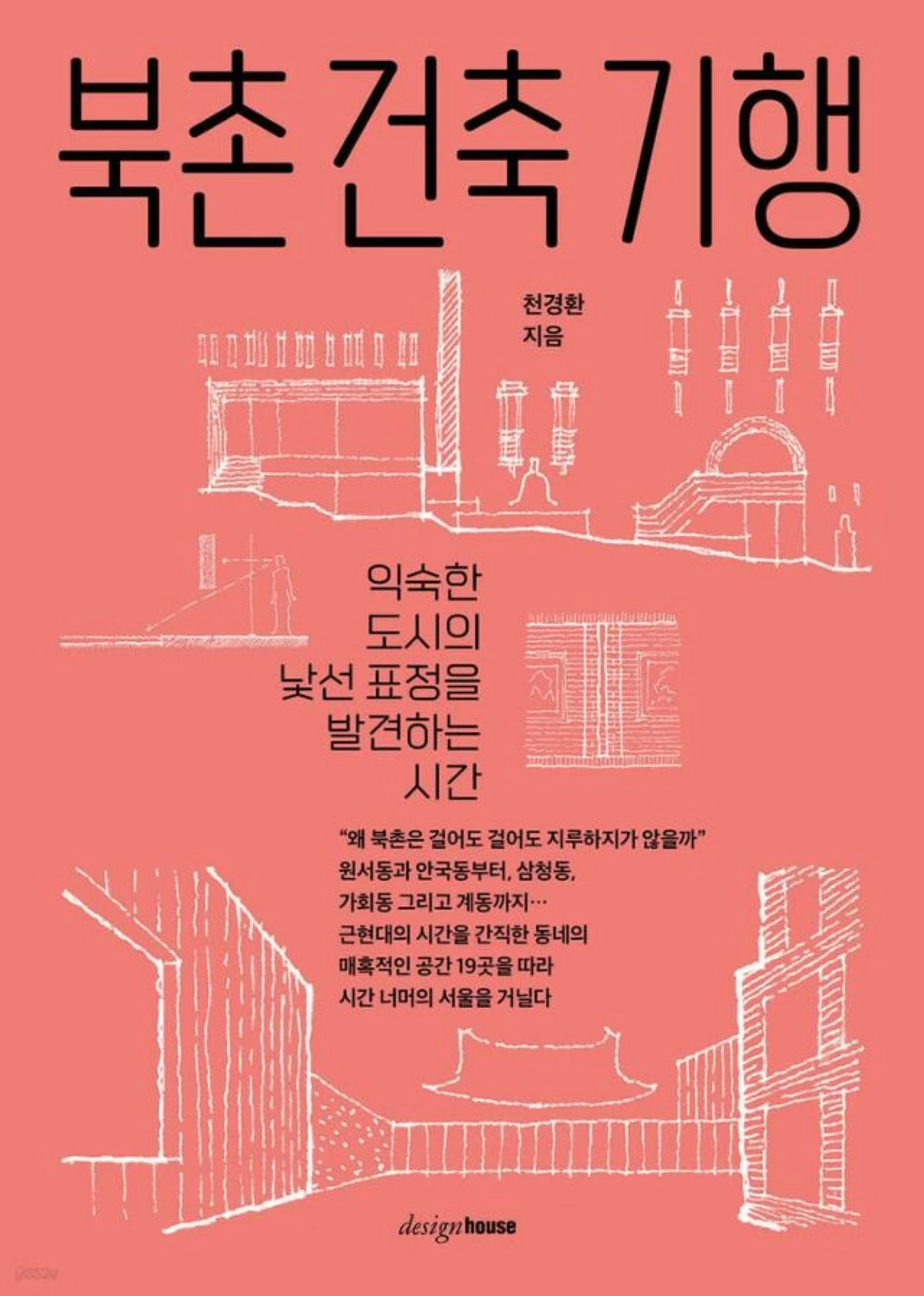
Bukchon Architectural Journey, by Chun Kyung-hwan, published by Designhouse. (Photo: The Korea Times, Park Ji-yeon)
Hoping to share more broadly the stories he has long exchanged with visitors on his walks, Chun published “Bukchon Architectural Journey” last month through Designhouse. When asked how best to approach an urban architectural walk, his answer was straightforward.
“With architecture, you can often get a sense of the architect’s intention and the guiding theme of a design simply by looking carefully at a building in relation to its surroundings. Focus on what can only be experienced in person, but do not worry too much about finding the ‘correct’ answer. Just allow yourself to enjoy the experience.”
This article from the Hankook Ilbo, the sister publication of The Korea Times, is translated by a generative AI system and edited by The Korea Times.