







Stocks slip as central bank hike, oil weigh on risk
Published Apr 23, 2026 06:11 pm


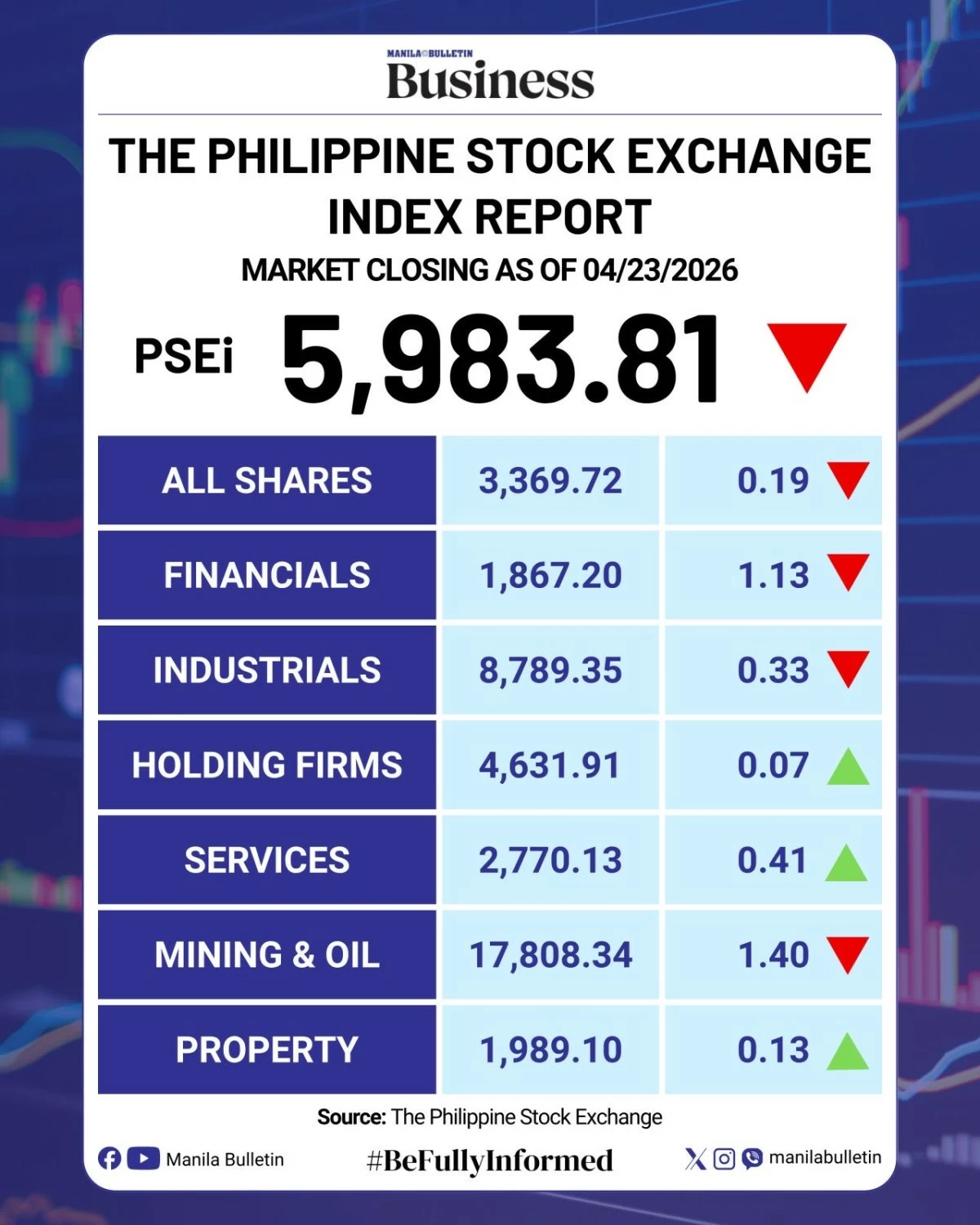
Local stocks retreated on Thursday, April 23, as the central bank's interest-rate hike and heightened geopolitical tensions between the United States (US) and Iran dampened investor appetite for riskier assets.
The Philippine Stock Exchange index (PSEi) slipped 5.75 points, or 0.1 percent, to close at 5,983.81, marking its second consecutive day of declines. While the loss was marginal, the benchmark index struggled to find footing as sectoral performances ended equally split between gainers and losers. Trading activity remained subdued, with 4.03 billion shares valued at ₱5.74 billion changing hands amid cautious stance among market participants.
Market sentiment turned sour after the Bangko Sentral ng Pilipinas (BSP) adjusted its policy rates, a move designed to anchor inflation expectations but one that typically raises borrowing costs for listed firms.
Luis Limlingan, managing director at Regina Capital Development Corp., noted that the central bank’s tightening cycle continues to weigh on the local bourse, keeping equity demand constrained.
According to Limlingan, the rate hike was a primary headwind, preventing the index from tracking gains in some overseas markets.
Compounding the domestic pressure was a resurgence in global energy prices. Crude oil continued its upward trajectory as diplomatic efforts between Washington and Tehran appeared to reach an impasse.
Despite the recent extension of a fragile ceasefire, investors remain wary of a total breakdown in negotiations that could disrupt global supply chains.
The local market is extending its decline as investors remain preoccupied with the outlook of the situation between the US and Iran, said Japhet Tantiangco, research manager at Philstocks Financial. The lack of a definitive deal to end the long-standing hostilities has created a climate of uncertainty, particularly for energy-dependent economies like the Philippines.
While global equities saw a modest bounce overnight, the positive spillover failed to ignite a rally domestically.
Ron Acoba, chief investment strategist at Trading Edge Consultancy, said the local market’s inability to follow global leads suggests that domestic risks—specifically the combination of rising rates and expensive fuel—are currently taking precedence.
Investors stayed cautious, opting for the sidelines even as international headlines offered brief moments of optimism regarding the US-Iran deadlock. With the index hovering just below the psychological 6,000 level, analysts suggest that a sustained recovery will require both a stabilization in oil prices and a clearer signal from the central bank on the future path of monetary policy.