ADVERTISEMENT

North Korea again tests cluster munitions in a launch observed by Kim and his daughter

Published Apr 20, 2026 12:06 pm
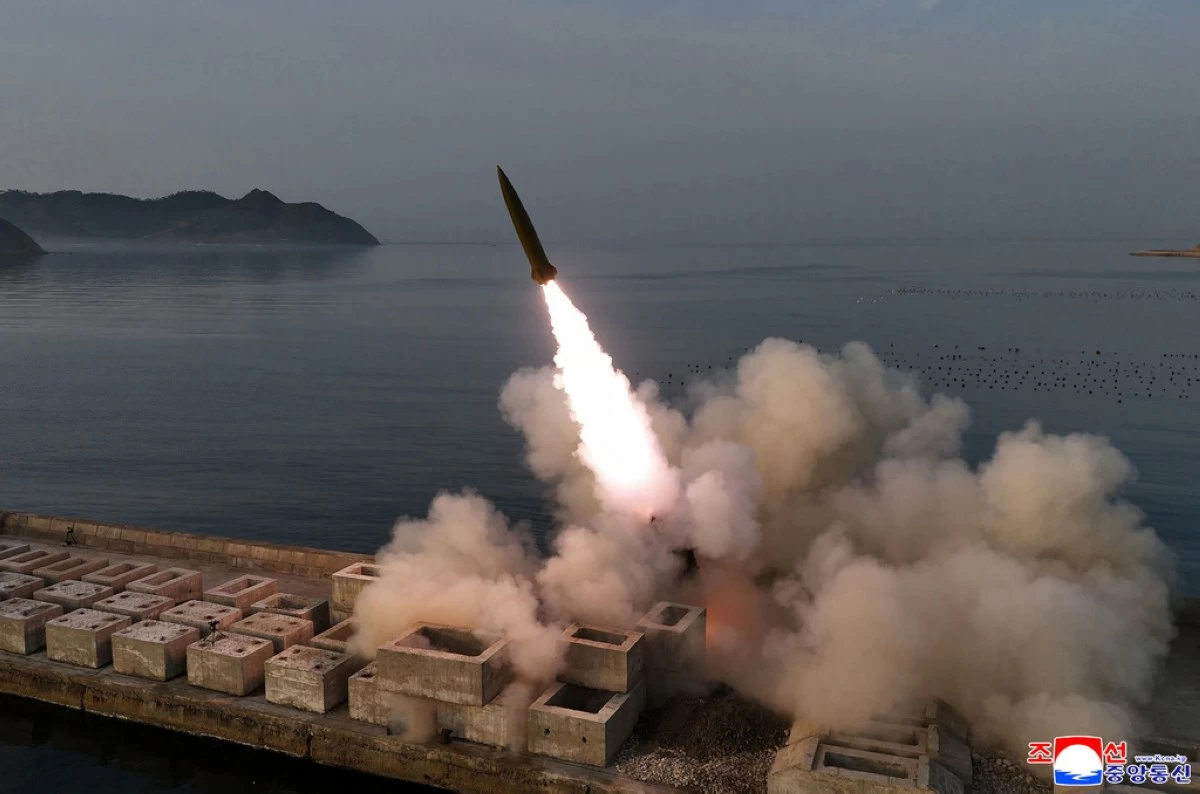
This photo provided by the North Korean government, shows what it says a test launch of an upgraded surface-to-surface ballistic missile at an undisclosed place in North Korea Sunday, April 19, 2026. (Korean Central News Agency/Korea News Service via AP)
SEOUL, South Korea (AP) — North Korea said Monday it test-launched ballistic missiles with cluster bomb warheads in the second such test this month, likely underscoring its push to expand its capabilities to penetrate U.S. and South Korean defenses.
The report by the North’s official Korean Central News Agency appeared to refer to the multiple ballistic missile launches South Korea, Japan and the U.S. detected Sunday off North Korea's east coast.
KCNA photos showed North Korean leader Kim Jong Un and his teenage daughter, both wearing black leather jackets, watching from a coastal observation point as a projectile soared over the water, trailing gray smoke. South Korea’s spy service recently assessed that the daughter, reportedly named Kim Ju Ae, could be considered Kim’s heir.
Kim oversaw the launches of five upgraded surface-to-surface Hwasong-11 Ra ballistic missiles with cluster bomb warheads and fragmentation mine warheads, KCNA said.
The missiles struck an island target and Kim expressed satisfaction over the launches, saying “It is of weighty significance in military actions to boost the high-density striking capability,” according to KCNA.
In the earlier launch this month, North Korea tested Hwasong-11 Ka surface—to-surface ballistic missiles with cluster bomb warheads that it said “can reduce to ashes any target covering an area of 6.5-7 hectares (16 to 17.2 acres).”
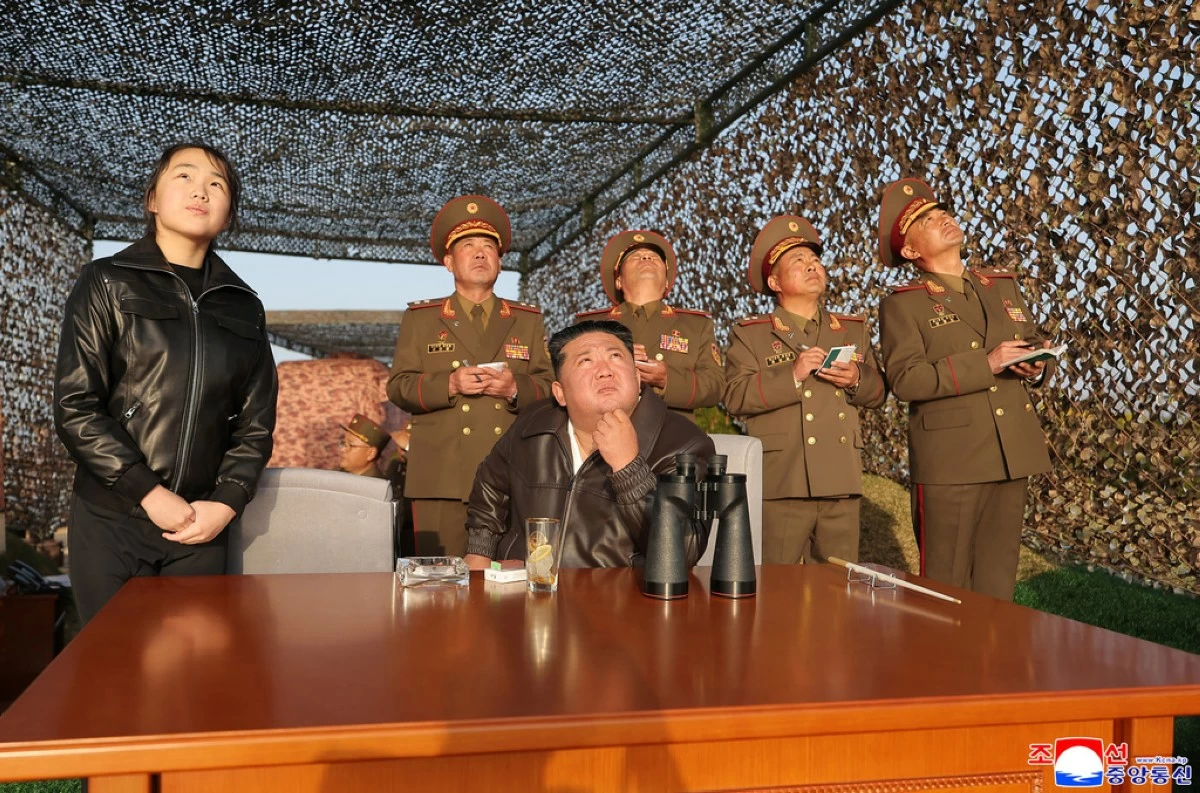
In this photo provided by the North Korean government, its leader Kim Jong Un, sitting, with his daughter observes what it says a test launch of an upgraded surface-to-surface ballistic missile at an undisclosed place in North Korea Sunday, April 19, 2026. (Korean Central News Agency/Korea News Service via AP)
North Korea has tested cluster bomb warheads before. But observers say the Iran war may have prompted North Korea to display it has cluster munitions and accelerate efforts to develop better ones.
The destructiveness of cluster munitions has been highlighted in the ongoing war, with Israel accusing Iran of using such weapons to challenge the country’s stretched air defenses. The warheads burst open at high altitudes, scattering dozens of smaller bomblets across a wide area that are difficult to intercept.
More than 120 countries have signed an international treaty banning the use of cluster munitions, but North Korea, Iran, Israel and the United States are not among them.
North Korea has been pushing to expand its nuclear arsenal and acquire an array of high-tech weapons since Kim’s nuclear diplomacy with U.S. President Donald Trump fell apart in 2019. Among them are multi-warhead nuclear missiles, hypersonic weapons and submarine-launched ballistic missiles, whose possessions would sharply increase prospects for North Korea defeating U.S. and South Korean missile defenses.
Trump has repeatedly expressed his desire to restore diplomacy with Kim, and the North Korean leader has recently left open the door for dialogue with Trump but urged Washington to drop demands for the North’s nuclear disarmament as a precondition for talks.
Trump is to travels to Beijing for a rescheduled summit with Xi Jinping in May. Some observers North Korea’s recent testing activities were likely meant to increase its leverage in future dealings with the U.S., as the Trump-Xi meeting could provide a diplomatic opening with Pyongyang.

Related Tags

world news North Korea Kim Jong Un
ADVERTISEMENT
.most-popular .layout-ratio{ padding-bottom: 79.13%; } @media (min-width: 768px) and (max-width: 1024px) { .widget-title { font-size: 15px !important; } }

{{ articles_filter_1561_widget.title }}

.most-popular .layout-ratio{ padding-bottom: 79.13%; } @media (min-width: 768px) and (max-width: 1024px) { .widget-title { font-size: 15px !important; } }

{{ articles_filter_1562_widget.title }}

.most-popular .layout-ratio{ padding-bottom: 79.13%; } @media (min-width: 768px) and (max-width: 1024px) { .widget-title { font-size: 15px !important; } }

{{ articles_filter_1563_widget.title }}

{{ articles_filter_1564_widget.title }}

.mb-article-details { position: relative; } .mb-article-details .article-body-preview, .mb-article-details .article-body-summary{ font-size: 17px; line-height: 30px; font-family: "Libre Caslon Text", serif; color: #000; } .mb-article-details .article-body-preview iframe , .mb-article-details .article-body-summary iframe{ width: 100%; margin: auto; } .read-more-background { background: linear-gradient(180deg, color(display-p3 1.000 1.000 1.000 / 0) 13.75%, color(display-p3 1.000 1.000 1.000 / 0.8) 30.79%, color(display-p3 1.000 1.000 1.000) 72.5%); position: absolute; height: 200px; width: 100%; bottom: 0; display: flex; justify-content: center; align-items: center; padding: 0; } .read-more-background a{ color: #000; } .read-more-btn { padding: 17px 45px; font-family: Inter; font-weight: 700; font-size: 18px; line-height: 16px; text-align: center; vertical-align: middle; border: 1px solid black; background-color: white; } .hidden { display: none; }
function initializeAllSwipers() { // Get all hidden inputs with cms_article_id document.querySelectorAll('[id^="cms_article_id_"]').forEach(function (input) { const cmsArticleId = input.value; const articleSelector = '#article-' + cmsArticleId + ' .body_images'; const swiperElement = document.querySelector(articleSelector); if (swiperElement && !swiperElement.classList.contains('swiper-initialized')) { new Swiper(articleSelector, { loop: true, pagination: false, navigation: { nextEl: '#article-' + cmsArticleId + ' .swiper-button-next', prevEl: '#article-' + cmsArticleId + ' .swiper-button-prev', }, }); } }); } setTimeout(initializeAllSwipers, 3000); const intersectionObserver = new IntersectionObserver( (entries) => { entries.forEach((entry) => { if (entry.isIntersecting) { const newUrl = entry.target.getAttribute("data-url"); if (newUrl) { history.pushState(null, null, newUrl); let article = entry.target; // Extract metadata const author = article.querySelector('.author-section').textContent.replace('By', '').trim(); const section = article.querySelector('.section-info ').textContent.replace(' ', ' '); const title = article.querySelector('.article-title h1').textContent; // Parse URL for Chartbeat path format const parsedUrl = new URL(newUrl, window.location.origin); const cleanUrl = parsedUrl.host + parsedUrl.pathname; // Update Chartbeat configuration if (typeof window._sf_async_config !== 'undefined') { window._sf_async_config.path = cleanUrl; window._sf_async_config.sections = section; window._sf_async_config.authors = author; } // Track virtual page view with Chartbeat if (typeof pSUPERFLY !== 'undefined' && typeof pSUPERFLY.virtualPage === 'function') { try { pSUPERFLY.virtualPage({ path: cleanUrl, title: title, sections: section, authors: author }); } catch (error) { console.error('ping error', error); } } // Optional: Update document title if (title && title !== document.title) { document.title = title; } } } }); }, { threshold: 0.1 } ); function showArticleBody(button) { const article = button.closest("article"); const summary = article.querySelector(".article-body-summary"); const body = article.querySelector(".article-body-preview"); const readMoreSection = article.querySelector(".read-more-background"); // Hide summary and read-more section summary.style.display = "none"; readMoreSection.style.display = "none"; // Show the full article body body.classList.remove("hidden"); } document.addEventListener("DOMContentLoaded", () => { let loadCount = 0; // Track how many times articles are loaded const offset = [1, 2, 3, 4, 5, 6, 7, 8, 9, 10]; // Offset values const currentUrl = window.location.pathname.substring(1); let isLoading = false; // Prevent multiple calls if (!currentUrl) { console.log("Current URL is invalid."); return; } const sentinel = document.getElementById("load-more-sentinel"); if (!sentinel) { console.log("Sentinel element not found."); return; } function isSentinelVisible() { const rect = sentinel.getBoundingClientRect(); return ( rect.top < window.innerHeight && rect.bottom >= 0 ); } function onScroll() { if (isLoading) return; if (isSentinelVisible()) { if (loadCount >= offset.length) { console.log("Maximum load attempts reached."); window.removeEventListener("scroll", onScroll); return; } isLoading = true; const currentOffset = offset[loadCount]; window.loadMoreItems().then(() => { let article = document.querySelector('#widget_1690 > div:nth-last-of-type(2) article'); intersectionObserver.observe(article) loadCount++; }).catch(error => { console.error("Error loading more items:", error); }).finally(() => { isLoading = false; }); } } window.addEventListener("scroll", onScroll); });

Sign up by email to receive news.