ADVERTISEMENT

Canada's prime minister says economic ties with US are a weakness that must be corrected

Published Apr 20, 2026 10:53 am
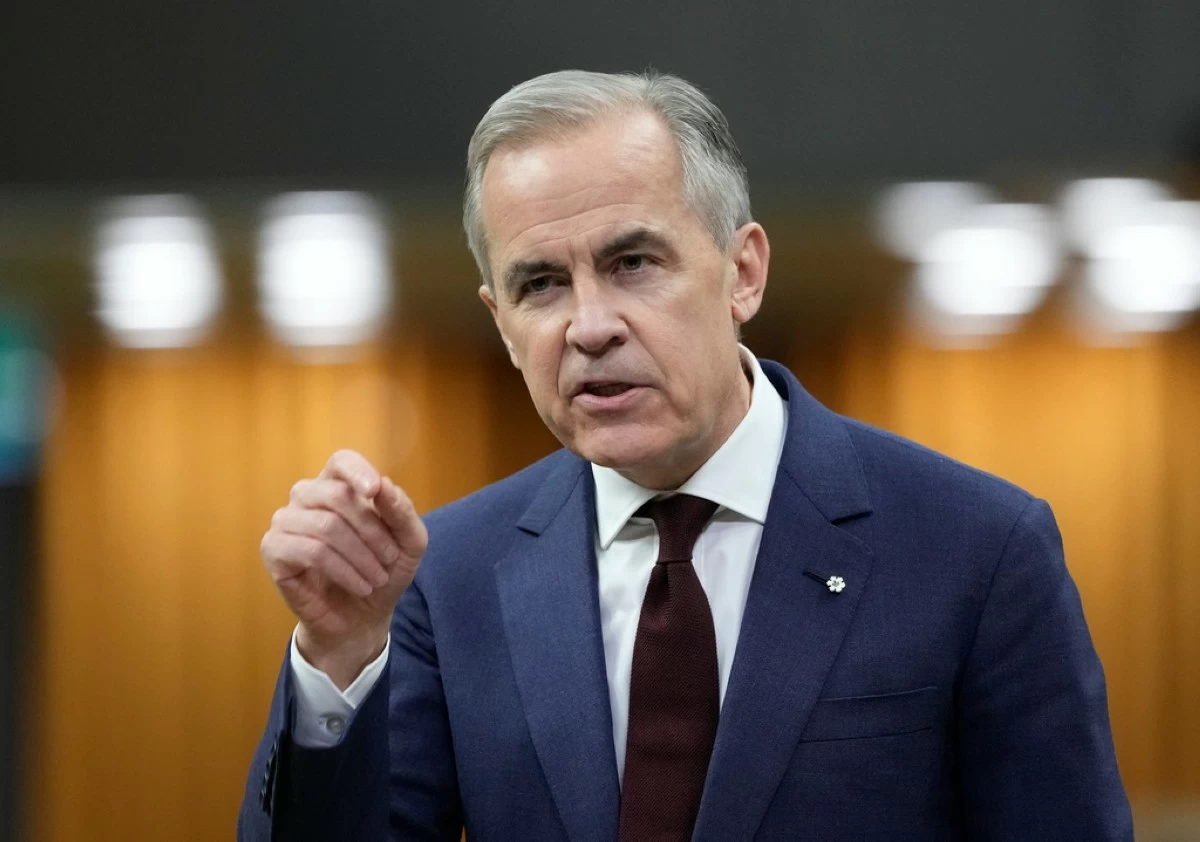
Canada Prime Minister Mark Carney rises during Question Period on Parliament Hill in Ottawa, April 15, 2026. (Adrian Wyld/The Canadian Press via AP, File)
VANCOUVER, British Columbia (AP) — Canadian Prime Minister Mark Carney said in a video address released Sunday that Canada’s strong economic ties to the United States were once a strength but are now a weakness that must be corrected.
In the 10-minute address, Carney spoke about his government’s efforts to strengthen the Canadian economy by attracting new investments and signing trade deals with other countries.
“The world is more dangerous and divided,” Carney said. “The U.S. has fundamentally changed its approach to trade, raising its tariffs to levels last seen during the Great Depression.
“Many of our former strengths, based on our close ties to America, have become weaknesses. Weaknesses that we must correct.”
Carney said tariffs imposed by U.S. President Donald Trump have affected workers in the auto and steel industries. He added that businesses are holding back investments “restrained by the pall of uncertainty that’s hanging over all of us.”
Many Canadians have also been angered by Trumps comments suggesting Canada become the 51st state.
Carney said he plans to give Canadians regular updates on his government’s efforts to diversify away from the U.S.
“Security can’t be achieved by ignoring the obvious or downplaying the very real threats that we Canadians face,” he said. “I promise you I will never sugarcoat our challenges.”
It’s not the first time Carney, who served as a central bank governor, first at the Bank of Canada and later with the Bank of England, has spoken about a shift in world power.
During a speech in January at the World Economic Forum in Davos, Switzerland, he received widespread praise for condemning economic coercion by great powers against small countries.
His remarks brought a rebuke from Trump.
“Canada lives because of the United States,” Trump said after the speech. “Remember that, Mark, the next time you make your statements.”
There was no immediate White House reaction Sunday to the address.
Carney’s comments came days after securing a majority government following special election wins and as the opposition Conservatives push him to deliver a U.S. trade deal, which was among his promises in last year’s election.
A review of the current version of the North American Free Trade Agreement between Canada, the U.S. and Mexico is scheduled for July.
In his address, Carney said he wants to attract new investments into Canada, double the size of clean energy capacity and reduce trade barriers within the country. He also emphasized Canada’s increased defense spending, reduction in taxes and efforts to make housing more affordable.
“We have to take care of ourselves because we can’t rely on one foreign partner,” he said. “We can’t control the disruption coming from our neighbors. We can’t control our future on the hope it will suddenly stop.
“We can control what happens here. We can build a stronger country that can withstand disruptions from aboard.”
Carney said simply hoping the “United States will return to normal” is not a feasible strategy.
“Hope isn’t a plan and nostalgia is not a strategy,” he said.
Carney said Canada has “been a great neighbor” standing with the U.S. in conflicts including Afghanistan, plus two World Wars.
“The U.S. has changed and we must respond,” he said. "It’s about taking back control of our security, our borders and our future.”

Related Tags

world news Canadian Prime Minister Mark Carney
ADVERTISEMENT
.most-popular .layout-ratio{ padding-bottom: 79.13%; } @media (min-width: 768px) and (max-width: 1024px) { .widget-title { font-size: 15px !important; } }

{{ articles_filter_1561_widget.title }}

.most-popular .layout-ratio{ padding-bottom: 79.13%; } @media (min-width: 768px) and (max-width: 1024px) { .widget-title { font-size: 15px !important; } }

{{ articles_filter_1562_widget.title }}

.most-popular .layout-ratio{ padding-bottom: 79.13%; } @media (min-width: 768px) and (max-width: 1024px) { .widget-title { font-size: 15px !important; } }

{{ articles_filter_1563_widget.title }}

{{ articles_filter_1564_widget.title }}

.mb-article-details { position: relative; } .mb-article-details .article-body-preview, .mb-article-details .article-body-summary{ font-size: 17px; line-height: 30px; font-family: "Libre Caslon Text", serif; color: #000; } .mb-article-details .article-body-preview iframe , .mb-article-details .article-body-summary iframe{ width: 100%; margin: auto; } .read-more-background { background: linear-gradient(180deg, color(display-p3 1.000 1.000 1.000 / 0) 13.75%, color(display-p3 1.000 1.000 1.000 / 0.8) 30.79%, color(display-p3 1.000 1.000 1.000) 72.5%); position: absolute; height: 200px; width: 100%; bottom: 0; display: flex; justify-content: center; align-items: center; padding: 0; } .read-more-background a{ color: #000; } .read-more-btn { padding: 17px 45px; font-family: Inter; font-weight: 700; font-size: 18px; line-height: 16px; text-align: center; vertical-align: middle; border: 1px solid black; background-color: white; } .hidden { display: none; }
function initializeAllSwipers() { // Get all hidden inputs with cms_article_id document.querySelectorAll('[id^="cms_article_id_"]').forEach(function (input) { const cmsArticleId = input.value; const articleSelector = '#article-' + cmsArticleId + ' .body_images'; const swiperElement = document.querySelector(articleSelector); if (swiperElement && !swiperElement.classList.contains('swiper-initialized')) { new Swiper(articleSelector, { loop: true, pagination: false, navigation: { nextEl: '#article-' + cmsArticleId + ' .swiper-button-next', prevEl: '#article-' + cmsArticleId + ' .swiper-button-prev', }, }); } }); } setTimeout(initializeAllSwipers, 3000); const intersectionObserver = new IntersectionObserver( (entries) => { entries.forEach((entry) => { if (entry.isIntersecting) { const newUrl = entry.target.getAttribute("data-url"); if (newUrl) { history.pushState(null, null, newUrl); let article = entry.target; // Extract metadata const author = article.querySelector('.author-section').textContent.replace('By', '').trim(); const section = article.querySelector('.section-info ').textContent.replace(' ', ' '); const title = article.querySelector('.article-title h1').textContent; // Parse URL for Chartbeat path format const parsedUrl = new URL(newUrl, window.location.origin); const cleanUrl = parsedUrl.host + parsedUrl.pathname; // Update Chartbeat configuration if (typeof window._sf_async_config !== 'undefined') { window._sf_async_config.path = cleanUrl; window._sf_async_config.sections = section; window._sf_async_config.authors = author; } // Track virtual page view with Chartbeat if (typeof pSUPERFLY !== 'undefined' && typeof pSUPERFLY.virtualPage === 'function') { try { pSUPERFLY.virtualPage({ path: cleanUrl, title: title, sections: section, authors: author }); } catch (error) { console.error('ping error', error); } } // Optional: Update document title if (title && title !== document.title) { document.title = title; } } } }); }, { threshold: 0.1 } ); function showArticleBody(button) { const article = button.closest("article"); const summary = article.querySelector(".article-body-summary"); const body = article.querySelector(".article-body-preview"); const readMoreSection = article.querySelector(".read-more-background"); // Hide summary and read-more section summary.style.display = "none"; readMoreSection.style.display = "none"; // Show the full article body body.classList.remove("hidden"); } document.addEventListener("DOMContentLoaded", () => { let loadCount = 0; // Track how many times articles are loaded const offset = [1, 2, 3, 4, 5, 6, 7, 8, 9, 10]; // Offset values const currentUrl = window.location.pathname.substring(1); let isLoading = false; // Prevent multiple calls if (!currentUrl) { console.log("Current URL is invalid."); return; } const sentinel = document.getElementById("load-more-sentinel"); if (!sentinel) { console.log("Sentinel element not found."); return; } function isSentinelVisible() { const rect = sentinel.getBoundingClientRect(); return ( rect.top < window.innerHeight && rect.bottom >= 0 ); } function onScroll() { if (isLoading) return; if (isSentinelVisible()) { if (loadCount >= offset.length) { console.log("Maximum load attempts reached."); window.removeEventListener("scroll", onScroll); return; } isLoading = true; const currentOffset = offset[loadCount]; window.loadMoreItems().then(() => { let article = document.querySelector('#widget_1690 > div:nth-last-of-type(2) article'); intersectionObserver.observe(article) loadCount++; }).catch(error => { console.error("Error loading more items:", error); }).finally(() => { isLoading = false; }); } } window.addEventListener("scroll", onScroll); });

Sign up by email to receive news.