






Manila Bulletin
 Philippines
National
Brawner declares largest Balikatan open, highlights alliance strength amid regional tensions
Philippines
National
Brawner declares largest Balikatan open, highlights alliance strength amid regional tensions
Philippines
National
Brawner declares largest Balikatan open, highlights alliance strength amid regional tensions
Brawner declares largest Balikatan open, highlights alliance strength amid regional tensions
Published Apr 20, 2026 02:46 pm


(Photo: US Embassy in Manila)
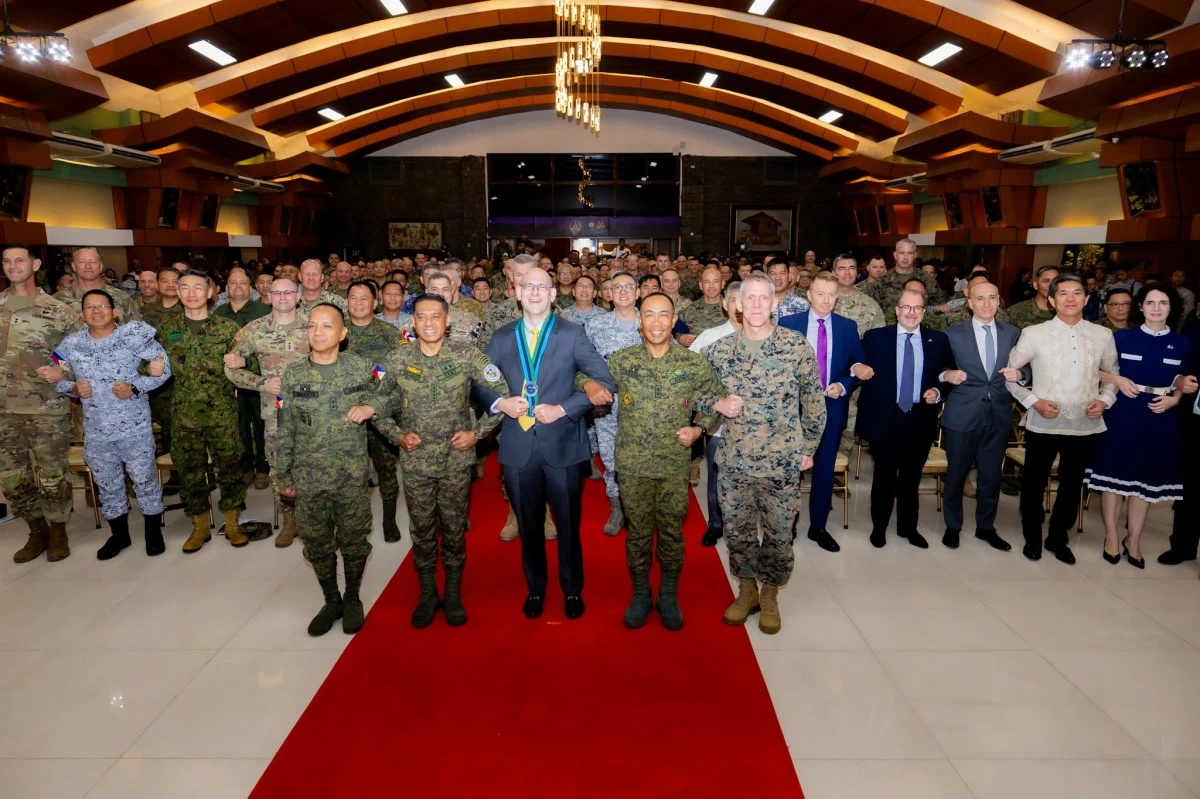
Armed Forces of the Philippines (AFP) Chief, General Romeo Brawner Jr. opened the 41st iteration of Exercise Balikatan at Camp Aguinaldo in Quezon City on Monday, April 20, saying it would be more than a military routine but a test of alliance and a signal of shared responsibility amid a tense global climate.
The exercise runs from April 20 to May 8, bringing together more than 17,000 troops from the AFP, United States, Australia, Canada, France, Japan, New Zealand, and the United Kingdom. Observers from 17 other countries will also be present.
“We gather today not simply to begin another exercise but to reaffirm something far more enduring. The strength of an alliance, the clarity of a shared purpose, and the responsibility that we carry together in securing our region,” Brawner said in his speech.
“For more than three decades, Balikatan has stood as a living testament to the partnership between the Philippines and the United States. One that has grown stronger, more responsive, and more relevant with time,” Brawner said.
The AFP chief linked the scale of the drills to evolving threats. The exercises would be conducted amid global conflicts, particularly in the Middle East, and their impact on US commitments in the Indo-Pacific.
Brawner said he had spoken with US Indo-Pacific Command (Indopacom) chief Admiral Samuel Paparo at the onset of tensions in the Middle East, when US and Israel launched a military offensive in Iran.
“He assured me that despite the conflict happening now in the Middle East and elsewhere around the world, the commitment of the United States is still strong. The Balikatan exercise for this year will be, according to his own words, the biggest ever,” Brawner stated.
What the AFP and the US military meant by “biggest” version of Balikatan refers not only to the sheer number of participants, but also to the scope and scale of the exercises.
Around 10,000 US troops are joining the drills, according to Lieutenant General Christian Wortman, Balikatan’s US exercise director.
“What is unique and new this year is the fact that we have seven participating nations. All of the nations that are participating are bringing important capabilities,” said Wortman.
Japan, taking part as a full participant, also deployed about 1,400 Japanese ground troops, the first time that they have returned to the Philippines since World War II. Canada is also joining actively after years as an observer.
“I think it is a reflection of shared interests and shared values. Everybody recognizes the importance of the Indo-Pacific region,” Wortman added.
War games
The exercises will test integrated air and missile defense, maritime security operations, live fire exercises, and joint multinational readiness training.
Among the systems to be featured is the BrahMos supersonic cruise missile as the Philippine Marine Corps’ (PMC) coastal defense regiment takes part in a simulated firing during a maritime strike event in Northern Luzon.
Two target vessels will be sunk during the drill, one of them is the BRP Quezon, a World War II-era ship that will be used as a target.
The exercise will also use Japanese radar systems for early warning and integrated air and missile defense. Major General Francisco Lorenzo, Balikatan’s Philippines exercise director, said the radars will help detect threats and allow forces to respond in real time.
Despite the show of force, AFP and US military officials insisted the drills are not directed at any country.
“Emphatically no,” Wortman said when asked if the exercise targets China. “There is no target nation.”
The drills will include activities in provinces in Northern Luzon which face Taiwan, Palawan where Chinese vessels frequently roam amid tensions in the West Philippine Sea (WPS), the Visayas, and Mindanao.
About 500 personnel from the Philippine Coast Guard (PCG) will also join maritime law enforcement, search and rescue, and environmental response drills. Four PCG vessels will be deployed for joint operations at sea.
Protests
Meanwhile, the scale of the exercise was questioned by critics, who raised concerns over an expanded US military presence in the country.
Protesters from left-leaning coalition Bagong Alyansang Makabayan (BAYAN) gathered outside Camp Aguinaldo during the opening ceremony and denounced the Balikatan. The group called on the national government to halt the drills and remove US troops and missile systems from the country.
The group said the drills reflect “the expanding intervention of the US military” and what it described as a “subservient foreign policy” of the Marcos administration.
“Balikatan is costly, disruptive to local communities, and endangers the local population by recklessly allowing foreign troops to use our land and water territories as a war playground,” the group said.
The coalition also reiterated its opposition to the Enhanced Defense Cooperation Agreement (EDCA), which allows US forces access to selected Philippine military bases. It called for the dismantling of EDCA sites and other facilities used by US troops.
Wortman, in response, said there are no plans for a permanent US deployment tied to the exercise, stressing that forces will leave after the drills.
“Any US presence or activities in the Philippines will be done at the invitation of the Philippine government,” he said.