







Oil prices set for second weekly rollback on Mideast detente
Published Apr 17, 2026 02:49 pm


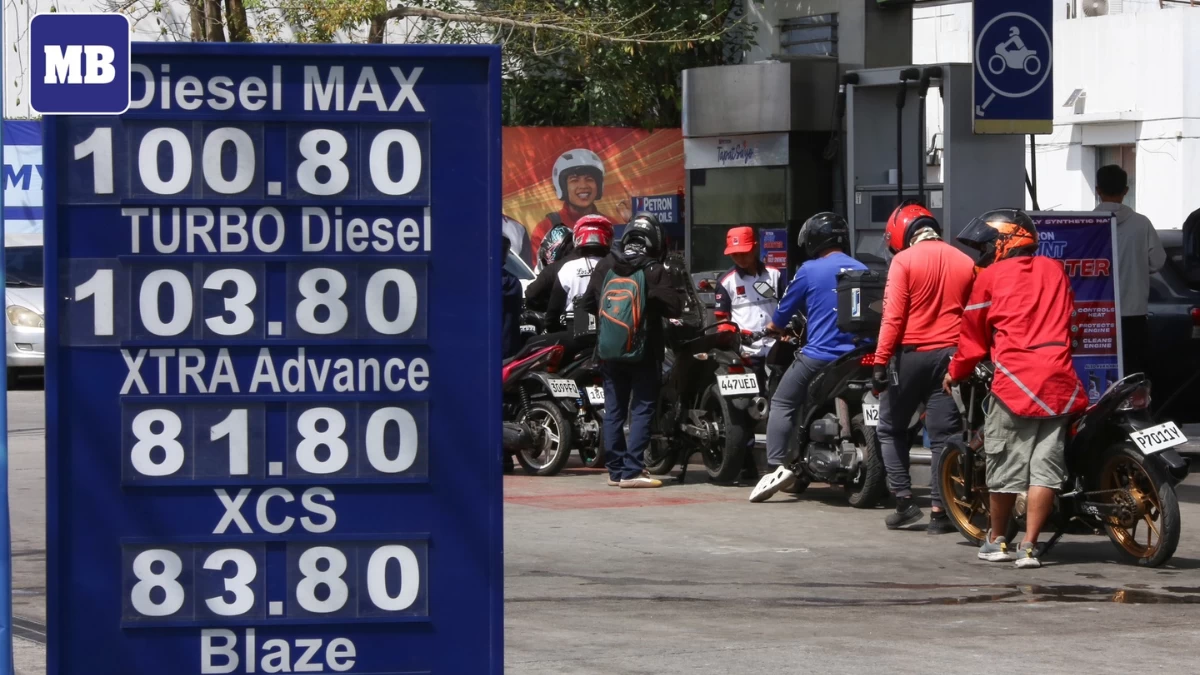
Motorcycle riders pull into a gas station along Commonwealth Avenue in Quezon City on Friday, March 20. To bolster national energy security, the Department of Energy announced a government order of up to 300,000 barrels of diesel from a Southeast Asian supplier set for delivery next week—a move aimed at assisting private oil firms in stabilizing future fuel stocks. (Photo by Santi San Juan | MB)
Oil prices are on track for a significant retreat next week as fragile geopolitical detente in the Middle East erodes the war risk premiums that have kept global benchmarks elevated.
Based on the four-day trading average of the Mean of Platts Singapore (MOPS), the industry’s regional pricing standard, the cost of diesel is expected to drop by ₱17 to ₱19 per liter. Gasoline prices are also tracking lower, with a projected reduction of ₱2 to ₱3 per liter.
Local oil firms typically finalize these price adjustments every Monday, with the changes taking effect the following Tuesday.
The downward pressure on prices follows a rare period of relative calm in the Middle East. Market sentiment has shifted as the United States (US), Iran, and Israel entered a temporary agreement to halt direct strikes and retaliatory actions.
This cooling of tensions was further supported by a 10-day ceasefire between Israel and Lebanon. Together, these developments have significantly dampened fears of a wider regional conflict that could disrupt critical crude supply routes or production infrastructure.
The Department of Energy (DOE) is currently monitoring these international movements as it prepares to validate the upcoming domestic adjustments. While the agency has yet to release the final collated average for Metro Manila pump prices, officials are closely watching how local retailers reflect the MOPS declines.
Domestic supply remains stable despite the global volatility. The Philippine government expects the final 300,000 barrels of a planned 900,000-barrel diesel procurement to arrive by late April. This influx of supply is part of a broader strategy to bolster national reserves and maintain price stability during periods of international uncertainty.
The DOE has also taken a more aggressive stance toward the private sector to ensure that the benefits of lower global oil prices reach consumers promptly. The agency recently warned oil companies that they must align their pump prices with the downward international trend. Failure to implement transparent and fair rollbacks could result in show-cause orders or legal sanctions under the National Energy Emergency Declaration and Executive Order 110.
Under these frameworks, the government maintains the authority to investigate and penalize retailers that are found to be lagging in their price adjustments or engaging in unfair pricing practices during periods of market correction.