ADVERTISEMENT

China still on path to beat US as world's largest economy

Published Apr 17, 2026 06:12 am
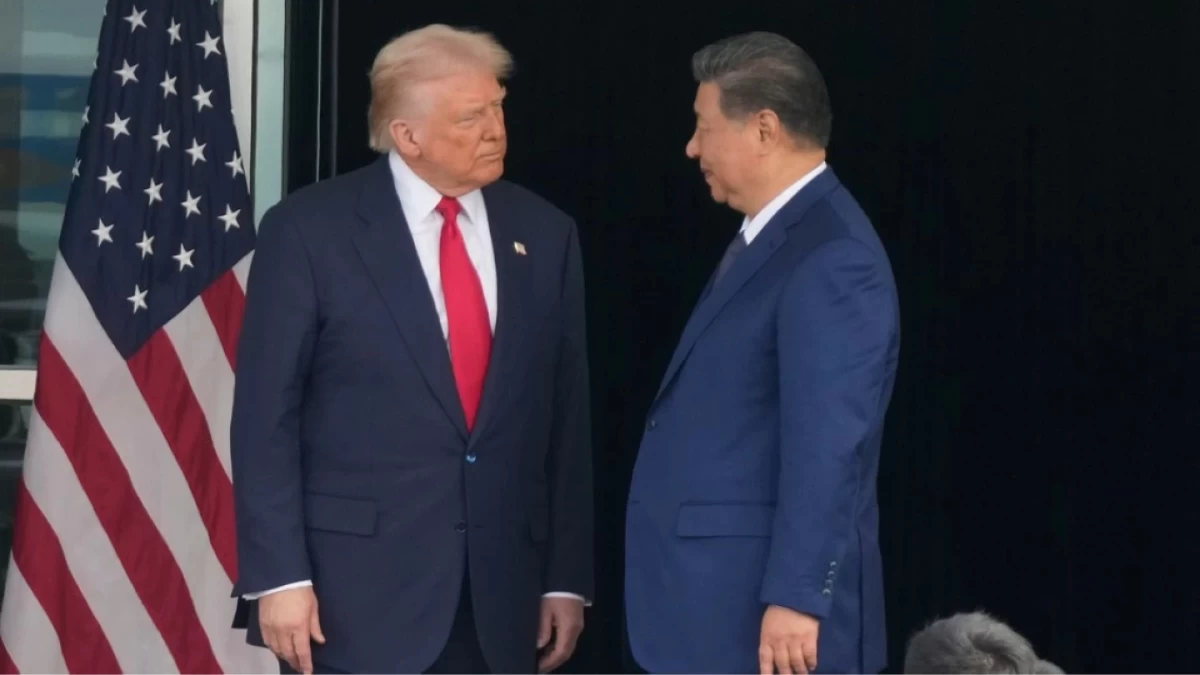
President Donald Trump, left, and Chinese President Xi Jinping, look at each other after their summit meeting at Gimhae International Airport Jinping in Busan, South Korea, Thursday, Oct. 30, 2025. (AP Photo/Mark Schiefelbein)
BEIJING, China — China is projected to surpass the United States (US) as the world’s largest economy as early as 2030, insulated from Middle East volatility and American protectionism by long-term strategic planning, according to a leading foreign policy expert.
Qu Bo, dean of the School of International Studies at China Foreign Affairs University (CFAU), said Beijing remains on a trajectory to overtake Washington in the near term.
“I believe after 2030 and by a certain time point,” Qu told visiting journalists here when asked when China could take over the US’ spot as the number one economy in the world.
He said this projection hinges on China’s ability to maintain economic growth of around five percent annually, from last year’s value of just over $20 trillion.
The US economy, which stood at over $30 trillion in 2025, is expected to face a snag this year, largely due to the war it directly triggered in the Middle East.
Government data showed that China’s economy expanded by five percent in the first quarter, exceeding estimates of slower growth, as it remained resilient despite external shocks.
As other countries like the Philippines bear the brunt of the ongoing crisis, Qu said China’s economy continues to persevere through “very strong strategic thinking” backed by its five-year plans.
China’s five-year plans are overarching governance guidelines that shape the country’s economic and social development goals within a set period.
Qu said these plans usually cover measures to counter “worst-case scenarios,” such as the conflict in the Middle East, which has been driving up the price of key planting inputs like fertilizers.
For instance, citing China’s efforts to achieve food security, he said that even if such inputs were to disappear from the market, the country would still be able to support the food needs of its more than 1.4 billion people within 18 months.
As the US continues to take a protectionist stance in its trade policies, particularly through its so-called reciprocal tariffs, Qu said China remains in favor of free trade and multilateralism.
“China really likes to cooperate with other countries. We try to maintain our support of multilateralism and economic globalization to avoid fragmentation,” he said.
Qu said this should encourage countries to build stronger economic ties with one another, such as between China and the Association of Southeast Asian Nations (ASEAN).
He said the free trade agreement between China and ASEAN reflects the significance of pursuing partnerships to ensure that economies and supply chains remain stable amid trade barriers and disruptions.
“We [need] to consolidate our economic connections with our neighboring countries. And the first place, the direction is with ASEAN countries,” said Qu.
As chair of this year’s ASEAN, the Philippines has urged members of the bloc to maintain economic integration to uphold the region’s energy resiliency amid the threat of tighter supply.
For its part, China is chair of this year’s Asia-Pacific Economic Cooperation (APEC), where it aims to uphold not only deeper regional integration but also build an “open, dynamic, and inclusive Asia-Pacific community that promotes shared and sustainable growth.”

Related Tags

Association of Southeast Asian Nations (ASEAN) Asia-Pacific Economic Cooperation (APEC) China Foreign Affairs University (CFAU)
ADVERTISEMENT
.most-popular .layout-ratio{ padding-bottom: 79.13%; } @media (min-width: 768px) and (max-width: 1024px) { .widget-title { font-size: 15px !important; } }

{{ articles_filter_1561_widget.title }}

.most-popular .layout-ratio{ padding-bottom: 79.13%; } @media (min-width: 768px) and (max-width: 1024px) { .widget-title { font-size: 15px !important; } }

{{ articles_filter_1562_widget.title }}

.most-popular .layout-ratio{ padding-bottom: 79.13%; } @media (min-width: 768px) and (max-width: 1024px) { .widget-title { font-size: 15px !important; } }

{{ articles_filter_1563_widget.title }}

{{ articles_filter_1564_widget.title }}

.mb-article-details { position: relative; } .mb-article-details .article-body-preview, .mb-article-details .article-body-summary{ font-size: 17px; line-height: 30px; font-family: "Libre Caslon Text", serif; color: #000; } .mb-article-details .article-body-preview iframe , .mb-article-details .article-body-summary iframe{ width: 100%; margin: auto; } .read-more-background { background: linear-gradient(180deg, color(display-p3 1.000 1.000 1.000 / 0) 13.75%, color(display-p3 1.000 1.000 1.000 / 0.8) 30.79%, color(display-p3 1.000 1.000 1.000) 72.5%); position: absolute; height: 200px; width: 100%; bottom: 0; display: flex; justify-content: center; align-items: center; padding: 0; } .read-more-background a{ color: #000; } .read-more-btn { padding: 17px 45px; font-family: Inter; font-weight: 700; font-size: 18px; line-height: 16px; text-align: center; vertical-align: middle; border: 1px solid black; background-color: white; } .hidden { display: none; }
function initializeAllSwipers() { // Get all hidden inputs with cms_article_id document.querySelectorAll('[id^="cms_article_id_"]').forEach(function (input) { const cmsArticleId = input.value; const articleSelector = '#article-' + cmsArticleId + ' .body_images'; const swiperElement = document.querySelector(articleSelector); if (swiperElement && !swiperElement.classList.contains('swiper-initialized')) { new Swiper(articleSelector, { loop: true, pagination: false, navigation: { nextEl: '#article-' + cmsArticleId + ' .swiper-button-next', prevEl: '#article-' + cmsArticleId + ' .swiper-button-prev', }, }); } }); } setTimeout(initializeAllSwipers, 3000); const intersectionObserver = new IntersectionObserver( (entries) => { entries.forEach((entry) => { if (entry.isIntersecting) { const newUrl = entry.target.getAttribute("data-url"); if (newUrl) { history.pushState(null, null, newUrl); let article = entry.target; // Extract metadata const author = article.querySelector('.author-section').textContent.replace('By', '').trim(); const section = article.querySelector('.section-info ').textContent.replace(' ', ' '); const title = article.querySelector('.article-title h1').textContent; // Parse URL for Chartbeat path format const parsedUrl = new URL(newUrl, window.location.origin); const cleanUrl = parsedUrl.host + parsedUrl.pathname; // Update Chartbeat configuration if (typeof window._sf_async_config !== 'undefined') { window._sf_async_config.path = cleanUrl; window._sf_async_config.sections = section; window._sf_async_config.authors = author; } // Track virtual page view with Chartbeat if (typeof pSUPERFLY !== 'undefined' && typeof pSUPERFLY.virtualPage === 'function') { try { pSUPERFLY.virtualPage({ path: cleanUrl, title: title, sections: section, authors: author }); } catch (error) { console.error('ping error', error); } } // Optional: Update document title if (title && title !== document.title) { document.title = title; } } } }); }, { threshold: 0.1 } ); function showArticleBody(button) { const article = button.closest("article"); const summary = article.querySelector(".article-body-summary"); const body = article.querySelector(".article-body-preview"); const readMoreSection = article.querySelector(".read-more-background"); // Hide summary and read-more section summary.style.display = "none"; readMoreSection.style.display = "none"; // Show the full article body body.classList.remove("hidden"); } document.addEventListener("DOMContentLoaded", () => { let loadCount = 0; // Track how many times articles are loaded const offset = [1, 2, 3, 4, 5, 6, 7, 8, 9, 10]; // Offset values const currentUrl = window.location.pathname.substring(1); let isLoading = false; // Prevent multiple calls if (!currentUrl) { console.log("Current URL is invalid."); return; } const sentinel = document.getElementById("load-more-sentinel"); if (!sentinel) { console.log("Sentinel element not found."); return; } function isSentinelVisible() { const rect = sentinel.getBoundingClientRect(); return ( rect.top < window.innerHeight && rect.bottom >= 0 ); } function onScroll() { if (isLoading) return; if (isSentinelVisible()) { if (loadCount >= offset.length) { console.log("Maximum load attempts reached."); window.removeEventListener("scroll", onScroll); return; } isLoading = true; const currentOffset = offset[loadCount]; window.loadMoreItems().then(() => { let article = document.querySelector('#widget_1690 > div:nth-last-of-type(2) article'); intersectionObserver.observe(article) loadCount++; }).catch(error => { console.error("Error loading more items:", error); }).finally(() => { isLoading = false; }); } } window.addEventListener("scroll", onScroll); });

Sign up by email to receive news.