ADVERTISEMENT

Gov't plans buying more imported rice to keep prices stable

Published Apr 16, 2026 06:04 am
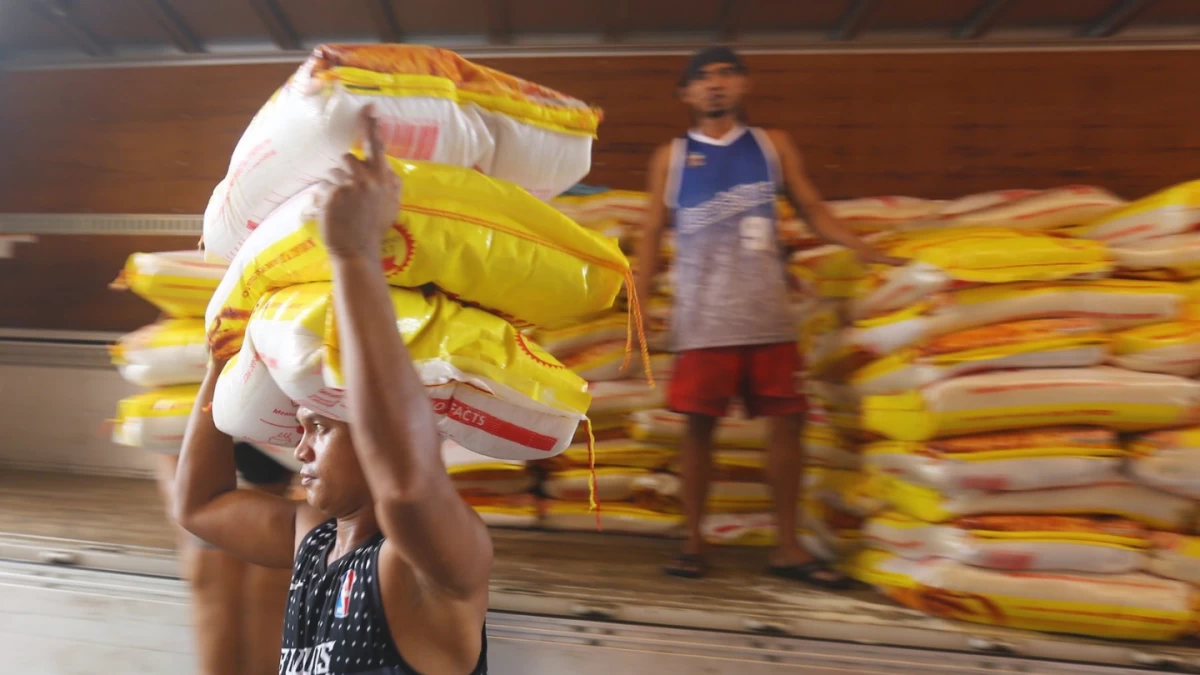
Laborers unload sacks of imported rice in the Uyanguren business district of Davao City on March 26. The Philippines is set to increase foreign rice purchases from suppliers like Vietnam and India to stabilize domestic stocks as the government warns that local production could fall by at least 20% this year due to high fertilizer and fuel costs. (Photo by Keith Bacongco I MB)
The Philippines is preparing to increase its foreign rice purchases this year as the government moves to stabilize domestic supply and temper price volatility for Filipinos' main food staple.
Agriculture Secretary Francisco Tiu Laurel said the country is ready to scale up shipments from its traditional overseas sources to build a more robust buffer.
While the DA has not yet identified the import volume, he said the country is planning to bring in more milled rice from Vietnam, Myanmar, Cambodia, India, and Pakistan within the year.
“There is no volume yet because it is currently the peak of the harvest season,” Tiu Laurel told Manila Bulletin, noting that the specific quantity will be decided afterwards.
Latest data from the Bureau of Plant Industry (BPI) showed that the five countries account for around 92.7 percent of the Philippines’ rice imports as of April 9, estimated at 1.36 million metric tons (MT).
Vietnam, the country’s top rice supplier, holds the lion’s share at 85.47 percent, or 1.16 million MT of the total import volume.
Despite previously indicating the need to limit rice shipments this year to keep farmgate prices of palay (unmilled rice) at a reasonable level, the government has been left with no choice but to resort to importation to supplement domestic supply.
The country’s rice production is widely expected to decline this year due to increased fertilizer costs, driven by supply constraints caused by the ongoing conflict in the Middle East.
In a worst-case scenario in which the government fails to intervene, the DA estimated that local rice output could be cut in half this year. At best, the minimum decline is pegged at around 20 percent.
These projections suggest that the country will be unable to reach this year’s projected palay production of 20.3 million MT, which would have been the highest level ever, surpassing the 20.06 million MT achieved in 2023.
Tiu Laurel said the government is now taking the necessary steps to ensure these outcomes remain only projections.
So far, the DA has rolled out a ₱10-billion assistance package covering targeted interventions, with the rice sector given top priority. It is also planning to provide up to ₱20 billion more, this time focusing solely on farm inputs.
“The current indicators point to a comfortable supply position. The Philippines continues to benefit from strong global rice availability, with major exporters such as India and Vietnam in peak harvest season,” the DA said in a statement.
As the country looks to expand rice imports, Tiu Laurel said the government aims to ensure an ample supply of the commodity “without undermining local producers.”
To facilitate the seamless entry of imports into the country, President Ferdinand “Bongbong” Marcos Jr. has asked the DA to study the potential lowering of tariffs to help reduce retail prices.
This would be on top of the upcoming implementation of a ₱50-per-kilo price cap on five-percent broken imported rice to prevent unreasonable price hikes.

Related Tags

Department of Agriculture (DA) Agriculture Secretary Francisco Tiu Laurel rice imports
ADVERTISEMENT
.most-popular .layout-ratio{ padding-bottom: 79.13%; } @media (min-width: 768px) and (max-width: 1024px) { .widget-title { font-size: 15px !important; } }

{{ articles_filter_1561_widget.title }}

.most-popular .layout-ratio{ padding-bottom: 79.13%; } @media (min-width: 768px) and (max-width: 1024px) { .widget-title { font-size: 15px !important; } }

{{ articles_filter_1562_widget.title }}

.most-popular .layout-ratio{ padding-bottom: 79.13%; } @media (min-width: 768px) and (max-width: 1024px) { .widget-title { font-size: 15px !important; } }

{{ articles_filter_1563_widget.title }}

{{ articles_filter_1564_widget.title }}

.mb-article-details { position: relative; } .mb-article-details .article-body-preview, .mb-article-details .article-body-summary{ font-size: 17px; line-height: 30px; font-family: "Libre Caslon Text", serif; color: #000; } .mb-article-details .article-body-preview iframe , .mb-article-details .article-body-summary iframe{ width: 100%; margin: auto; } .read-more-background { background: linear-gradient(180deg, color(display-p3 1.000 1.000 1.000 / 0) 13.75%, color(display-p3 1.000 1.000 1.000 / 0.8) 30.79%, color(display-p3 1.000 1.000 1.000) 72.5%); position: absolute; height: 200px; width: 100%; bottom: 0; display: flex; justify-content: center; align-items: center; padding: 0; } .read-more-background a{ color: #000; } .read-more-btn { padding: 17px 45px; font-family: Inter; font-weight: 700; font-size: 18px; line-height: 16px; text-align: center; vertical-align: middle; border: 1px solid black; background-color: white; } .hidden { display: none; }
function initializeAllSwipers() { // Get all hidden inputs with cms_article_id document.querySelectorAll('[id^="cms_article_id_"]').forEach(function (input) { const cmsArticleId = input.value; const articleSelector = '#article-' + cmsArticleId + ' .body_images'; const swiperElement = document.querySelector(articleSelector); if (swiperElement && !swiperElement.classList.contains('swiper-initialized')) { new Swiper(articleSelector, { loop: true, pagination: false, navigation: { nextEl: '#article-' + cmsArticleId + ' .swiper-button-next', prevEl: '#article-' + cmsArticleId + ' .swiper-button-prev', }, }); } }); } setTimeout(initializeAllSwipers, 3000); const intersectionObserver = new IntersectionObserver( (entries) => { entries.forEach((entry) => { if (entry.isIntersecting) { const newUrl = entry.target.getAttribute("data-url"); if (newUrl) { history.pushState(null, null, newUrl); let article = entry.target; // Extract metadata const author = article.querySelector('.author-section').textContent.replace('By', '').trim(); const section = article.querySelector('.section-info ').textContent.replace(' ', ' '); const title = article.querySelector('.article-title h1').textContent; // Parse URL for Chartbeat path format const parsedUrl = new URL(newUrl, window.location.origin); const cleanUrl = parsedUrl.host + parsedUrl.pathname; // Update Chartbeat configuration if (typeof window._sf_async_config !== 'undefined') { window._sf_async_config.path = cleanUrl; window._sf_async_config.sections = section; window._sf_async_config.authors = author; } // Track virtual page view with Chartbeat if (typeof pSUPERFLY !== 'undefined' && typeof pSUPERFLY.virtualPage === 'function') { try { pSUPERFLY.virtualPage({ path: cleanUrl, title: title, sections: section, authors: author }); } catch (error) { console.error('ping error', error); } } // Optional: Update document title if (title && title !== document.title) { document.title = title; } } } }); }, { threshold: 0.1 } ); function showArticleBody(button) { const article = button.closest("article"); const summary = article.querySelector(".article-body-summary"); const body = article.querySelector(".article-body-preview"); const readMoreSection = article.querySelector(".read-more-background"); // Hide summary and read-more section summary.style.display = "none"; readMoreSection.style.display = "none"; // Show the full article body body.classList.remove("hidden"); } document.addEventListener("DOMContentLoaded", () => { let loadCount = 0; // Track how many times articles are loaded const offset = [1, 2, 3, 4, 5, 6, 7, 8, 9, 10]; // Offset values const currentUrl = window.location.pathname.substring(1); let isLoading = false; // Prevent multiple calls if (!currentUrl) { console.log("Current URL is invalid."); return; } const sentinel = document.getElementById("load-more-sentinel"); if (!sentinel) { console.log("Sentinel element not found."); return; } function isSentinelVisible() { const rect = sentinel.getBoundingClientRect(); return ( rect.top < window.innerHeight && rect.bottom >= 0 ); } function onScroll() { if (isLoading) return; if (isSentinelVisible()) { if (loadCount >= offset.length) { console.log("Maximum load attempts reached."); window.removeEventListener("scroll", onScroll); return; } isLoading = true; const currentOffset = offset[loadCount]; window.loadMoreItems().then(() => { let article = document.querySelector('#widget_1690 > div:nth-last-of-type(2) article'); intersectionObserver.observe(article) loadCount++; }).catch(error => { console.error("Error loading more items:", error); }).finally(() => { isLoading = false; }); } } window.addEventListener("scroll", onScroll); });

Sign up by email to receive news.