ADVERTISEMENT

Astronomers measure the mind-blowing power and speed of black hole jets for the first time

Published Apr 16, 2026 11:28 pm
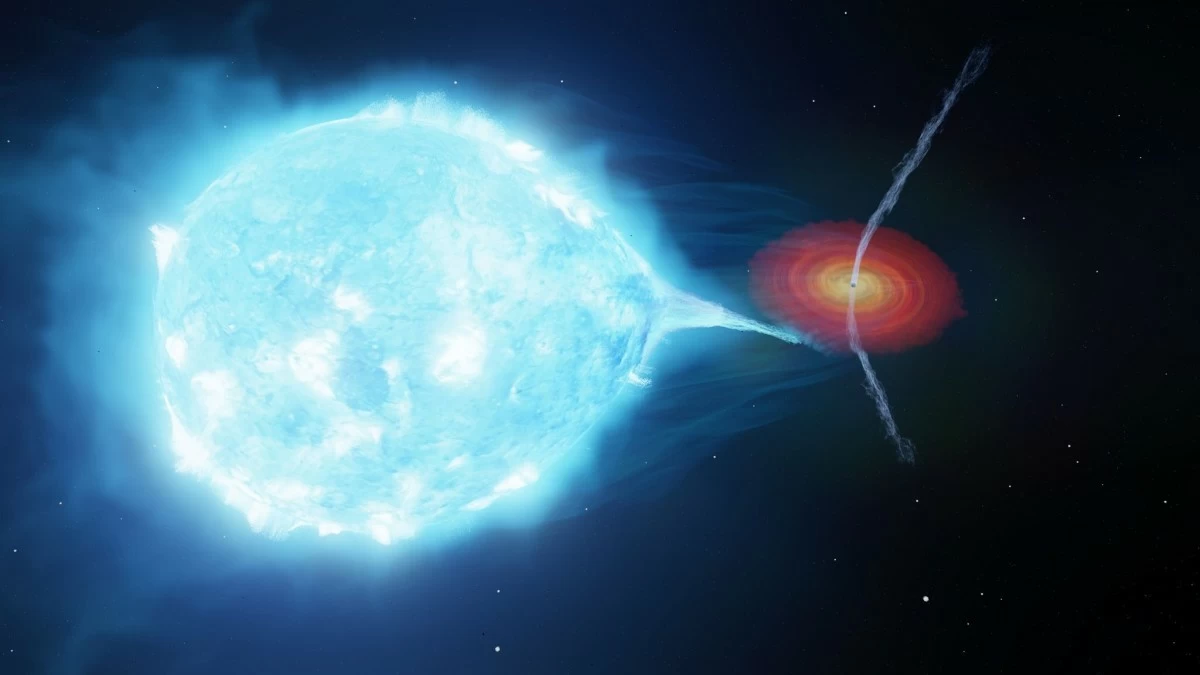
This image provided by International Centre for Radio Astronomy Research (ICRAR) shows the strong stellar wind from the supergiant star pushes the jets launched by the black hole away from the star.  ( (International Centre for Radio Astronomy Research (ICRAR) via AP)
This image provided by International Centre for Radio Astronomy Research (ICRAR) shows the strong stellar wind from the supergiant star pushes the jets launched by the black hole away from the star. ( (International Centre for Radio Astronomy Research (ICRAR) via AP)

CAPE CANAVERAL, Fla. (AP) — For the first time, scientists have measured the instantaneous mind-blowing power of jets blasting from a black hole.

The jet power from this relatively close black hole-star system is equivalent to 10,000 suns, an international research team reported Thursday. They also tracked the jet speed: roughly 355 million mph (540 million kph) — half the speed of light.

Located 7,200 light-years away, Cygnus X-1 features not only a black hole — the first one ever identified more than a half-century ago — but a blue supergiant star, its constant companion. A light-year is nearly 6 trillion miles (9.7 trillion kilometers).

The University of Oxford’s Steve Prabu and his team based their findings on 18 years of high-resolution radio imaging obtained by a global telescope network. He conducted the research while still at Australia’s Curtin University, which led the study published in Nature Astronomy.

Prabu and his colleagues were able to measure the swift power of these “dancing jets” as he calls them, as they were pushed in opposite directions by the star’s wind. The group based its calculations on how much the jets were bent by the stellar wind as well as computer modeling.

Until now, a black hole’s jet power had to be averaged over tens of thousands of years, the researchers said.

Prabu said a key finding is that 10% of all the energy released as matter falls toward the black hole is carried away by the jets.

On the skimpy side as black holes go, the one in Cygnus X-1 is continually pulling gases from its stellar playmate as they orbit one another. Discovered in the 1960s, the binary system is located in our Milky Way’s Cygnus, or swan, constellation.

The supergiant star feeds material to the black hole, giving it “something to ‘eat’ and launch as jets,” Prabu said in an email.

These jets can help scientists better understand how black holes help shape galaxies and other cosmic structures through large-scale shocks and turbulence.

Prabu plans to apply similar techniques to other black holes. “It would be exciting to measure jet power in many more systems,” he said.

Related Tags

WORLDNEWS
ADVERTISEMENT
.most-popular .layout-ratio{ padding-bottom: 79.13%; } @media (min-width: 768px) and (max-width: 1024px) { .widget-title { font-size: 15px !important; } }

{{ articles_filter_1561_widget.title }}

.most-popular .layout-ratio{ padding-bottom: 79.13%; } @media (min-width: 768px) and (max-width: 1024px) { .widget-title { font-size: 15px !important; } }

{{ articles_filter_1562_widget.title }}

.most-popular .layout-ratio{ padding-bottom: 79.13%; } @media (min-width: 768px) and (max-width: 1024px) { .widget-title { font-size: 15px !important; } }

{{ articles_filter_1563_widget.title }}

{{ articles_filter_1564_widget.title }}

.mb-article-details { position: relative; } .mb-article-details .article-body-preview, .mb-article-details .article-body-summary{ font-size: 17px; line-height: 30px; font-family: "Libre Caslon Text", serif; color: #000; } .mb-article-details .article-body-preview iframe , .mb-article-details .article-body-summary iframe{ width: 100%; margin: auto; } .read-more-background { background: linear-gradient(180deg, color(display-p3 1.000 1.000 1.000 / 0) 13.75%, color(display-p3 1.000 1.000 1.000 / 0.8) 30.79%, color(display-p3 1.000 1.000 1.000) 72.5%); position: absolute; height: 200px; width: 100%; bottom: 0; display: flex; justify-content: center; align-items: center; padding: 0; } .read-more-background a{ color: #000; } .read-more-btn { padding: 17px 45px; font-family: Inter; font-weight: 700; font-size: 18px; line-height: 16px; text-align: center; vertical-align: middle; border: 1px solid black; background-color: white; } .hidden { display: none; }
function initializeAllSwipers() { // Get all hidden inputs with cms_article_id document.querySelectorAll('[id^="cms_article_id_"]').forEach(function (input) { const cmsArticleId = input.value; const articleSelector = '#article-' + cmsArticleId + ' .body_images'; const swiperElement = document.querySelector(articleSelector); if (swiperElement && !swiperElement.classList.contains('swiper-initialized')) { new Swiper(articleSelector, { loop: true, pagination: false, navigation: { nextEl: '#article-' + cmsArticleId + ' .swiper-button-next', prevEl: '#article-' + cmsArticleId + ' .swiper-button-prev', }, }); } }); } setTimeout(initializeAllSwipers, 3000); const intersectionObserver = new IntersectionObserver( (entries) => { entries.forEach((entry) => { if (entry.isIntersecting) { const newUrl = entry.target.getAttribute("data-url"); if (newUrl) { history.pushState(null, null, newUrl); let article = entry.target; // Extract metadata const author = article.querySelector('.author-section').textContent.replace('By', '').trim(); const section = article.querySelector('.section-info ').textContent.replace(' ', ' '); const title = article.querySelector('.article-title h1').textContent; // Parse URL for Chartbeat path format const parsedUrl = new URL(newUrl, window.location.origin); const cleanUrl = parsedUrl.host + parsedUrl.pathname; // Update Chartbeat configuration if (typeof window._sf_async_config !== 'undefined') { window._sf_async_config.path = cleanUrl; window._sf_async_config.sections = section; window._sf_async_config.authors = author; } // Track virtual page view with Chartbeat if (typeof pSUPERFLY !== 'undefined' && typeof pSUPERFLY.virtualPage === 'function') { try { pSUPERFLY.virtualPage({ path: cleanUrl, title: title, sections: section, authors: author }); } catch (error) { console.error('ping error', error); } } // Optional: Update document title if (title && title !== document.title) { document.title = title; } } } }); }, { threshold: 0.1 } ); function showArticleBody(button) { const article = button.closest("article"); const summary = article.querySelector(".article-body-summary"); const body = article.querySelector(".article-body-preview"); const readMoreSection = article.querySelector(".read-more-background"); // Hide summary and read-more section summary.style.display = "none"; readMoreSection.style.display = "none"; // Show the full article body body.classList.remove("hidden"); } document.addEventListener("DOMContentLoaded", () => { let loadCount = 0; // Track how many times articles are loaded const offset = [1, 2, 3, 4, 5, 6, 7, 8, 9, 10]; // Offset values const currentUrl = window.location.pathname.substring(1); let isLoading = false; // Prevent multiple calls if (!currentUrl) { console.log("Current URL is invalid."); return; } const sentinel = document.getElementById("load-more-sentinel"); if (!sentinel) { console.log("Sentinel element not found."); return; } function isSentinelVisible() { const rect = sentinel.getBoundingClientRect(); return ( rect.top < window.innerHeight && rect.bottom >= 0 ); } function onScroll() { if (isLoading) return; if (isSentinelVisible()) { if (loadCount >= offset.length) { console.log("Maximum load attempts reached."); window.removeEventListener("scroll", onScroll); return; } isLoading = true; const currentOffset = offset[loadCount]; window.loadMoreItems().then(() => { let article = document.querySelector('#widget_1690 > div:nth-last-of-type(2) article'); intersectionObserver.observe(article) loadCount++; }).catch(error => { console.error("Error loading more items:", error); }).finally(() => { isLoading = false; }); } } window.addEventListener("scroll", onScroll); });

Sign up by email to receive news.