






Manila Bulletin
 Business
The Stock Market
Local stocks slump as Mideast tensions, political noise weigh
Business
The Stock Market
Local stocks slump as Mideast tensions, political noise weigh
Business
The Stock Market
Local stocks slump as Mideast tensions, political noise weigh
Local stocks slump as Mideast tensions, political noise weigh
Published Apr 14, 2026 05:24 pm


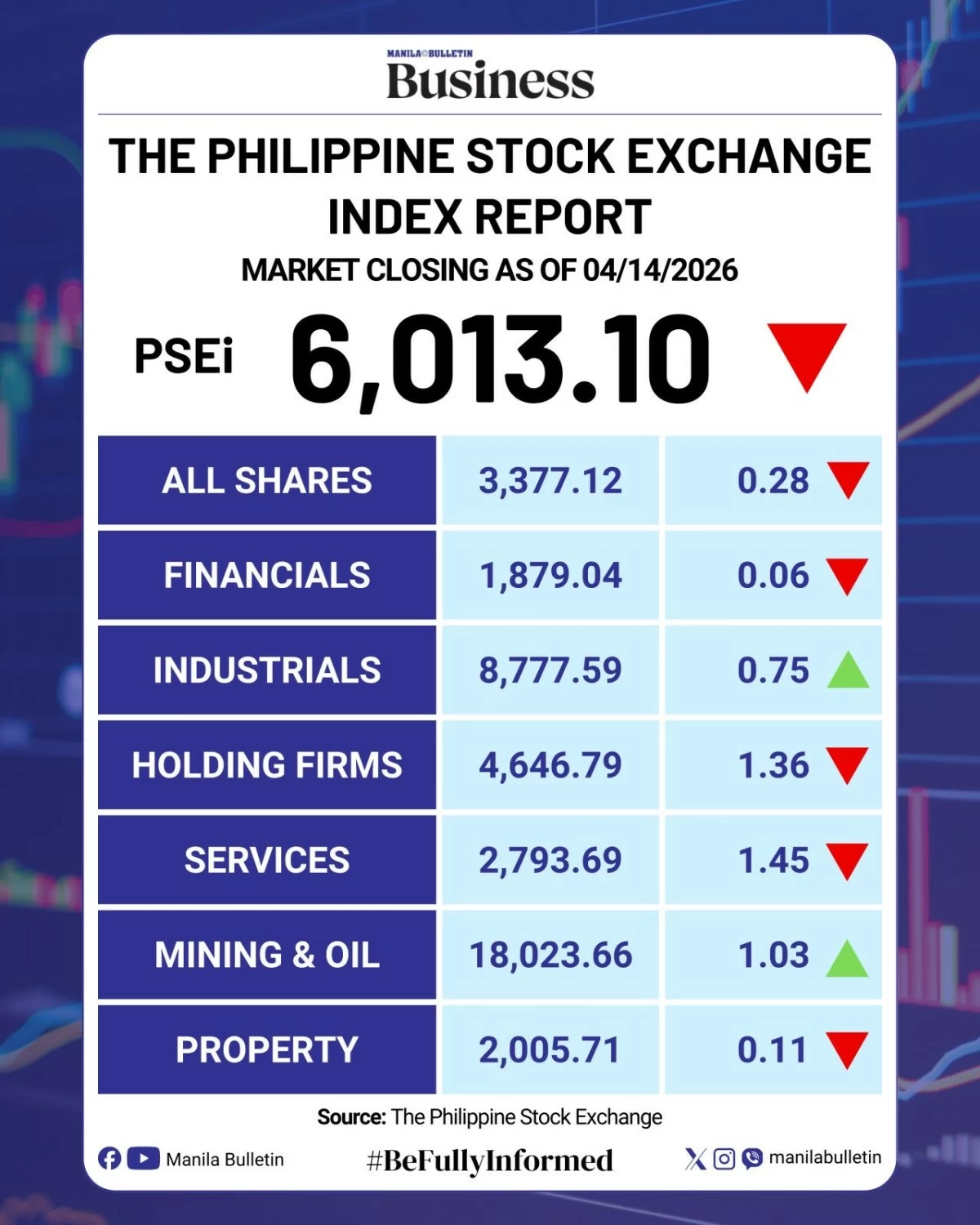
Local equities market extended its decline on Tuesday, April 14, as escalating tensions in the Middle East and domestic political instability dampened investor appetite, offsetting otherwise positive global leads.
The Philippine Stock Exchange index (PSEi) retreated 40.95 points, or 0.68 percent, to finish at 6,013.10. While the Mining and Industrial sectors managed to post modest gains, the broader market was dragged down by a sharp retreat in the Services sector.
Trading activity showed signs of exhaustion, with volume thinning to 1.48 billion shares valued at ₱5.92 billion. Despite the index’s decline, market breadth remained slightly positive as gainers edged out losers 110 to 93, while 61 issues remained unchanged.
Market participants largely retreated to the sidelines, wary of the potential for a wider regional conflict in the Middle East to disrupt global energy supplies. Luis Limlingan, managing director at Regina Capital Development Corp., noted that buying activity remained muted as investors awaited further developments regarding geopolitical shifts.
The anxiety was compounded by technical concerns in the energy market, with Philstocks Financial Research Manager Japhet Tantiangco pointing to the continued threat of elevated oil prices. Tantiangco cited the risk of a potential blockade of the Strait of Hormuz by US forces as a primary driver of inflation fears, a scenario that would likely keep domestic consumer prices under pressure.
Sentiment was further soured by internal economic and political headwinds. A recent report indicating that the Philippines is trailing its Southeast Asian neighbors in the Foreign Direct Investment Confidence Index weighed on the long-term outlook for capital inflows.
Meanwhile, local political noise added a layer of domestic volatility that discouraged aggressive positioning. Michael Ricafort, chief economist at Rizal Commercial Banking Corp., observed that the PSEi struggled to capitalize on favorable international cues because the domestic narrative was clouded by these political distractions.
The prevailing mood remains one of cautious positioning. Analysts suggest that until there is more clarity regarding the trajectory of global crude prices and a stabilization of the local political climate, the PSEi may continue to struggle to find a firm floor. For now, the combination of external supply-side shocks and internal policy uncertainty continues to limit risk appetite across the local exchange.