






 Business
The Economy
World Bank: Oil relief may strain Philippine finances, further slow growth
Business
The Economy
World Bank: Oil relief may strain Philippine finances, further slow growth
World Bank: Oil relief may strain Philippine finances, further slow growth


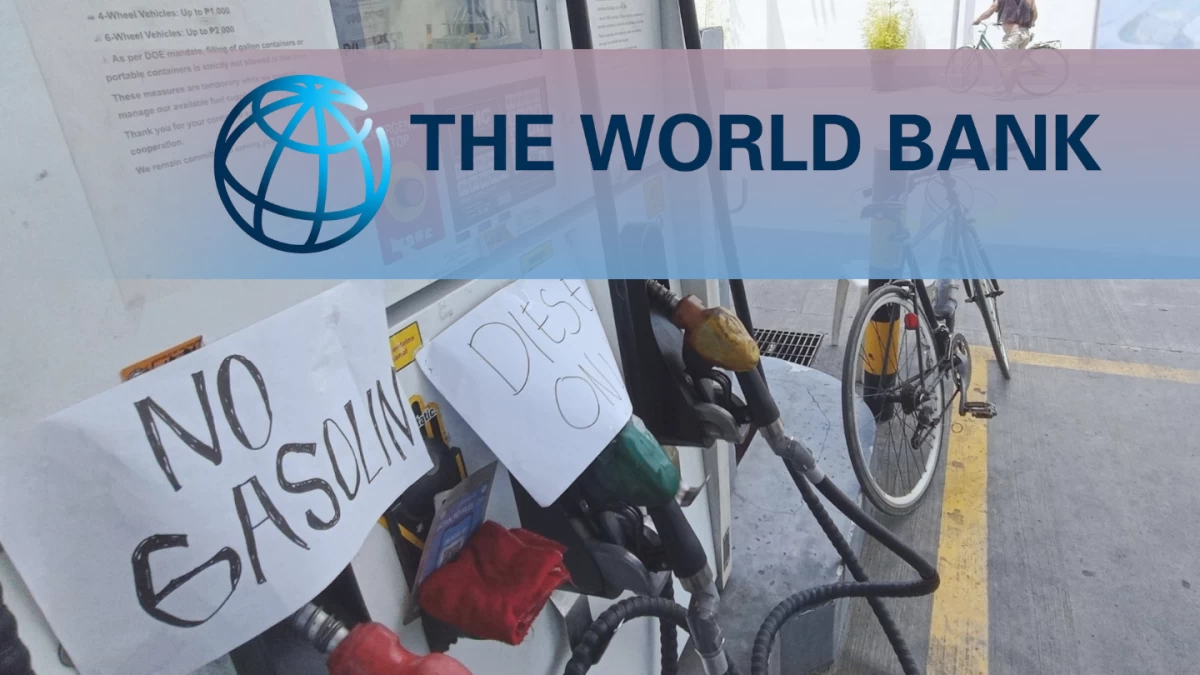
The short-term relief measures put in place by the Philippine government to mitigate the impact of the global oil crisis spilling over to local shores risk inflicting fiscal strain and could further slow the country’s already sluggish economic growth, according to the World Bank.
During the online launch of the World Bank’s April 2026 East Asia & Pacific Economic Update report on Thursday, April 9 (Manila time), Aaditya Mattoo, director at the Washington-based lender’s development research group, noted that countries in the region, including the Philippines, have put in place energy subsidies, cash transfers, and tax reduction measures to support badly hit sectors after the war in the Middle East brought about oil price and supply shocks. President Ferdinand R. Marcos Jr. had declared a national energy emergency to address the crisis.
But Mattoo pointed out that these stop-gap measures result in trade-offs, including fiscal pressures, higher debt, and elevated interest rates while borrowing for crisis response, as well as slower economic growth.
He noted that bond spreads in the Philippines and Indonesia have already risen by up to 30 basis points (bps) since the war started, indicating tighter financing conditions that make it difficult for governments to borrow as lenders seek higher yields. This has already manifested in the recent weekly Bureau of the Treasury (BTr) auctions, where target borrowings were unattained while the government capped rising rates.
Another oil crisis mitigation measure introduced by the Philippines and its neighbors was work-from-home (WFH) and other flexible arrangements, whose trade-off, Mattoo pointed out, would be tempered consumer spending as people spend less time outside their homes and save up some money amid the harder times. Less consumption would also slow growth, he warned.
Taking these into consideration, the World Bank’s latest regional report projected Philippine gross domestic product (GDP) growth for 2026 at merely 3.7 percent, poised to become the slowest annual economic expansion since the worst post-war recession recorded in 2020 at the height of the Covid-19 pandemic.
As Manila Bulletin earlier reported, the World Bank in mid-February estimated 2026 Philippine growth at 4.6 percent, below the government’s downgraded five- to six-percent growth target for the year.
“The growth outlook remains moderate over the near term, with activity expected to remain subdued in 2026 before gradually strengthening... The impact of the government’s anti-corruption efforts and a significantly lower infrastructure budget in 2026 is expected to weigh on public investment,” the World Bank said in a report before the Middle East war erupted by end-February.
The World Bank now expects 2027 GDP growth at 5.6 percent, better than the February estimate of 5.3 percent and within next year’s downscaled 5.5- to 6.5-percent government goal.
Mattoo said the global oil crisis would also impact remittances from overseas Filipino workers (OFWs) in the Middle East, whose home-bound cash transfers are equivalent to 1.5 percent of GDP.
He added that fuel price shocks hurt the poorest Filipinos the most, widening inequality, as data showed that low-income households in the country spend more on goods and services directly impacted by oil consumption and related transport costs.
Citing estimates in the regional World Bank report, Mattoo said a 30-percent, or about $20, increase in crude oil prices could raise inflation by about 0.62 percentage point (ppt) in the Philippines after six months. The report said inflation in the Philippines and Thailand are “among the more exposed economies given their reliance on imported oil.”
“The drag on industrial production follows the same pattern, with Thailand and the Philippines most affected,” the World Bank added, with nearly 0.2-ppt reduction in economic activity for both countries, the report showed.
Earlier in the week, the Marcos Jr. administration’s chief economic manager assured that the government has enough resources to tackle the oil crisis head-on, given an improving fiscal position with rising revenues coupled with prudent spending on public goods and services.
“Our strong fiscal performance in February sets us up for a stable first quarter of this year. This acts as our safety net, giving us the resources to support the economy, especially during this time of uncertainty,” Finance Secretary Frederick D. Go said in a statement.
The BTr reported last Tuesday, April 7, that the national government’s (NG) budget deficit slightly narrowed to ₱171.2 billion in February from ₱171.4 billion a year ago.
Revenue collections climbed by over two-fifths to ₱361.3 billion last February, as the non-tax take jumped 540.2 percent to ₱111.5 billion due to the earlier-than-usual remittances of state-run corporations’ 2025 dividends to the NG.
Government spending, meanwhile, rose by more than a fourth to ₱532.5 billion, with primary expenditures, or what are considered productive public spending, surging by over 29 percent to ₱483.6 billion and accounting for over 90 percent of total disbursements for the month.
As of end-February, the cumulative budget deficit narrowed by 94.4 percent to merely ₱5.8 billion from ₱103.1 billion a year ago, mainly as government expenditures were kept in check at the start of the year in the aftermath of the flood-control infrastructure scandal.
“With tax and non-tax revenues growing and expenditures kept targeted, we have successfully reduced our fiscal deficit,” said Go, who, as Department of Finance (DOF) chief, oversees the country’s fiscal health.
“This fiscal buffer allows us space to provide timely, targeted, and managed subsidies to help those most affected in our country by the Middle East event,” Go said, referring to government aid that would be deployed amid the ongoing state of national energy emergency.
Pending bills in Congress, like the so-called “Bayanihan 3,” aim to provide financial aid to sectors most badly hit by the global oil price and supply shock wrought by the war between the United States (US)-backed Israel and Iran.
As the war raged on, domestic inflation hit a 20-month high of 4.1 percent in March, squeezing Filipino households and driving up the cost of basic goods and services.
In a joint statement released Thursday, April 8, the heads of the International Monetary Fund (IMF), the World Bank Group (WBG), and the World Food Program (WFP) warned that the ongoing war in the Middle East is severely disrupting global energy and food markets, with serious consequences for vulnerable populations worldwide.
The three multilateral institutions highlighted that the conflict has already caused “one of the largest disruptions to global energy markets in modern history,” pushing up prices for oil, gas, and fertilizers while creating transport bottlenecks. The situation, they said, “will inevitably lead to rising food prices and food insecurity.”
They noted that the brunt of the crisis will be felt most by low-income, import-dependent economies where “fiscal space is constrained and debt burdens are already high, reducing governments’ ability to protect vulnerable households.”
“Our institutions will continue to monitor developments closely and coordinate the use of all available tools to support those impacted by the crisis,” the statement added.
They pledged to provide targeted support “to safeguard lives and livelihoods, and to lay the foundations for a resilient recovery that delivers stability, growth and jobs,” leveraging their respective mandates and existing response mechanisms.
The IMF, the WBG, and the WFP said they are closely coordinating to address both immediate humanitarian needs and the broader economic implications of the war, emphasizing that a combined approach is crucial to mitigate the impact of rising energy and food prices globally.