







DTI shifts gear from ICE to EV incentives


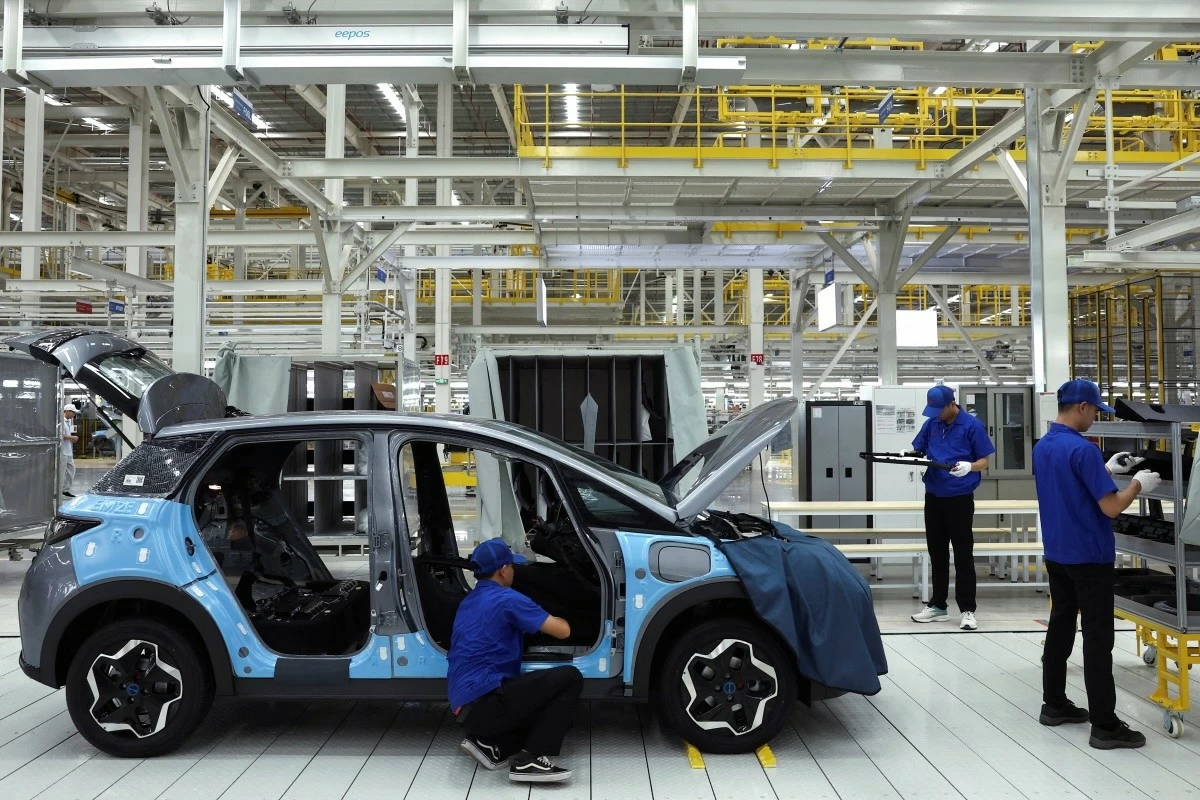
The Department of Trade and Industry (DTI) will no longer pursue an incentive program aimed at attracting investments in internal combustion engine (ICE) vehicles, as it shifts its focus toward the domestic production of electric vehicles (EVs).
Trade Secretary Cristina Roque told reporters on Wednesday, April 8, that the Revitalizing the Automotive Industry for Competitiveness Enhancement (RACE) program will no longer proceed as planned, with the DTI instead moving forward with the Electric Vehicle Incentive Strategy (EVIS).
“We’re going straight to EVIS. For now, there’s no RACE,” she said on the sidelines of the opening of the 2026 National Food Fair.
RACE was designed to grant up to ₱3 billion in incentives to support the production of four-wheeled ICE vehicles in the country.
It was seen as a successor to the recently concluded Comprehensive Automotive Resurgence Strategy (CARS), which focused on attracting investments in motor vehicle and parts manufacturing.
Both CARS and RACE were part of the unprogrammed appropriations (UAs) in this year’s ₱6.793-trillion national budget that were scrapped by President Ferdinand R. Marcos Jr. Only CARS had its funding restored, specifically to cover its remaining obligations to investors.
Earlier this year, Roque said RACE was still part of the government’s plans to bolster the local automotive manufacturing base.
But with EV adoption growing at unprecedented levels, the government sees EVIS as the more appropriate program to pursue.
“We want investors who are going to make EVs here in the Philippines. So we give them incentives to encourage more [EVs] to be produced in the Philippines,” said Roque.
EVIS aims to encourage investments to develop a manufacturing base for EVs, including batteries, electric components and parts, as well as the deployment of charging stations.
The program seeks to narrow the cost gap between EVs and traditional motor vehicles, encouraging Filipinos to shift to EVs.
Roque said the executive order (EO) outlining the implementation of EVIS, including its fiscal and non-fiscal incentives, is expected to be issued within three months.
“We’re still trying to fix everything. But we’re hoping to release it soon, especially with the situation now,” she said.
In recent weeks, there has been a stronger uptake of EVs, especially as consumers move away from conventional vehicles due to rising fuel prices.
Finance Secretary Frederick Go said manufacturing EVs locally could help reduce the country’s dependence on oil imports, reinforcing resilience against oil shocks.
Japanese automotive giant Mitsubishi Motors Corp. (MMC) announced plans to start manufacturing hybrid EVs at its plant in Laguna province by 2028.
MMC aims to realize this plan through EVIS, which it intends to apply for once the program takes effect.
EVIS is expected to begin in 2028, targeting the rollout of up to nine million EVs and nearly 400,000 charging stations by 2040.
The program is estimated to attract ₱120 billion in investments and generate 680,000 jobs.