






Manila Bulletin
 Philippines
National
Volcanic unrest continues: Taal records weak phreatic eruption on April 6
Philippines
National
Volcanic unrest continues: Taal records weak phreatic eruption on April 6
Philippines
National
Volcanic unrest continues: Taal records weak phreatic eruption on April 6
Volcanic unrest continues: Taal records weak phreatic eruption on April 6
Mayon, Kanlaon volcanoes also show significant activity in past 24 hours
Published Apr 6, 2026 11:04 am


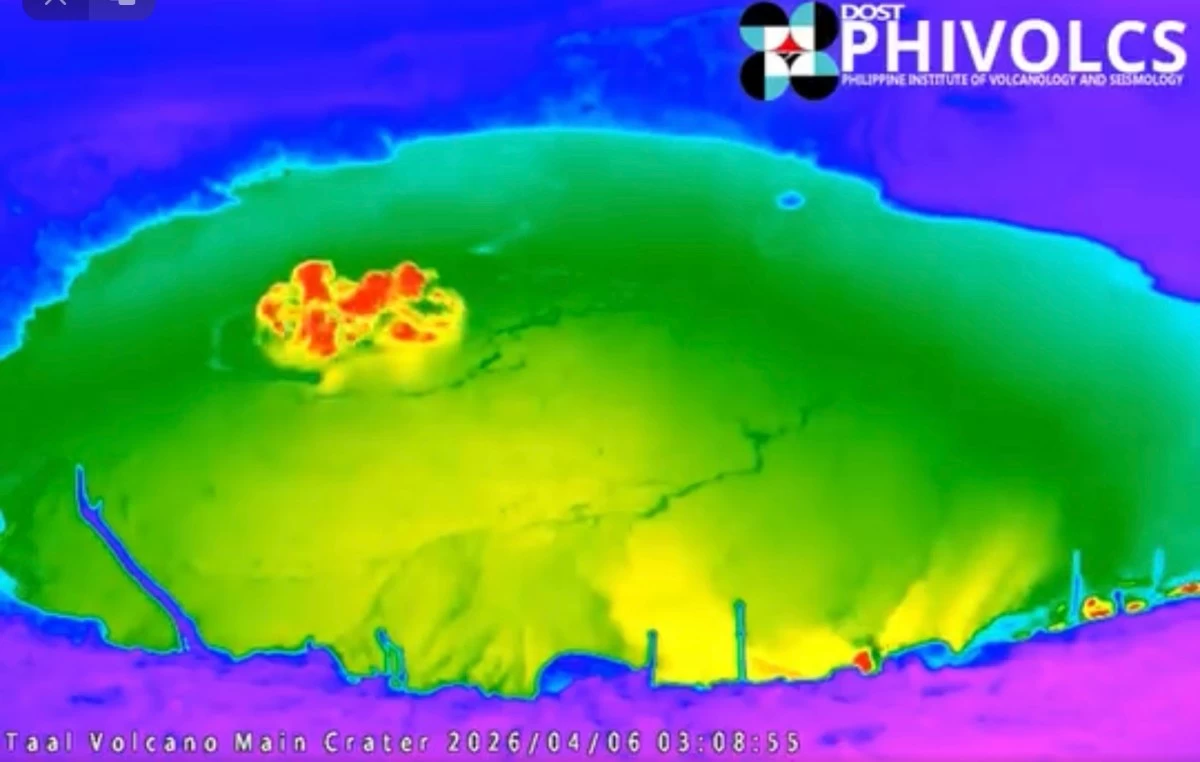
Infrared image of a very weak phreatic eruption at the Main Crater of Taal Volcano at 3:08 a.m. on April 6, lasting two minutes based on seismic and camera records. The event generated a plume that rose 200 meters above the crater lake, as recorded by the Daang Kastila and Main Crater thermal cameras. Alert Level 1 remains in effect over Taal Volcano. (Courtesy of Phivolcs)
Monitoring data showed notable activity across three of the country’s most active volcanoes in the past 24 hours, according to the Philippine Institute of Volcanology and Seismology (Phivolcs).
At Taal Volcano in Batangas, a “very weak” phreatic or steam-driven eruption was observed at 3:08 a.m. on Monday, April 6, lasting about two minutes.
Phivolcs said the event generated a plume that rose approximately 200 meters above the main crater lake, citing seismic data and thermal camera observations from the Daang Kastila and Main Crater monitoring stations.
The agency said Alert Level 1 remains in effect over Taal, indicating “low-level unrest.”
It reiterated that entry into Taal Volcano Island, particularly the Main Crater and Daang Kastila fissures, remains prohibited due to possible hazards such as sudden steam-driven explosions, volcanic earthquakes, minor ashfall, and volcanic gas emissions.
Meanwhile, Kanlaon Volcano on Negros Island recorded ash emission events at 1:10 p.m., 3:10 p.m. and 5:09 p.m. on Sunday, April 5, triggering grayish plumes rising between 350 meters and 1.2 kilometers above the summit crater.
Phivolcs cited that the emissions, which lasted from eight to 131 minutes, have drifted southwest to south-southwest, as recorded by the Kanlaon Volcano Observatory in Canlaon City
The activity was accompanied by 49 volcanic earthquakes, including three tremors that lasted up to 91 minutes, it added.
Kanlaon remains under Alert Level 2 due to “increased unrest,” which means entry into the four-kilometer permanent danger zone is strictly prohibited.
In Albay, Phivolcs said Mayon Volcano continued its ongoing effusive eruption, which is characterized by the slow outflow of lava from the volcano, forming rivers of molten rock rather than explosive blasts.
It added that short-lived lava fountaining was recorded early Sunday, alongside sustained lava flows in the Basud, Bonga, and Mi-isi gullies.
Lava flows remained at 3.8 kilometers in Basud Gully, 3.2 kilometers in Bonga Gully, and 1.3 kilometers in Mi-isi Gully.
The activity was also accompanied by 344 rockfall events, 159 volcanic earthquakes, and 12 pyroclastic density current signals, locally known as “uson.”
Mayon remains under Alert Level 3.
Phivolcs reiterated that entry into the six-kilometer permanent danger zone is strictly prohibited due to the continued risk of lava flows, rockfalls, and sudden explosive activity.