






 Philippines
National
Marcos urges stronger national-LGU coordination amid Mideast crisis
Philippines
National
Marcos urges stronger national-LGU coordination amid Mideast crisis
Marcos urges stronger national-LGU coordination amid Mideast crisis


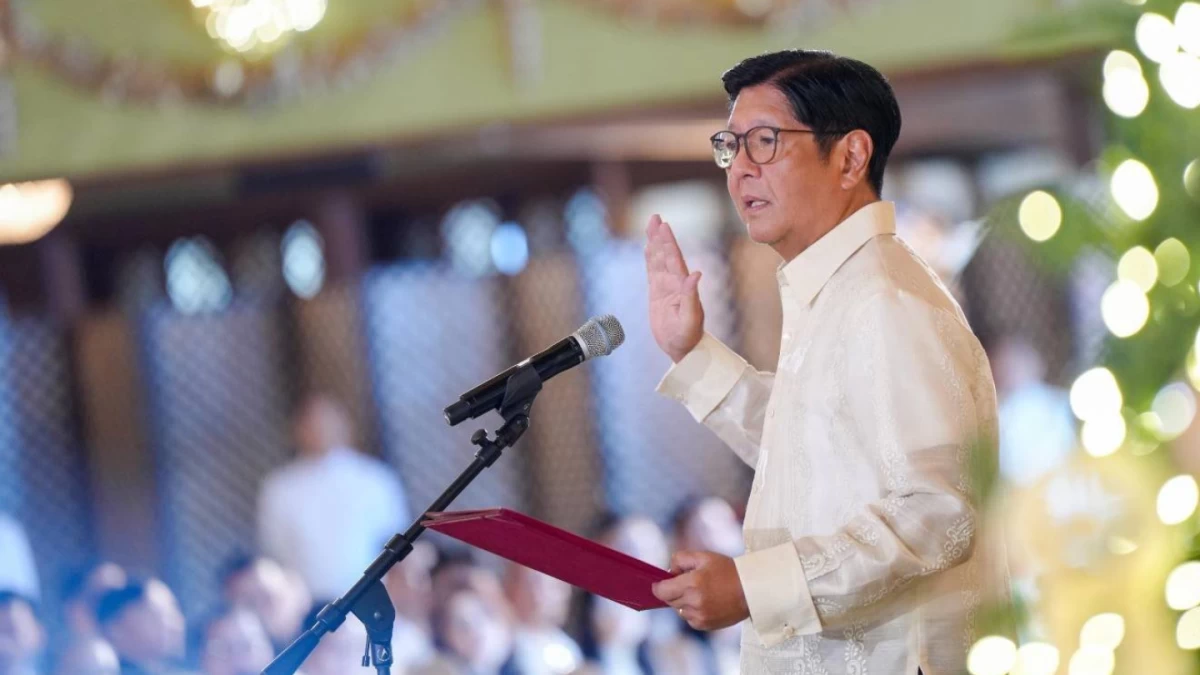
President Marcos has called for stronger coordination between national and local governments as the country deals with the impact of the ongoing conflict in the Middle East.
Speaking during the oath-taking of officers of the Vice Mayors’ League of the Philippines (VMLP) in Malacañan on Monday, April 6, the President stressed the importance of unity and cooperation in addressing emerging challenges.
“Sana manatili kayong matatag at pursigido sa inyong paglilingkod, lalo na ngayong maraming krisis ang kinakaharap ng bansa dahil sa tensyon na nangyayari sa Gitnang Silangan (I hope you remain steadfast and committed to your service, especially as the country faces many crises due to tensions in the Middle East),” he said.
He urged local officials to continue supporting their constituents as the government rolls out measures to cushion the effects of the crisis.
“Patuloy nating gabayan at suportahan ang ating mga mamamayan hanggang sa sama-sama natin malampasan ang mga pagsubok na ito (Let us continue to guide and support our people until we overcome these challenges together),” he added.
The government has extended assistance to sectors most affected by rising fuel prices, including transport workers, farmers, and fisherfolk.
Among these is the P1.28-billion aid package for transport workers, alongside fuel subsidies benefiting over 1.4 million drivers and operators.
Additional relief measures include 50-percent fare discounts on LRT-2 and MRT-3, “Libreng Sakay” programs in major cities, and toll discounts for public utility vehicles and food transport.
To stabilize food supply, the government will also implement a P1 roll-on/roll-off (RORO) terminal fee for vehicles carrying agricultural products starting April 15.
The measure aims to reduce logistics costs and ease pressure on food prices.
LGU capacity issues
President Marcos also acknowledged the persistent challenges faced by local government units, including administrative, financial, and technical limitations.
He said many LGUs continue to struggle with service delivery due to gaps in governance capacity.
With this, Marcos said the administration is pursuing amendments to the Local Government Code to clarify responsibilities and strengthen accountability.
“In collaboration with the ULAP, the DILG, and the DEPDev, we are pursuing necessary amendments… to enhance the fiscal capacities of LGUs,” he said.
The President cited data showing that only 29 percent of LGUs passed the Seal of Good Local Governance in 2023.
He noted that many LGUs face issues in financial management, disaster preparedness, and social protection.
Marcos also pointed out that a majority of LGUs remain heavily dependent on the National Tax Allotment.
Data from 2021 showed that 64 percent of LGUs rely on the NTA, while 71 percent of their operating income comes from external sources.
Push for digital governance
The administration is also addressing gaps in digital governance, including poor internet connectivity and limited ICT resources in many LGUs.
Efforts are underway to digitalize frontline services and improve coordination between national agencies and local governments.
Among the initiatives is the Electronic LGU (eLGU) system to modernize services, as well as the expansion of the Local Government Support Fund.
The government is also implementing the “Sa Bagong Pilipinas, Bawat Bayan Makikinabang” program to support local projects such as healthcare, rice distribution, and rural electrification.
The President said barangays will receive additional assistance, including a one-time P100,000 educational grant and funding for priority community projects.
Strengthening local governance
Marcos said these initiatives aim to make LGUs more self-reliant, responsive, and competitive.
“This will equip LGUs with the tools, the resources, and the clarity of mandate that they need to serve effectively,” he said.
The President reiterated that strong national-local coordination remains key to overcoming both immediate and long-term challenges.