








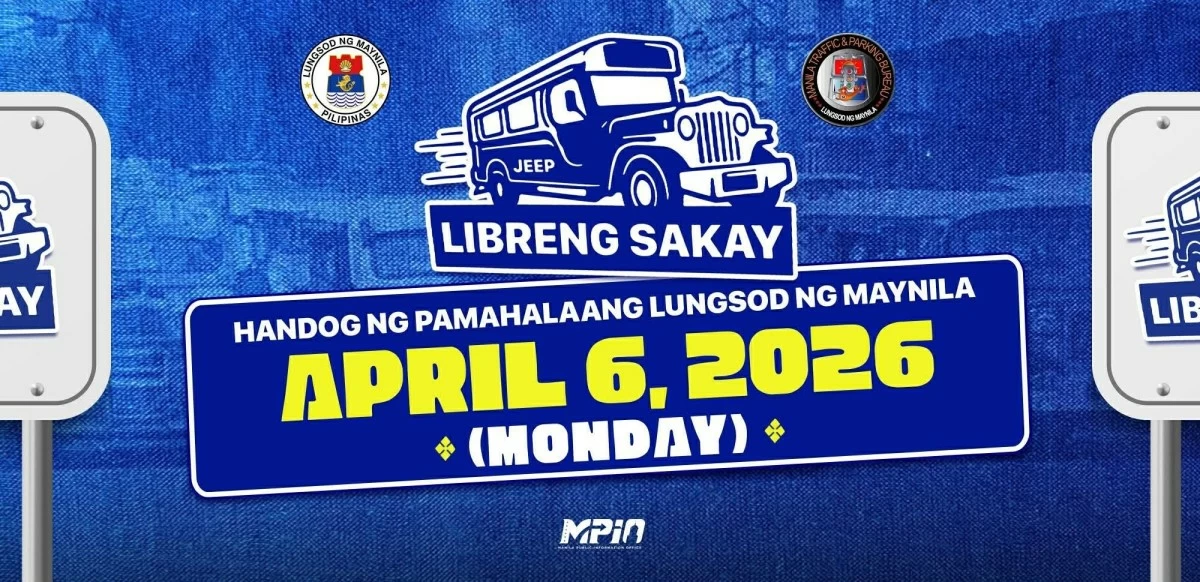
Manila City Mayor Francisco "Isko Moreno" Domagoso made the announcement on his official Facebook page, directing passengers to look for jeepneys bearing a "Libreng Sakay" tarpaulin, or to approach Manila Traffic and Parking Bureau (MTPB) enforcers accompanying drivers along their routes.
"Sa ating mga kababayan: muli pong magpapatuloy ang Libreng Sakay Handog ng Pamahalaang Lungsod bukas, April 6 (To our fellow citizens: the Libreng Sakay program of the city government will resume tomorrow, April 6)," the mayor said.
"Hanapin lamang ang mga jeep na may tarpaulin na Libreng Sakay, o kaya ang ating mga Manila Traffic and Parking Bureau enforcers na kasama ng ating mga Mamang Tsuper sa biyahe (Just look for jeepneys with a ‘Libreng Sakay’ tarpaulin, or approach our Manila Traffic and Parking Bureau enforcers accompanying our drivers along their routes)," he added.
Specific routes covered by the program were also released alongside the announcement.
The resumption follows a strong opening week, with the program serving a combined 308,738 passengers across its first two operating days, Monday, March 30, and Tuesday, March 31.
The Libreng Sakay program was launched under Executive Order No. 14, series of 2026, which mandates economic assistance for the transport sector in response to rising fuel costs.
Under the program, the Manila local government shoulders the daily earnings of participating jeepney drivers and operators, guaranteeing them a fixed income while passengers ride free of charge.
At the program's launch, the city committed a subsidy of P3,000 per driver per day.
However, the mayor subsequently raised this to P3,500 on March 31, after a P12 spike in fuel prices on the program's first operating day threatened to cut into drivers' guaranteed earnings.
The additional P500 per driver was funded by P661,000 in savings generated from the first day of operations, money the mayor chose to redirect to drivers rather than return to city coffers.
Domagoso designed the program to benefit four sectors simultaneously: operators, who receive guaranteed boundary payments; drivers, whose daily net income jumped from as low as P200-P300 to at least P1,000 in guaranteed pay, with 50 percent disbursed before their first trip and the remainder at shift's end; gas stations, which benefit from secured fuel purchases by the over 900 jeepneys completing full daily routes; and commuters, who travel within Manila at no cost.
More than 1,400 jeepneys are expected to participate in total, covering routes throughout Manila and adjoining areas.
The mayor has estimated that the program can serve approximately 100,000 passengers per day, providing significant relief to students, workers, and other daily commuters grappling with the cascading effects of the global oil crisis.
Domagoso had been candid about the program's cost, placing the total expenditure at roughly P20 million over five operating days- funded entirely by taxpayers.
He acknowledged that the initiative is meant as a "pantawid," or stopgap measure, given the limited and temporary nature of assistance available from the national government.
Despite this, he argued that the breadth of its impact across multiple sectors justified the public spending.
The program was originally scheduled to run across two weeks, Monday and Tuesday in the first week, and Monday through Wednesday the following week, with possible extension depending on available funds.