







When family matters
Published Apr 1, 2026 11:09 am


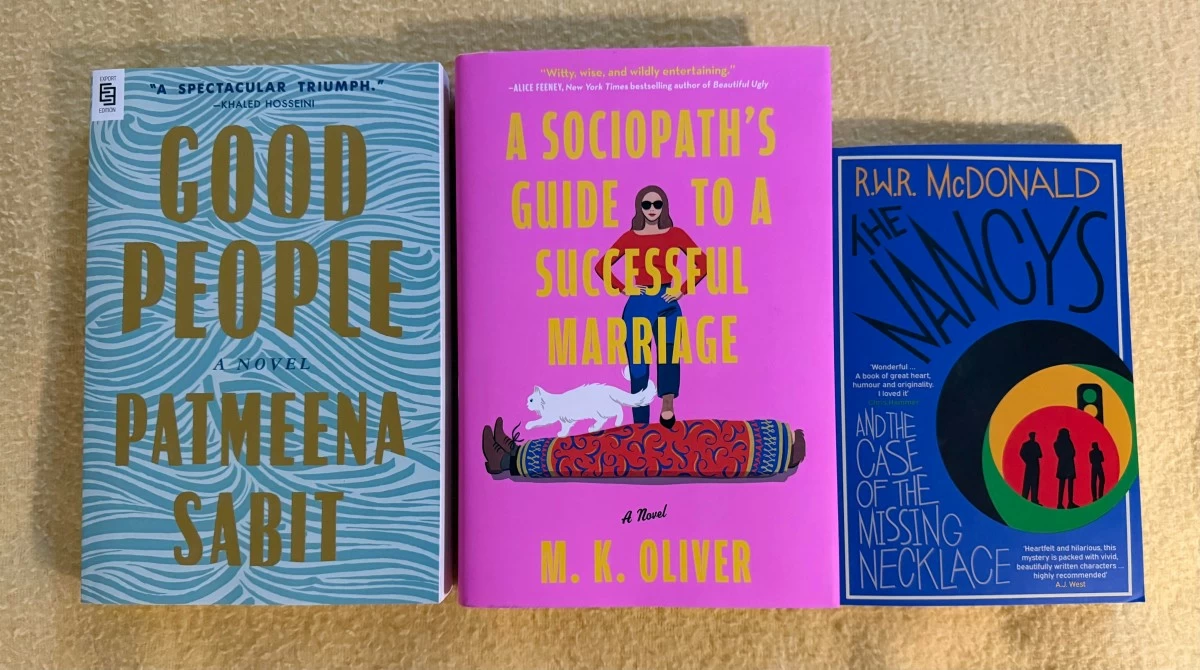
'Good People' by Patmeena Sabit, 'The Sociopath’s Guide to a Successful Marriage' by M. K. Oliver, and The Nancys by R. W. R. McDonald
How family plays a role in our lives is just one theme examined in these three sharp and astute novels. From an immigrant family in the US, to a sociopathic mother in London, and one set in New Zealand, with a young girl whose uncle encourages her to go detecting.
"Good People" by Patmeena Sabit
Our author is from Kabul, Afghanistan, settled with her refugee family in Virginia, and now lives in Toronto. So much of what transpires in this novel comes from the firsthand experience of having lived this immigrant experience herself, and how the immigrant population in any country can act like an insulated community. At the core of the novel is the Sharaf family, who seem to be living the American Dream in Fairfax. After years of struggle, they now live in a gated village and are seen as valuable members of the community - the parents and their four children. It’s when disaster strikes, with the eldest daughter, the teenage Zorah, figuring in a fatal accident, that the true narrative unfolds. Its ingenious structure is that the whole novel is formed by a polyphonic chorus of voices that consists of friends of the Sharaf family, the Virginian natives they would interact with, the investigative team, the school authorities, and so on.
What’s notable in the structure described is how the family itself is not among the narrators. Instead, we have this chorus of unreliable narrators. And I say unreliable, as from one page to the next, we have contrary views of what happened. Was Zorah the loved daughter, or was she a blight and embarrassment to the family for trying to go "American"? Were the family complicit in her death, thinking and acting on the view that she was better off dead than being the living embodiment of disobedience and bringing dishonor to the Sharaf name? Thought-provoking, the novel picks at the truth behind this Sharaf family picture of success in one’s adopted land. The gossip, the back-biting, the deep-rooted resentment, and the whole "I told you so" attitude are just some of the scenarios that we can encounter as public opinion holds sway over the family tragedy.
"The Sociopath’s Guide to a Successful Marriage" by M. K. Oliver
Lalla Rook is hereby nominated as our literary anti-heroine for 2026, and I’d like to see someone try to overtake her. Lalla lives in a posh house in London’s Muswell Hill, is frustrated over her husband not making partner yet at his investment bank, has a daughter who is in danger of not getting into the private school Lalla has dreamt she’ll enter, has the birthday party for her four year old son, and yes, there’s the getting rid of a corpse in her living room. Welcome to the world of Lalla, a model wife and mother who continuously multi-tasks, and disposing of a man she stabbed at least seven times is just one of the tasks for the day that we meet her. Working on the theme that any good mother will kill for her family, and sometimes, do it for fun, we are introduced to a world where the upper class does compete with each other and mask their jealousies, but also band together tightly when faced with an external threat.
A former head teacher from Liverpool, it may surprise some to discover that M. K. Oliver is a man. Part crime story, part comedy, he does a great job of detailing a female sociopath’s way of thinking and acting, and with often hilarious, jaw-dropping results. It isn’t long before the corpse in the Rook living room isn’t the only expired body in this bloody story. One abusive husband ends up fried to a crisp, and a presumed deceased first husband even shows up, as this tale stretches our imagination in a way that delights and will have you dropping the book with laughter. Simply put, Lalla is a wonderful creation, able to think and do things we can only imagine in our most evil moments. With Lalla, it’s not only second nature, but if her first nature, to act in this manner. There’s so much to savor, and it is a page-turner in its own right, as you’ll be dying to know what happens next, and how Lalla gets out of the scraps she finds herself in.
"The Nancys" by R. W. R. McDonald
A recent winner of the Ngaio Marsh Award for Best First Novel, The Nancys has Tippy Chan, 11 years old, at the center of the entertaining detective and family story. Tippy lives in a small town in rural New Zealand, and when her widowed mother takes a well-deserved break on a holiday cruise, it is left to Uncle Pike and his boyfriend Devon to return to the town and play babysitter/guardian to Tippy. All three love the Nancy Drew books, and it's their dream to one day take on that role of detective - and that’s why they informally call themselves the Nancy’s. So when Tippy’s teacher is found by the only traffic light of the town, with her head separated from her body, the Nancys are spurred to action and take it upon themselves to discover who the murderer is, and what the motive was. And they have to achieve all this before Tippy’s Mom returns from her holiday.
There’s charming, at times daft, dialogue. There’s humor in the face of danger, and the sparkling repartee between Tippy, Uncle Pike, and Devon will always win the day. Sam and Todd are Tippy’s best friends from school, and when Todd is involved in a freak bridge accident and is now in a coma, it's Tippy who discerns there may be a connection to the murder of their home school teacher. Melanie is a tough-as-nails neighbor, a tomboy, and something of a scary proposition to Tippy, but when Pike and Devon take Melanie on as their project for the local beauty contest, something hilarious is sparked, and you’ll look forward to the pages when Melanie appears. It's a Nancy Drew homage mixed with social comedy, and the real magic is performed as McDonald draws out the characters in this little mystery yarn. There’s much to like in the quaint novel, and how the local color is so brilliantly sketched. A Crime fiction work, but with so much heart.