ADVERTISEMENT

Filipinos express strong confidence in Japan, survey shows

Published Mar 31, 2026 03:59 pm

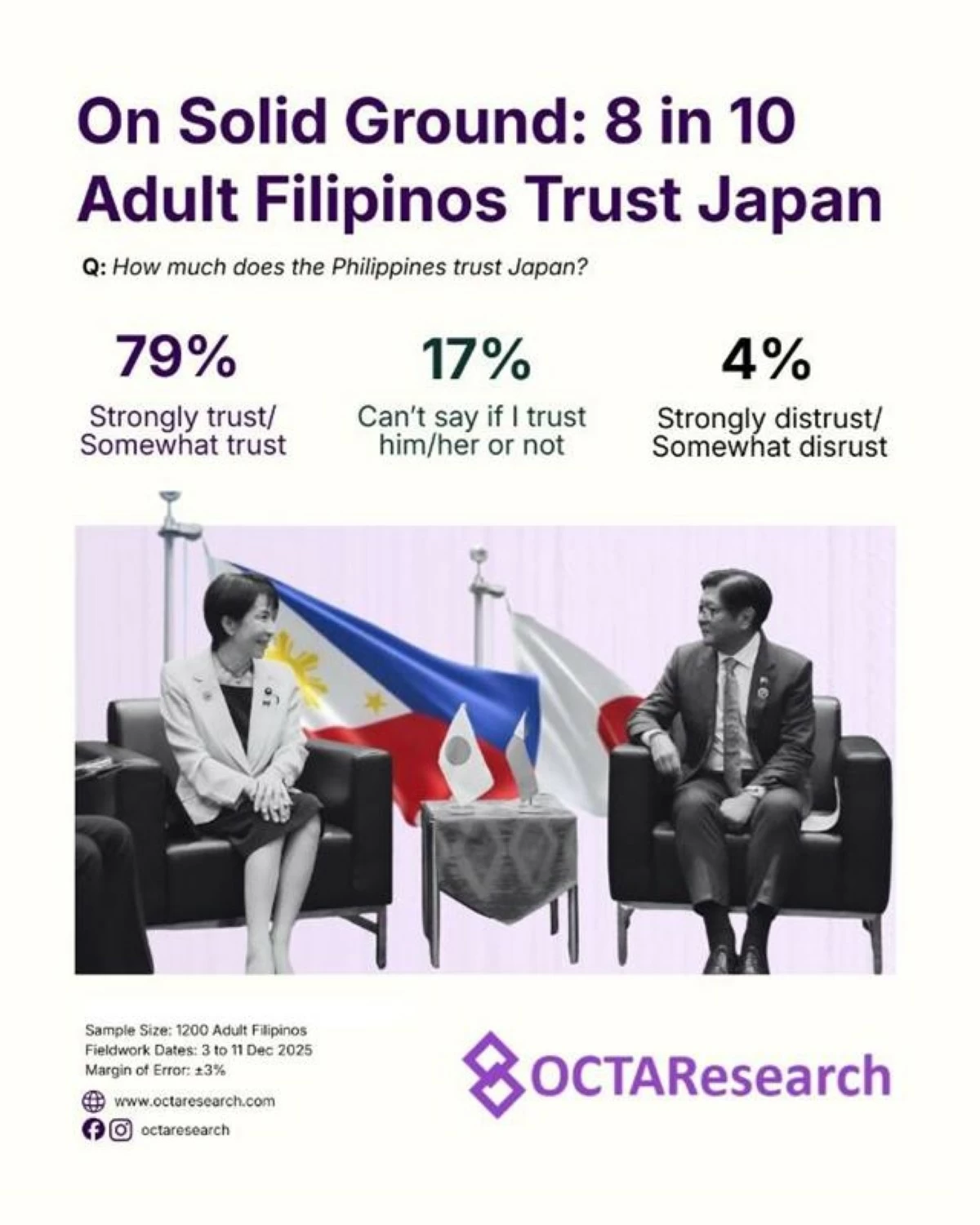
Filipinos continue to view Japan favorably, with a nationwide survey showing high levels of public trust that reflect the long-standing partnership between the two countries, according to results released in March 2026.

The findings come from the fourth quarter 2025 Tugon ng Masa survey conducted by OCTA Research, which measured public sentiment on Japan-Philippines relations. The study gathered opinions from 1,200 Filipino adults through face-to-face interviews conducted nationwide from December 3 to 11, 2025.

Researchers said the results point to sustained positive attitudes toward Japan across different regions and social groups, suggesting that public confidence in the relationship remains steady after decades of cooperation.

His Excellency President Ferdinand “Bongbong” Marcos, Jr. underscored Japan’s role as a strategic partner in advancing trade, investments, and quality infrastructure collaboration as he met with Japanese and Filipino business leaders in Malacañan on Wednesday, Feb. 18, 2026. (PCO photo)

Trust in Japan remains high

One of the key results of the survey is the strong level of trust Filipinos place in Japan as a country. Nearly eight in ten respondents said they trust Japan, while only a small portion expressed distrust. A number of respondents said they were undecided, indicating that while opinions remain largely positive, some views continue to evolve.

“The survey results indicate that Japan continues to rank among the Philippines’ most trusted international partners, with positive perceptions consistently observed across Metro Manila, Luzon, the Visayas, and Mindanao,” the OCTA Research report stated, noting that favorable views toward Japan are broadly shared nationwide.

Across economic groups, confidence in Japan remained strong. Respondents from higher income households reported particularly high trust levels, but positive views were also evident among middle- and lower- income groups, indicating broad acceptance across Philippine society.

The Embassy of Japan recently celebrated Senate Majority Leader Juan Miguel “Migz” Zubiri for receiving the Grand Cordon of the Order of the Rising Sun—Japan's highest honor for foreign nationals—in recognition of his pivotal role in strengthening the bilateral partnership between Manila and Tokyo was personally conferred on him by Emperor Naruhito at the Imperial Palace in Tokyo in November 2025. (Photo from the Office of Senate Majority Leader Juan Miguel
The Embassy of Japan recently celebrated Senate Majority Leader Juan Miguel “Migz” Zubiri for receiving the Grand Cordon of the Order of the Rising Sun—Japan's highest honor for foreign nationals—in recognition of his pivotal role in strengthening the bilateral partnership between Manila and Tokyo was personally conferred on him by Emperor Naruhito at the Imperial Palace in Tokyo in November 2025. (Photo from the Office of Senate Majority Leader Juan Miguel "Migz" Zubiri)

Positive perception of Japanese people

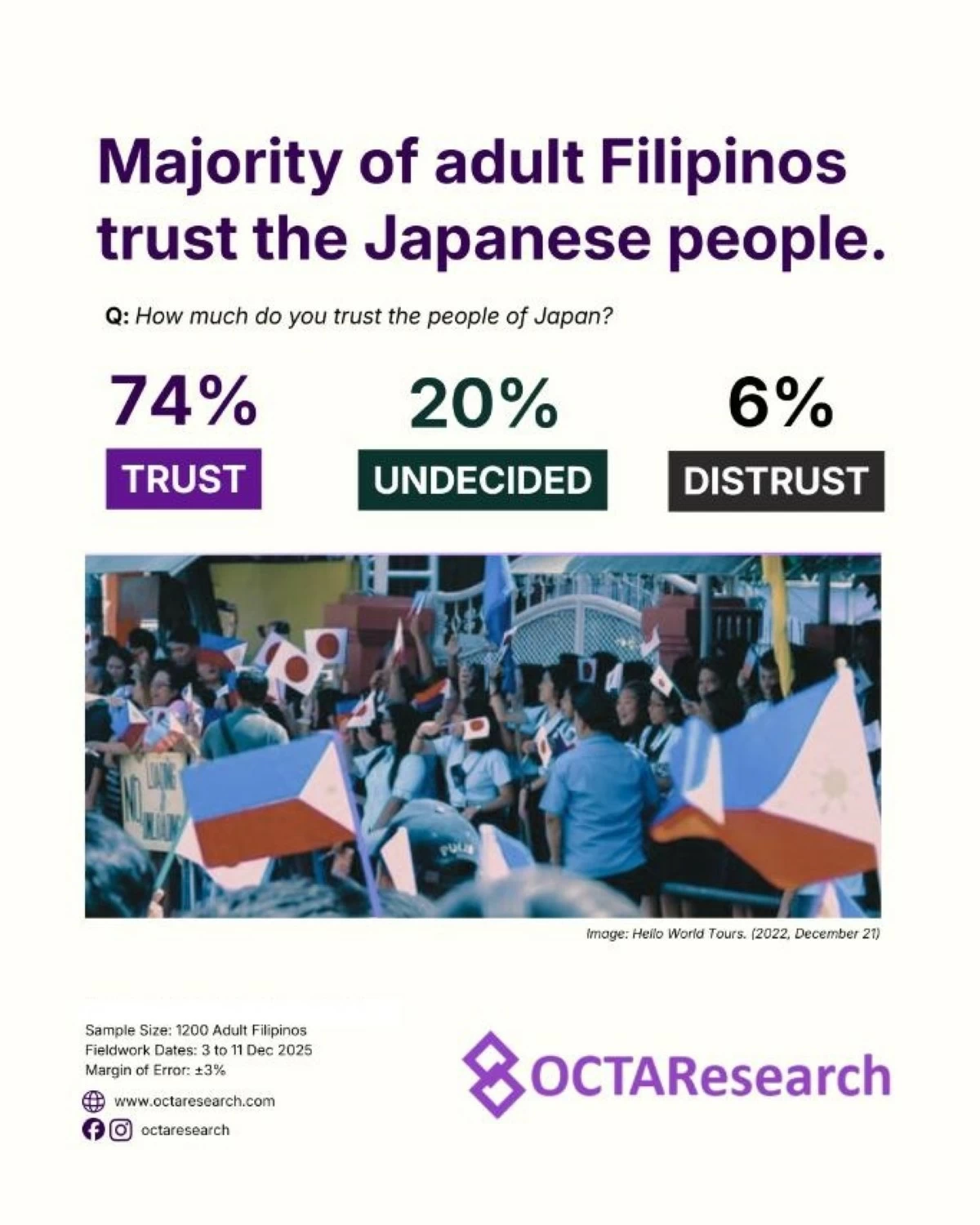
The survey also explored how Filipinos view Japanese citizens. Results showed that nearly three quarters of respondents expressed trust toward the Japanese people. “Favorable perceptions of Japan extend beyond government relations and are reinforced by people-to-people interactions, including cultural exchanges, tourism, educational cooperation, and the growing Filipino community in Japan,” the report said.

Income level differences were also limited, with most socioeconomic groups sharing similar positive views. Analysts said this suggests that impressions of Japanese citizens are widely shared regardless of economic background.
Bilateral relations viewed positively

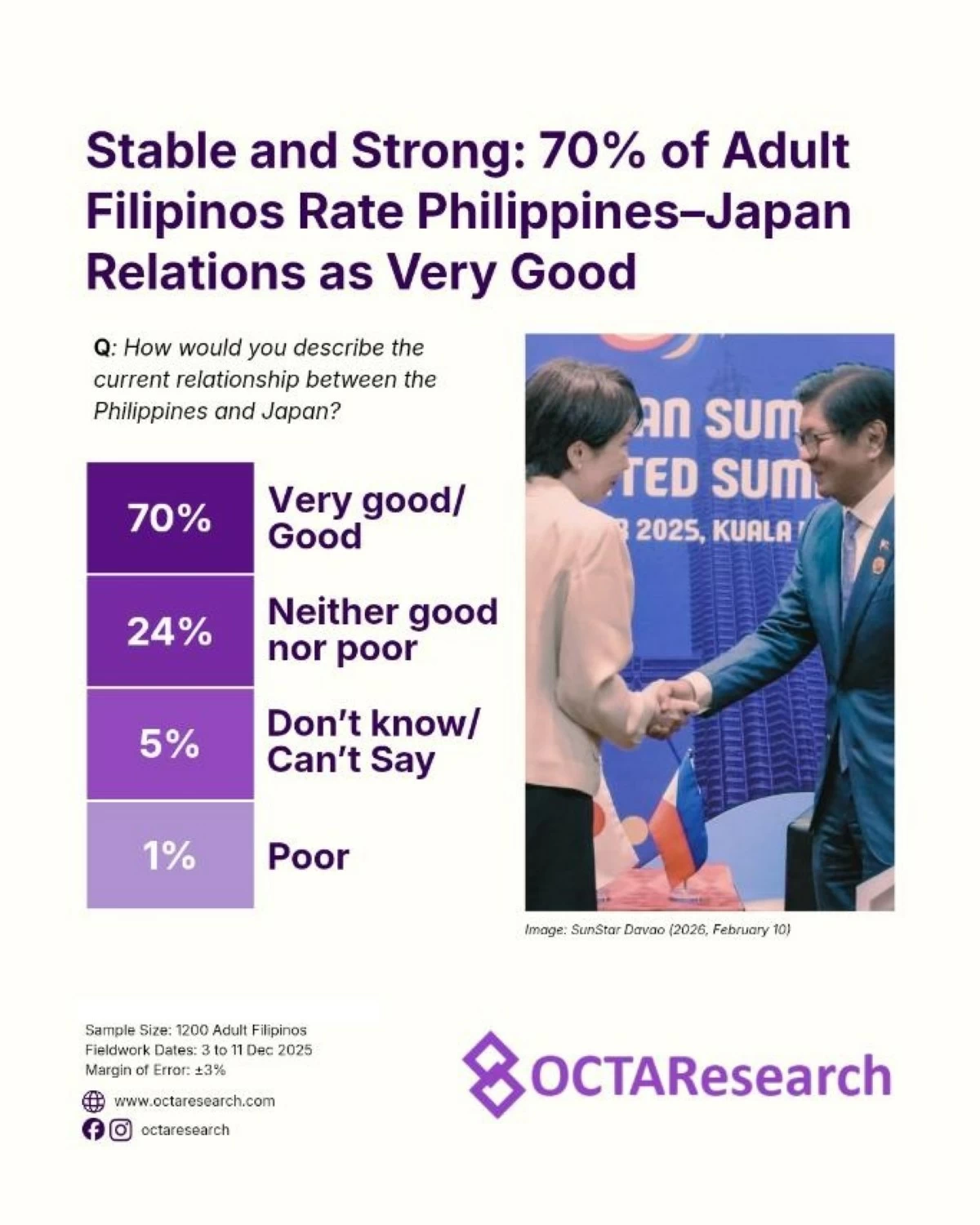
Public assessment of overall Japan-Philippines relations also received strong approval. Around seven in ten Filipinos described the relationship between the two nations as very good, indicating widespread confidence in ongoing cooperation.

“The positive public assessment of Japan-Philippines relations may be linked to Japan’s longstanding role as a development partner through infrastructure support, trade and investment cooperation, technology transfer, and official development assistance,” the report noted.

Beyond economic cooperation, collaboration in disaster response, maritime safety, and education has also strengthened ties. Cultural programs and tourism exchanges have further increased interaction between the two societies, helping build familiarity over time.

Researchers said these combined efforts have helped shape a relationship supported not only by policy agreements but also by public sentiment.
A relationship shaped by history

The survey findings were framed within the broader history of Japan-Philippines relations, which span more than 70 years. Over time, cooperation between the two countries has expanded from postwar rebuilding efforts to include trade, development assistance, education, and regional security cooperation.

Researchers said this long period of engagement has helped establish familiarity and trust between the two nations. Shared democratic values, mutual respect, and continued collaboration in regional initiatives were identified as factors strengthening the partnership.
Public sentiment supports future cooperation

Observers say strong public approval can play an important role in sustaining international partnerships. Positive sentiment toward Japan suggests that ongoing cooperation in areas such as infrastructure, trade, technology, and cultural exchange is supported by a broad base of Filipino public opinion.

As regional dynamics continue to shift, the survey indicates that many Filipinos see Japan as both a reliable partner and a trusted friend. The findings highlight how diplomacy, economic cooperation, and people to people connections have combined to build lasting confidence between the two nations.

Overall, the results present a picture of a partnership strengthened not only by official agreements but also by shared experiences and public trust developed through decades of interaction.

ADVERTISEMENT
.most-popular .layout-ratio{ padding-bottom: 79.13%; } @media (min-width: 768px) and (max-width: 1024px) { .widget-title { font-size: 15px !important; } }

{{ articles_filter_1561_widget.title }}

.most-popular .layout-ratio{ padding-bottom: 79.13%; } @media (min-width: 768px) and (max-width: 1024px) { .widget-title { font-size: 15px !important; } }

{{ articles_filter_1562_widget.title }}

.most-popular .layout-ratio{ padding-bottom: 79.13%; } @media (min-width: 768px) and (max-width: 1024px) { .widget-title { font-size: 15px !important; } }

{{ articles_filter_1563_widget.title }}

{{ articles_filter_1564_widget.title }}

.mb-article-details { position: relative; } .mb-article-details .article-body-preview, .mb-article-details .article-body-summary{ font-size: 17px; line-height: 30px; font-family: "Libre Caslon Text", serif; color: #000; } .mb-article-details .article-body-preview iframe , .mb-article-details .article-body-summary iframe{ width: 100%; margin: auto; } .read-more-background { background: linear-gradient(180deg, color(display-p3 1.000 1.000 1.000 / 0) 13.75%, color(display-p3 1.000 1.000 1.000 / 0.8) 30.79%, color(display-p3 1.000 1.000 1.000) 72.5%); position: absolute; height: 200px; width: 100%; bottom: 0; display: flex; justify-content: center; align-items: center; padding: 0; } .read-more-background a{ color: #000; } .read-more-btn { padding: 17px 45px; font-family: Inter; font-weight: 700; font-size: 18px; line-height: 16px; text-align: center; vertical-align: middle; border: 1px solid black; background-color: white; } .hidden { display: none; }
function initializeAllSwipers() { // Get all hidden inputs with cms_article_id document.querySelectorAll('[id^="cms_article_id_"]').forEach(function (input) { const cmsArticleId = input.value; const articleSelector = '#article-' + cmsArticleId + ' .body_images'; const swiperElement = document.querySelector(articleSelector); if (swiperElement && !swiperElement.classList.contains('swiper-initialized')) { new Swiper(articleSelector, { loop: true, pagination: false, navigation: { nextEl: '#article-' + cmsArticleId + ' .swiper-button-next', prevEl: '#article-' + cmsArticleId + ' .swiper-button-prev', }, }); } }); } setTimeout(initializeAllSwipers, 3000); const intersectionObserver = new IntersectionObserver( (entries) => { entries.forEach((entry) => { if (entry.isIntersecting) { const newUrl = entry.target.getAttribute("data-url"); if (newUrl) { history.pushState(null, null, newUrl); let article = entry.target; // Extract metadata const author = article.querySelector('.author-section').textContent.replace('By', '').trim(); const section = article.querySelector('.section-info ').textContent.replace(' ', ' '); const title = article.querySelector('.article-title h1').textContent; // Parse URL for Chartbeat path format const parsedUrl = new URL(newUrl, window.location.origin); const cleanUrl = parsedUrl.host + parsedUrl.pathname; // Update Chartbeat configuration if (typeof window._sf_async_config !== 'undefined') { window._sf_async_config.path = cleanUrl; window._sf_async_config.sections = section; window._sf_async_config.authors = author; } // Track virtual page view with Chartbeat if (typeof pSUPERFLY !== 'undefined' && typeof pSUPERFLY.virtualPage === 'function') { try { pSUPERFLY.virtualPage({ path: cleanUrl, title: title, sections: section, authors: author }); } catch (error) { console.error('ping error', error); } } // Optional: Update document title if (title && title !== document.title) { document.title = title; } } } }); }, { threshold: 0.1 } ); function showArticleBody(button) { const article = button.closest("article"); const summary = article.querySelector(".article-body-summary"); const body = article.querySelector(".article-body-preview"); const readMoreSection = article.querySelector(".read-more-background"); // Hide summary and read-more section summary.style.display = "none"; readMoreSection.style.display = "none"; // Show the full article body body.classList.remove("hidden"); } document.addEventListener("DOMContentLoaded", () => { let loadCount = 0; // Track how many times articles are loaded const offset = [1, 2, 3, 4, 5, 6, 7, 8, 9, 10]; // Offset values const currentUrl = window.location.pathname.substring(1); let isLoading = false; // Prevent multiple calls if (!currentUrl) { console.log("Current URL is invalid."); return; } const sentinel = document.getElementById("load-more-sentinel"); if (!sentinel) { console.log("Sentinel element not found."); return; } function isSentinelVisible() { const rect = sentinel.getBoundingClientRect(); return ( rect.top < window.innerHeight && rect.bottom >= 0 ); } function onScroll() { if (isLoading) return; if (isSentinelVisible()) { if (loadCount >= offset.length) { console.log("Maximum load attempts reached."); window.removeEventListener("scroll", onScroll); return; } isLoading = true; const currentOffset = offset[loadCount]; window.loadMoreItems().then(() => { let article = document.querySelector('#widget_1690 > div:nth-last-of-type(2) article'); intersectionObserver.observe(article) loadCount++; }).catch(error => { console.error("Error loading more items:", error); }).finally(() => { isLoading = false; }); } } window.addEventListener("scroll", onScroll); });

Sign up by email to receive news.