







Minor explosions at Mayon send ash 400 meters high — Phivolcs
Published Mar 28, 2026 09:54 am


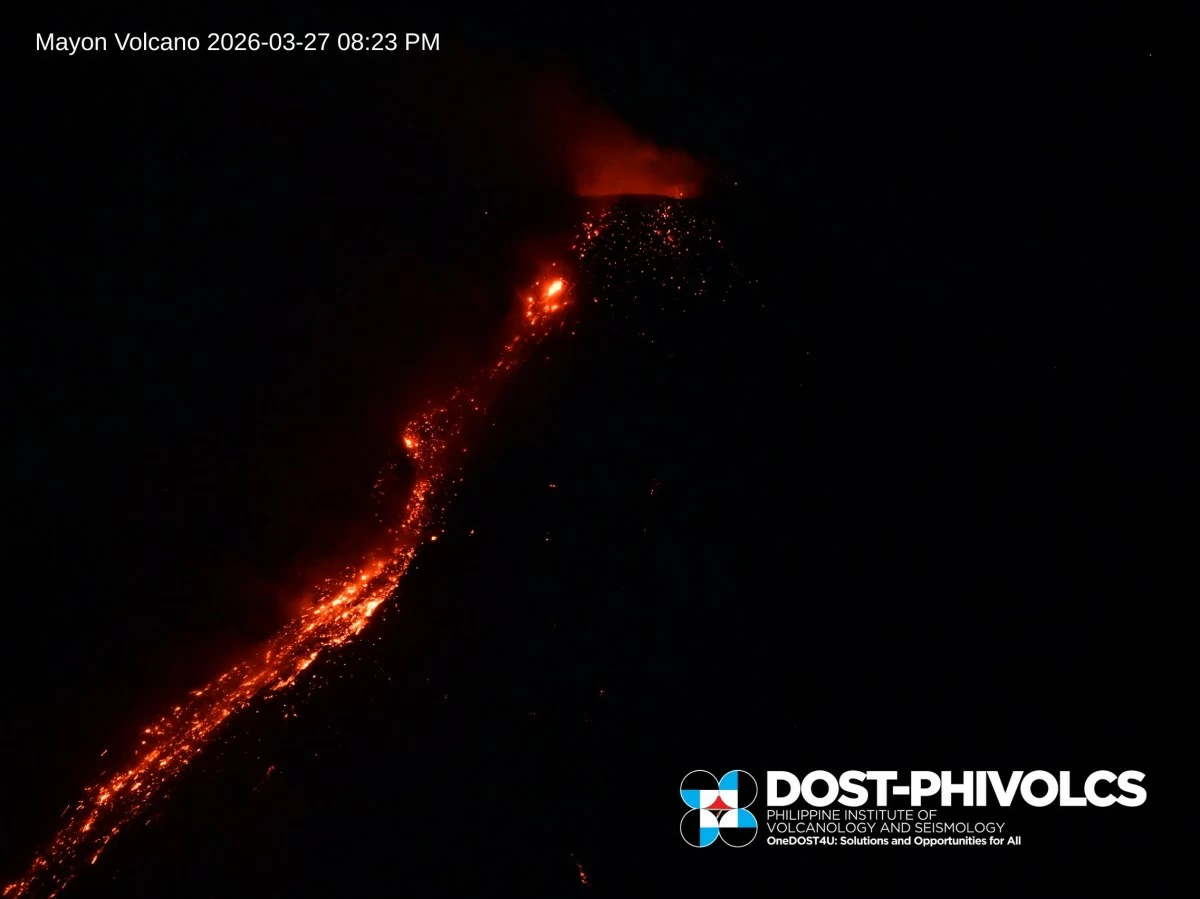
Mayon Volcano emits ash and lava during minor strombolian activity as recorded by the Philippine Institute of Volcanology and Seismology (Phivolcs) on March 27, 2026. The ash plume rose about 400 meters above the crater amid ongoing effusive eruption. (Phivolcs photo)
Mayon Volcano continued its effusive (non-explosive) eruption for the 82nd consecutive day, with minor explosive activity recorded on the evening of March 27, the Philippine Institute of Volcanology and Seismology (Phivolcs) said.
Phivolcs observed minor strombolian activity at 8:23 p.m. and 8:40 p.m., generating ash clouds that rose about 400 meters above the crater before drifting west-southwest.
The ongoing eruption continues to produce incandescent lava flows, pyroclastic density currents (PDCs) or “uson,” and rockfalls, it added.
In its 24-hour monitoring period from 12 a.m. on March 27 to 12 a.m. on March 28, lava flows remained confined to 3.8 kilometers in Basud Gully, 3.2 kilometers in Bonga Gully, and 1.3 kilometers in Mi-isi Gully.
Episodic minor strombolian activity and short-lived lava fountaining were also recorded. Strombolian activity is a type of eruption that involves small but explosive bursts of lava that shoot upward, often producing short-lived glowing lava fountains.
Phivolcs’ seismic monitoring logged 111 volcanic earthquakes, including nine volcanic tremors lasting between three and 71 minutes.
It also recorded 280 rockfall events and two PDC signals.
A fair crater glow remained visible to the naked eye, indicating continued magma activity at the summit.
Sulfur dioxide emissions averaged 2,205 tons on March 27.
Phivolcs reiterated that Alert Level 3 remains in effect over Mayon Volcano, indicating a high level of unrest.
The agency reminded the public that entry into the six-kilometer permanent danger zone is strictly prohibited due to the risk of sudden explosions, lava flows, rockfalls, and PDCs.