






 Business
Trade & Industry
Philippine trade growth picks up pace in February ahead of Middle East risks
Business
Trade & Industry
Philippine trade growth picks up pace in February ahead of Middle East risks
Philippine trade growth picks up pace in February ahead of Middle East risks


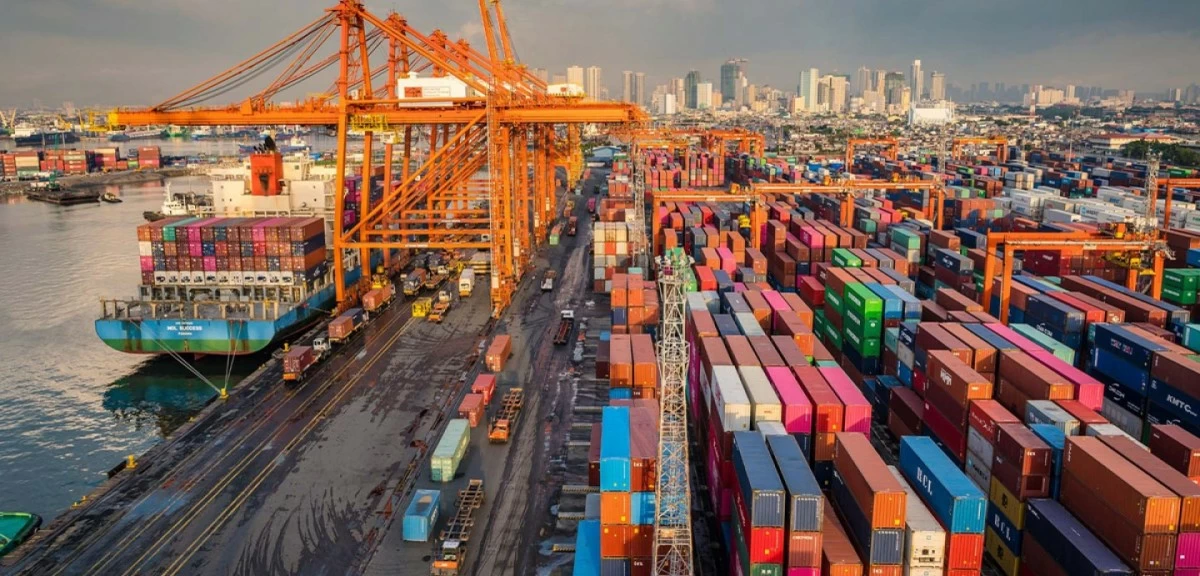
The Philippines’ goods trade with the rest of the world grew faster in February, ahead of the conflict in the Middle East posing a threat to the country’s exports.
The latest preliminary Philippine Statistics Authority (PSA) data on Friday, March 27, showed that total external trade rose 10.7 percent year-on-year to $18.34 billion last February, a quicker growth than a month ago and a year ago.
In terms of freight-on-board (FOB) value, two-way trade last month was lower than January’s $18.56 billion but higher than February 2025’s $16.57 billion.
Total trade as of end-February increased to $36.9 billion from $34.67 billion a year ago.
Merchandise exports grew eight percent year-on-year to $7.33 billion in February, with FOB values exceeding a year ago and a month ago levels, although the growth rate was slower.
End-February exports increased to $14.47 billion from $13.36 billion last year.
In February alone, exports to the United States (US), the Philippines’ top export market, soared 42.9 percent year-on-year to $1.41 billion, bringing two-month sales to America to $2.58 billion, up 21.7 percent year-on-year despite higher US tariffs slapped on imported Philippine goods.
The share of exports to the US also improved to 19.3 percent of total last February and 17.8 percent during the first two months.
Imports, meanwhile, jumped 12.6 percent year-on-year to over $11 billion in February, reversing the one-percent contraction last January and surpassing February 2025’s 2.1-percent growth.
Two-month imports climbed to $22.43 billion from $21.31 billion a year ago.
China remained the Philippines’ top source of imported products, with $3.12 billion worth last February, up 24 percent year-on-year, bringing end-February imports from China to $6.46 billion, up 10.7 percent.
The share of Philippine imports from China also improved to above 28 percent of total for both the month and year-to-date.
As import value and growth exceeded those of exports, the trade deficit widened by 23.1 percent year-on-year to $3.68 billion last month, reversing the contraction a year ago and a month ago, although the deficit at the start of the year was higher at $4.27 billion.
The year-to-date trade-in-goods deficit inched up to $7.96 billion from $7.95 billion last year.
Despite these foreign trade gains through February, Manila Bulletin reported earlier that exporters are bracing for the impact of soaring jet fuel prices, especially on electronics—the country’s top export commodity, which is mostly transported by air to overseas markets.
PSA data showed that Philippine exports of electronic products grew 20.5 percent year-on-year to $4.23 billion in February, accounting for 57.7 percent of total export sales for the month. End-February electronics exports rose by a fifth to $8.24 billion.
In particular, Semiconductor and Electronics Industries in the Philippines Foundation Inc. (SEIPI) president Danilo Lachica told Manila Bulletin that escalating conflict in the Middle East could disrupt cargo flights, threatening semiconductor exports that rely on just-in-time (JIT) delivery.
Export industry leaders warn that grounded planes could break global supply chains, halt overseas production, and lead to significant revenue losses.
Department of Trade and Industry-Export Marketing Bureau (DTI-EMB) Director Bianca Pearl R. Sykimte told Manila Bulletin that the government was still validating with exporters and logistics companies the potential impact of the prospect of grounded planes, flagged by no less than President Ferdinand R. Marcos Jr. in a Bloomberg interview this week.
“Offhand, roughly half (based on value) of our merchandise exports are shipped through air. These are largely high-value electronic products,” Sykimte said.