






Manila Bulletin
 Philippines
National
PH seals visiting forces deal with France; here's why it matters
Philippines
National
PH seals visiting forces deal with France; here's why it matters
Philippines
National
PH seals visiting forces deal with France; here's why it matters
PH seals visiting forces deal with France; here's why it matters
Published Mar 27, 2026 11:37 am


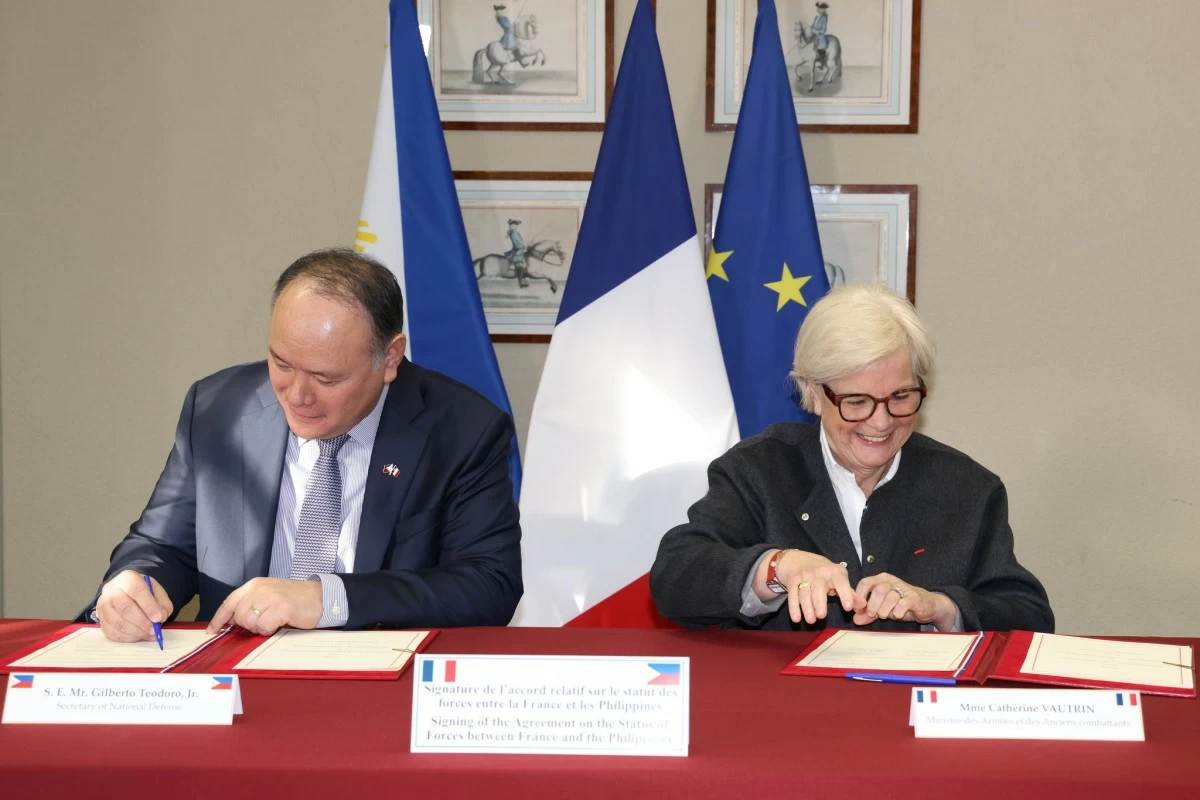
Department of National Defense (DND) Secretary Gilberto Teodoro Jr. (left) and French Minister for the Armed Forces and Veterans Catherine Vautrin sign the Status of Visiting Forces Agreement between the Philippines and France on March 26, 2026 at the École Militaire in Paris. The pact provides a legal framework for large-scale military cooperation and joint exercises between the two countries. (Photo: DND)
The Philippines and France have officially signed a Status of Visiting Forces Agreement (SOVFA), a landmark pact that provides a legal framework for large-scale military cooperation and joint exercises between the two countries.
Department of National Defense (DND) Secretary Gilberto Teodoro Jr. met French Minister for the Armed Forces and Veterans Catherine Vautrin on Thursday, March 26, at the École Militaire in Paris, where both sides finalized negotiations for a Philippines-France SOVFA.
“We signed the Status of Visiting Forces Agreement between the Philippines and France, only one year after His Excellency, President Ferdinand R. Marcos Jr., authorized us to begin negotiations,” Teodoro said.
“We were able to reach this stage in record time because of the fact that our two countries have had years of trust and confidence in working and dealing with one another. We have shared values, shared objectives, and shared visions for both our future and current generations,” he added.
The agreement, which mirrors similar deals that Manila holds with the United States, Australia, Japan, New Zealand, and Canada, is the country’s first such pact with a European state. It allows foreign troops to train and operate temporarily on Philippine soil under defined legal rules, and vice versa.
“The agreement will greatly bolster bilateral cooperation and offer an adequate level of legal protection to the joint activities between the Armed Forces of the Philippines and the French Armed Forces,” DND spokesperson Asst. Sec. Arsenio Andolong said.
A SOVFA sets the legal status of visiting troops, defining jurisdiction over crimes, entry and exit procedures, taxes, and movement of personnel and equipment.
For the Armed Forces of the Philippines (AFP), the agreement removes uncertainty when training or operating with the French Armed Forces, and activities can proceed faster and with fewer diplomatic hurdles, the DND explained.
Further, with a SOVFA, the AFP and French Armed Forces can scale up their exercises including naval drills, disaster response, and maritime security operations.
With the agreement, the AFP also gains exposure to French and NATO-standard systems, doctrine, and tactics that could improve their interoperability with the French military, which means Filipino troops can operate more smoothly with allies in real-world missions.
The deal capped months of engagement anchored on a December 2023 letter of intent to strengthen bilateral defense relations as Manila pushes to expand partnerships amid evolving security challenges across multiple regions.
During their bilateral meeting, Teodoro and Vautrin discussed regional security concerns spanning the Indo-Pacific, the Middle East, South-West Asia, and Europe. They stressed the need for multilateralism and a rules-based international order, and also called for peaceful dispute resolution and stronger supply chains during crises.
The meeting also highlighted shared positions on maritime law as both countries reaffirmed adherence to the 1982 United Nations Convention on the Law of the Sea (UNCLOS) and the 2016 arbitral ruling on the South China Sea, a decision that invalidated sweeping claims by China but continues to face resistance in the region.
France’s growing engagement with Southeast Asia also figured in the talks as Manila welcomed Paris’ rapprochement with the Association of Southeast Asian Nations (ASEAN) and its participation in the ASEAN Defence Ministers’ Meeting-Plus, particularly in working groups on humanitarian assistance, disaster response, and maritime security.
Defense ties between Manila and Paris have expanded in recent years through dialogues, military exchanges, port visits, and joint training activities. The DND said these efforts reflect Manila’s broader push to diversify its security partnerships beyond its traditional allies.
"This is a function of stewardship in several things, in enhancing both our individual and collective defense capabilities; and secondly, also equally important, is to protecting the international order under the regime of international law to include fundamental peremptory treaty in the world in 1982 UN Convention on the Law of the Sea," Teodoro shared.
"And lastly, it is a recognition of the contributions of our people to each other's countries and a commitment that we will work together to safeguard their safety and well-being wherever they may be, whether in France or in the Philippines, or wherever where we can both help each other," he added.
NATO ties
Prior to this, Teodoro called for “cross-regional convergence in the defense and military domains” during his meeting with Admiral Giuseppe Cavo Dragone, chair of the Military Committee of the North Atlantic Treaty Organization (NATO), on the sidelines of the 2026 Paris Defence and Strategy Forum.
The two officials built on earlier discussions at the 2025 Seoul Defense Dialogue, where they tackled geopolitical competition and strategic stability.
Teodoro said the Philippines is laying the groundwork for stronger interoperability and exchanges with European Union and NATO countries, which is tied to Manila’s goal of improving resilience and protecting Filipinos overseas.
NATO, for its part, signaled openness to deeper engagement as Dragone “affirmed NATO’s willingness to pursue cooperation with the Philippines.”
Both sides also recognized the importance of sharing information and best practices as security challenges become more interconnected, the DND said.