







Local equities erase gains on Iran-US diplomatic deadlock
Published Mar 26, 2026 06:03 pm


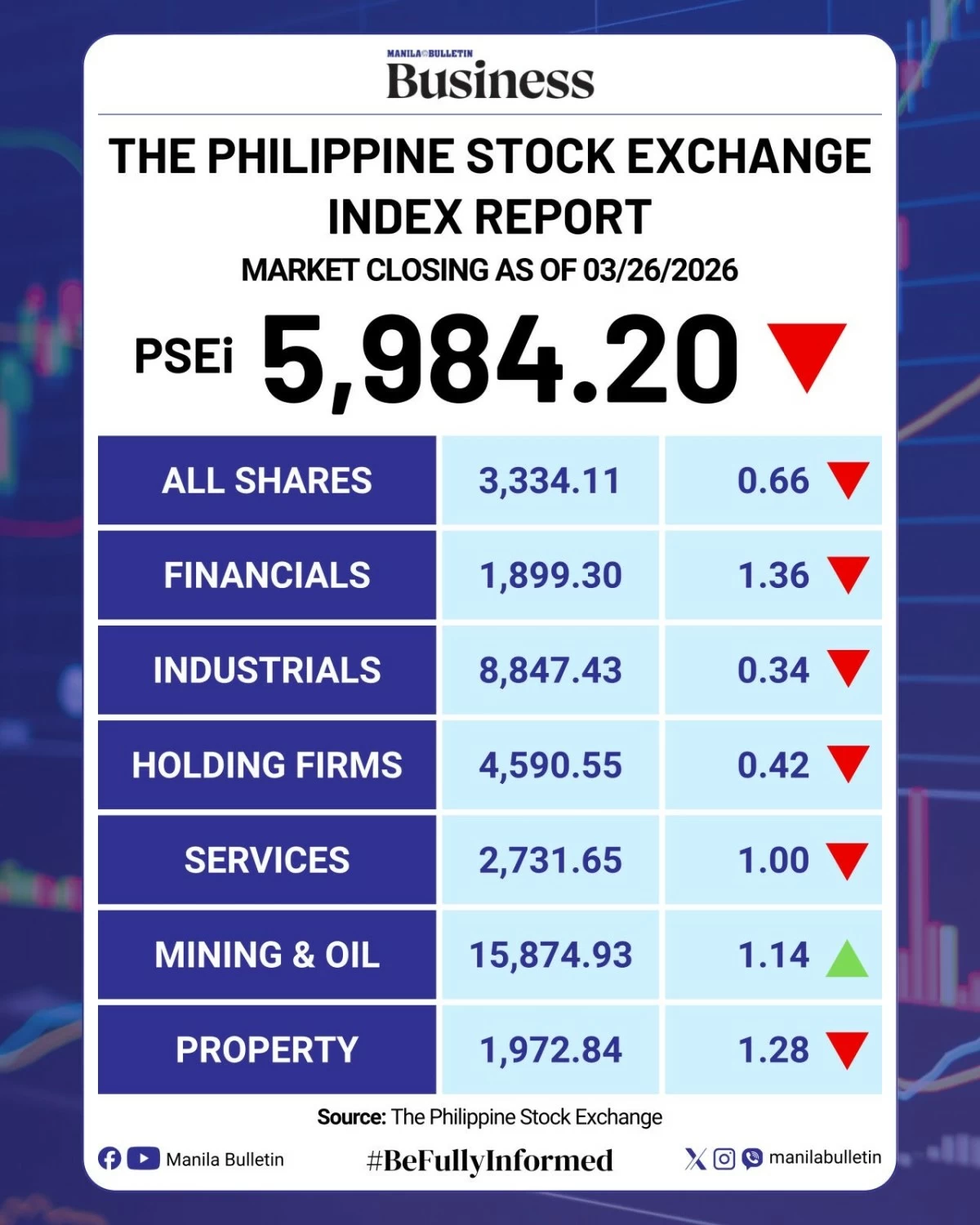
Benchmark stock index retreated on Thursday, March 26, slipping back below the 6,000 level as investors locked in gains from a two-day rally amid heightening geopolitical friction in the Middle East and domestic inflation concerns.
The Philippine Stock Exchange index (PSEi) fell 59.97 points, or 0.99 percent, to close at 5,984.20. While the broader market saw declines led by the banking sector, the mining index managed to buck the downward trend.
Trading remained active with 1.65 billion shares changing hands, valued at ₱7.88 billion. Market breadth was negative, with 100 decliners overtaking 78 gainers, while 78 issues remained unchanged.
Market participants turned cautious after Iran signaled it had no intention of engaging in diplomatic talks with the US, a development that dimmed hopes for a swift de-escalation of conflict in the Middle East.
The resulting uncertainty prompted a wave of profit-taking among local traders who opted to flatten their positions rather than hold through potential volatility.
“The Philippine market declined after ending in the green in the previous session, as investors engaged in profit-taking and likely maintained short-term positions amid persistent uncertainty in the Middle East,” said Luis Limlingan, managing director at Regina Capital Development Corp.
Domestic headwinds also pressured equities after the Bangko Sentral ng Pilipinas (BSP) signaled a hawkish stance to combat stubborn price pressures. Following an off-cycle meeting where the central bank maintained its key policy rate, analysts warned that inflation could remain elevated, potentially breaching the government’s target ceiling of four percent.
The pullback followed a brief period of optimism where the index had attempted to stabilize. Japhet Tantiangco, research manager at Philstocks Financial Inc., noted that the rally was short-lived as the lack of a diplomatic resolution between Washington and Tehran soured the global appetite for risk assets.
Investor focus remains centered on the central bank's next move and the trajectory of global oil prices, which have fluctuated in response to the Middle East crisis. High interest rates and the threat of sustained inflation continue to cloud the outlook for corporate earnings, particularly for rate-sensitive sectors like property and banking.