

ADVERTISEMENT

The sweet revival of a flooded land into a muscovado community in Antique

Published Mar 25, 2026 04:59 pm
In Antique—known as the country’s muscovado capital—Hamungaya Farms quietly produces the traditional sugar on its 40-hectare property. But when 69-year-old Felipe Pachoco and his wife, Joyce, took over the land in 2003, it was far from ideal.
Decades earlier, shifting river courses in the 1970s had flooded much of the farm, leaving nearly half of it submerged in water.
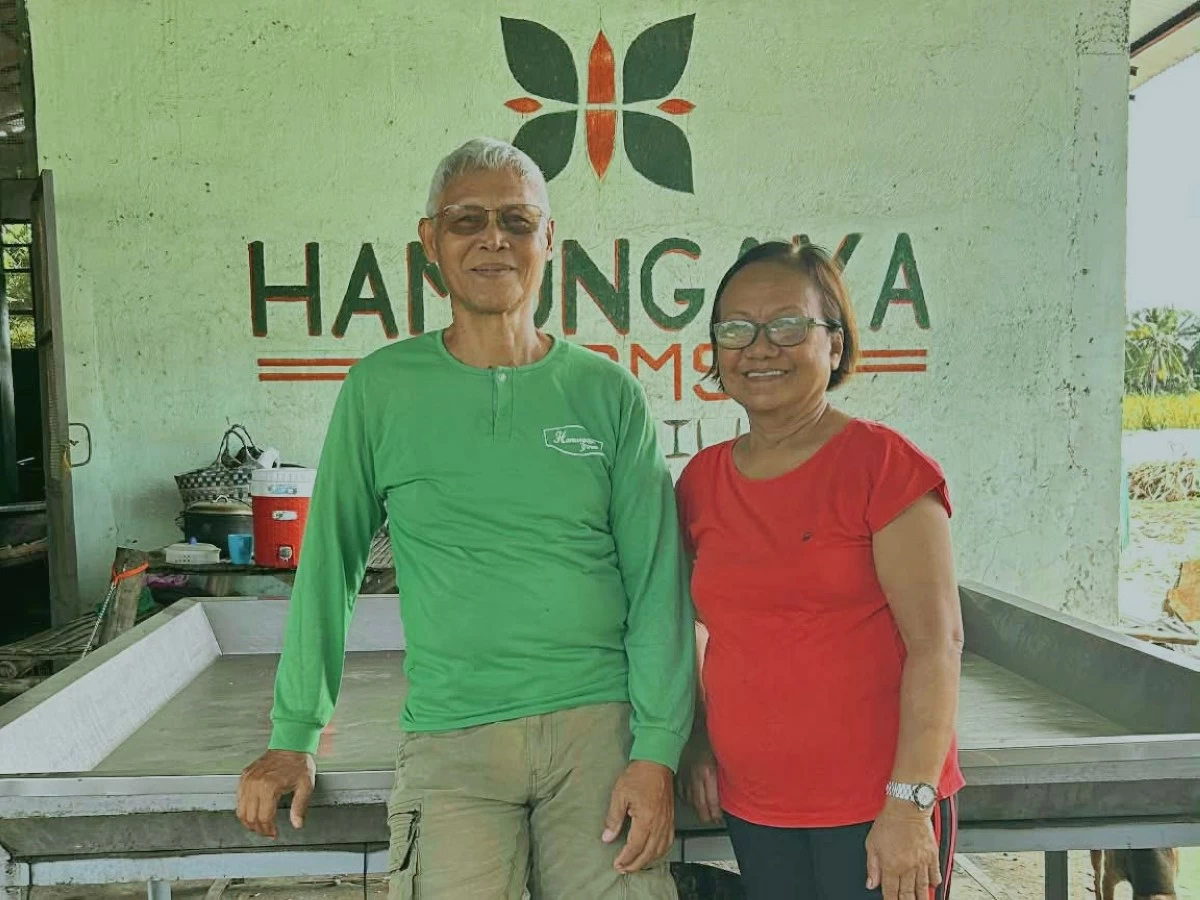
Felipe Pachoco poses with his wife, Joyce, the couple who founded Hamungaya Farms.
“From the southern side, it slowly moved to the north and hit our farm. Then in the late ’80s, the course of the river slowly returned to the south, and the area gradually accrued topsoil deposits,” Felipe recalled.
Rather than settling for conventional crop farming, Felipe, together with his wife, envisioned something more enduring: a muscovado mill that could not only maximize their land but also revive economic activity within the community.
The rise of a sugarcane farming community
Although the Pachoco family owns only around six of the 40 hectares of sugarcane-supplying Hamungaya Farms, Felipe shared that they encouraged neighboring farmers to cultivate sugarcane on lands that had long been used only as pasture.
With nearly three decades of experience at the Department of Science and Technology and a lifelong background in farming, Felipe was no stranger to sugarcane production and agricultural technology.
He explained that muscovado production involves three key stakeholders: the landowner, the tenant, and the mill. Typically, the landowner plants the sugarcane, while tenants, when present, handle harvesting. Both are responsible for transporting the cane to the mill.
A fair relationship with farmers
What sets Hamungaya Farms apart is its compensation system for partner farmers—one Felipe describes as a revival of the bayanihan spirit.
“We call them the tresyador, meaning one-third. In our operation, we don’t use cash. Everything is paid in kind,” he explained. “They only get their share after processing, which takes two to three days from harvesting.”
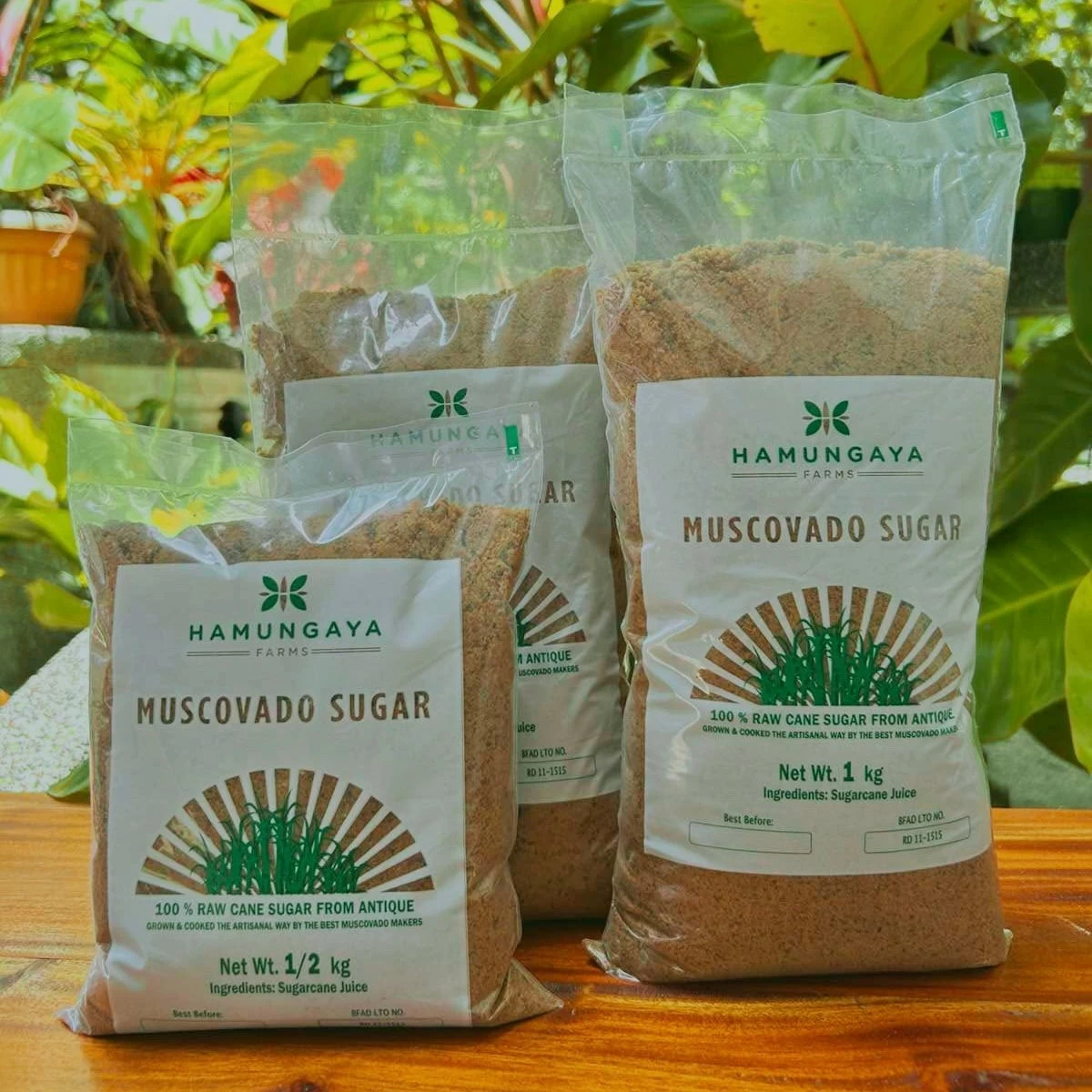
Hamungaya Farms’ finished muscovado sugar.
“On the third day, when the process ends, they receive their share. If their harvest is big, their one-third is also big. These are the fairest terms between labor and capital,” he added.
Felipe credits much of this advocacy to his only son, Jan, who is particularly mindful of labor welfare. “Jan wants a fair relationship between capital and labor. If the landowner or mill benefits, that benefit should be shared and returned to the laborers,” he said.
Jan’s background in community development and sustainable agriculture helped bring these principles to life at Hamungaya Farms.
“I brought the advocacies from my previous work and replicated them on the farm,” Jan shared. “I wanted us, as a small business, to grow as a whole community, so livelihoods remain sustainable.”
Next in line
While maintaining his career in engineering, Jan formally took charge of Hamungaya Farms’ operations in 2019. His days begin early, often by 8 a.m., checking in with operators about machine conditions, milling schedules, and inventory levels.
Felipe, meanwhile, has gradually stepped back—allowing his son to learn firsthand. “Sometimes I step in when there are things that need my intervention,” he said.
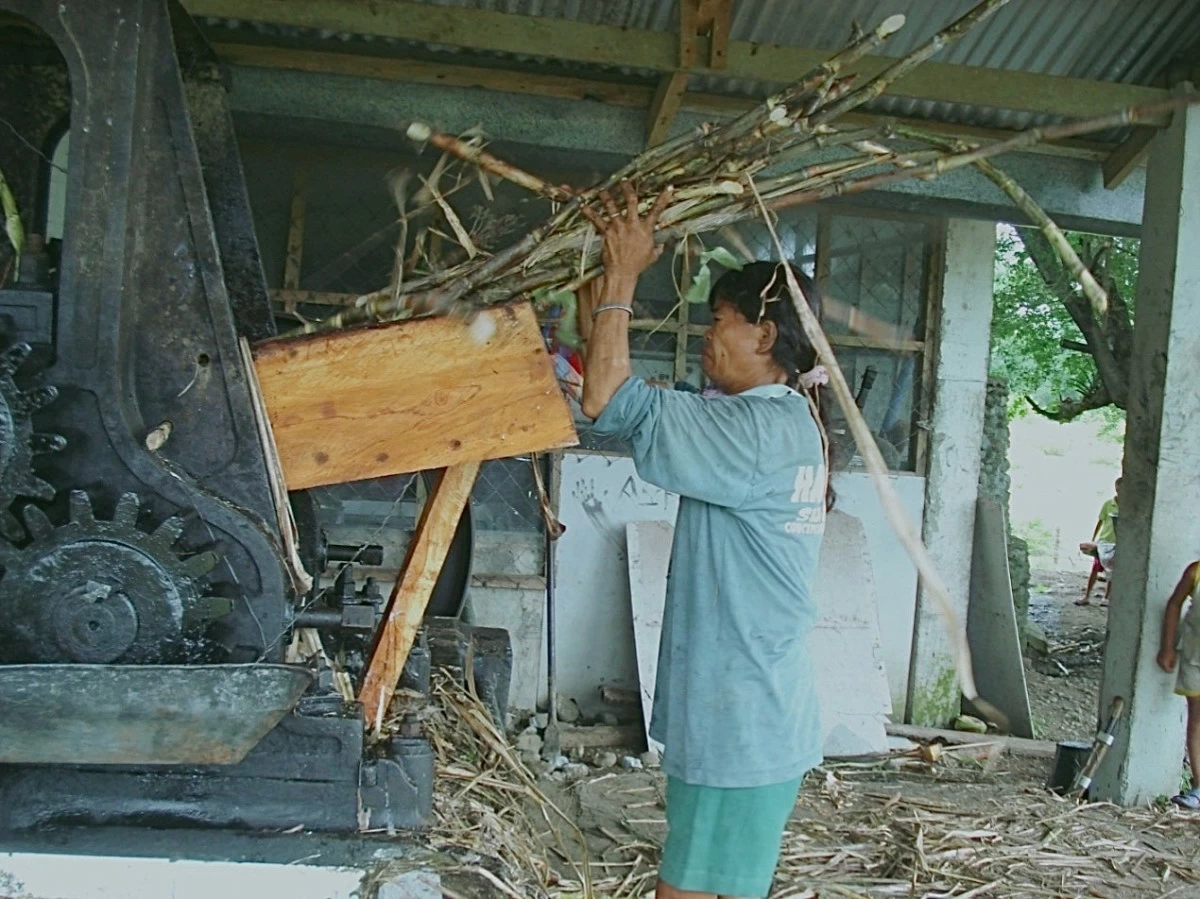
SWEET STORY — Freshly harvested sugarcane crushed to extract juice.
Felipe also noted that production volume depends largely on the amount of sugarcane delivered to the mill. Even the most efficient equipment, he said, cannot compensate for limited supply.
Despite the relative ease of growing sugarcane and producing muscovado, both Jan and Felipe agreed that marketing remains their biggest challenge.
“The farmers are already here. They’ve known how to make sugar since they were young,” Jan said. “Selling the product is the hardest part.”
“If we don’t market it, the farmers will be affected,” Felipe said. “We won’t have money to recirculate. We need to release inventory so we can continue buying raw materials.”
The potential of muscovado
Felipe pointed out that larger sugar-producing provinces, such as Negros Occidental, face greater struggles due to low market prices and high mechanization costs.
“It’s a two-edged sword,” he explained. “Sugar has become unprofitable in other highly mechanized areas.”
In such cases, Felipe explained that farmers in other areas are paid only ₱1,200 per ton of sugar. In Antique, however, that same ₱1,200-worth of sugarcane can be converted into about 70 kilos of muscovado. At a conservative price of ₱50 per kilo, he said, one ton would amount to around ₱3,500 pesos—significantly higher than what farmers earn from other sugar mills.
Looking ahead
Hamungaya Farms is currently operating at full capacity, producing up to 100 tons annually. If demand increases, Jan said building another facility is a real possibility.
They are also exploring value-added products such as muscovado candy, designed to make the product more accessible and enjoyable for consumers.
Amid growth and expansion, Hamungaya Farms remains anchored to its core belief: that behind every bag of muscovado are farmers whose labor deserves recognition and fair returns. (Photos courtesy of Jan Sandino Pachoco)

Related Tags

MUSCOVADO HAMUNGAYA FARMS SPOTLIGHT FEATURES
ADVERTISEMENT
.most-popular .layout-ratio{ padding-bottom: 79.13%; } @media (min-width: 768px) and (max-width: 1024px) { .widget-title { font-size: 15px !important; } }

{{ articles_filter_1561_widget.title }}

.most-popular .layout-ratio{ padding-bottom: 79.13%; } @media (min-width: 768px) and (max-width: 1024px) { .widget-title { font-size: 15px !important; } }

{{ articles_filter_1562_widget.title }}

.most-popular .layout-ratio{ padding-bottom: 79.13%; } @media (min-width: 768px) and (max-width: 1024px) { .widget-title { font-size: 15px !important; } }

{{ articles_filter_1563_widget.title }}

{{ articles_filter_1564_widget.title }}

.mb-article-details { position: relative; } .mb-article-details .article-body-preview, .mb-article-details .article-body-summary{ font-size: 17px; line-height: 30px; font-family: "Libre Caslon Text", serif; color: #000; } .mb-article-details .article-body-preview iframe , .mb-article-details .article-body-summary iframe{ width: 100%; margin: auto; } .read-more-background { background: linear-gradient(180deg, color(display-p3 1.000 1.000 1.000 / 0) 13.75%, color(display-p3 1.000 1.000 1.000 / 0.8) 30.79%, color(display-p3 1.000 1.000 1.000) 72.5%); position: absolute; height: 200px; width: 100%; bottom: 0; display: flex; justify-content: center; align-items: center; padding: 0; } .read-more-background a{ color: #000; } .read-more-btn { padding: 17px 45px; font-family: Inter; font-weight: 700; font-size: 18px; line-height: 16px; text-align: center; vertical-align: middle; border: 1px solid black; background-color: white; } .hidden { display: none; }
function initializeAllSwipers() { // Get all hidden inputs with cms_article_id document.querySelectorAll('[id^="cms_article_id_"]').forEach(function (input) { const cmsArticleId = input.value; const articleSelector = '#article-' + cmsArticleId + ' .body_images'; const swiperElement = document.querySelector(articleSelector); if (swiperElement && !swiperElement.classList.contains('swiper-initialized')) { new Swiper(articleSelector, { loop: true, pagination: false, navigation: { nextEl: '#article-' + cmsArticleId + ' .swiper-button-next', prevEl: '#article-' + cmsArticleId + ' .swiper-button-prev', }, }); } }); } setTimeout(initializeAllSwipers, 3000); const intersectionObserver = new IntersectionObserver( (entries) => { entries.forEach((entry) => { if (entry.isIntersecting) { const newUrl = entry.target.getAttribute("data-url"); if (newUrl) { history.pushState(null, null, newUrl); let article = entry.target; // Extract metadata const author = article.querySelector('.author-section').textContent.replace('By', '').trim(); const section = article.querySelector('.section-info ').textContent.replace(' ', ' '); const title = article.querySelector('.article-title h1').textContent; // Parse URL for Chartbeat path format const parsedUrl = new URL(newUrl, window.location.origin); const cleanUrl = parsedUrl.host + parsedUrl.pathname; // Update Chartbeat configuration if (typeof window._sf_async_config !== 'undefined') { window._sf_async_config.path = cleanUrl; window._sf_async_config.sections = section; window._sf_async_config.authors = author; } // Track virtual page view with Chartbeat if (typeof pSUPERFLY !== 'undefined' && typeof pSUPERFLY.virtualPage === 'function') { try { pSUPERFLY.virtualPage({ path: cleanUrl, title: title, sections: section, authors: author }); } catch (error) { console.error('ping error', error); } } // Optional: Update document title if (title && title !== document.title) { document.title = title; } } } }); }, { threshold: 0.1 } ); function showArticleBody(button) { const article = button.closest("article"); const summary = article.querySelector(".article-body-summary"); const body = article.querySelector(".article-body-preview"); const readMoreSection = article.querySelector(".read-more-background"); // Hide summary and read-more section summary.style.display = "none"; readMoreSection.style.display = "none"; // Show the full article body body.classList.remove("hidden"); } document.addEventListener("DOMContentLoaded", () => { let loadCount = 0; // Track how many times articles are loaded const offset = [1, 2, 3, 4, 5, 6, 7, 8, 9, 10]; // Offset values const currentUrl = window.location.pathname.substring(1); let isLoading = false; // Prevent multiple calls if (!currentUrl) { console.log("Current URL is invalid."); return; } const sentinel = document.getElementById("load-more-sentinel"); if (!sentinel) { console.log("Sentinel element not found."); return; } function isSentinelVisible() { const rect = sentinel.getBoundingClientRect(); return ( rect.top < window.innerHeight && rect.bottom >= 0 ); } function onScroll() { if (isLoading) return; if (isSentinelVisible()) { if (loadCount >= offset.length) { console.log("Maximum load attempts reached."); window.removeEventListener("scroll", onScroll); return; } isLoading = true; const currentOffset = offset[loadCount]; window.loadMoreItems().then(() => { let article = document.querySelector('#widget_1690 > div:nth-last-of-type(2) article'); intersectionObserver.observe(article) loadCount++; }).catch(error => { console.error("Error loading more items:", error); }).finally(() => { isLoading = false; }); } } window.addEventListener("scroll", onScroll); });

Sign up by email to receive news.