ADVERTISEMENT

Keep power in check; fix poll finance rules before 2028

Published Mar 25, 2026 12:05 am  |  Updated Mar 25, 2026 01:51 pm
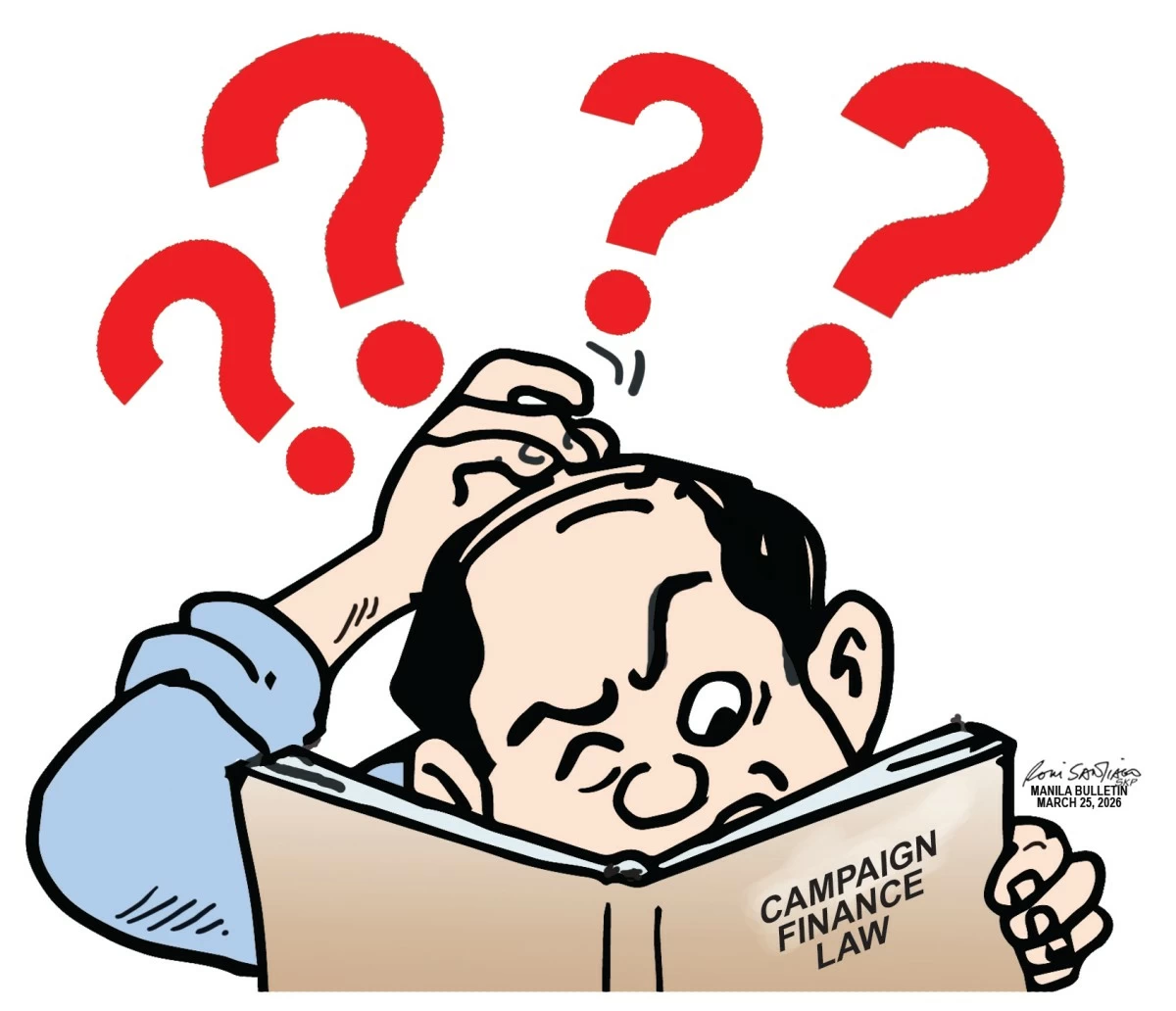
In just over two years, the country will again head into a high-stakes national election. But long before the first ballot is cast in May 2028, a more fundamental contest must be resolved: the battle for clarity in our campaign finance laws. The recent ruling involving a case regarding Statement of Contributions and Expenditures (SOCE) has exposed a troubling inconsistency—one that, if left unaddressed, could undermine the integrity of future elections.
At the core of the confusion lies what appears to be a legal puzzle. On one hand, the Commission on Elections (Comelec) absolved an elective official for failure to disclose campaign contributions, citing the Peñera Doctrine—that a person is not considered a candidate until the start of the campaign period. On the other hand, the same decision found fault with the campaign fund contributors under Section 99 of the Omnibus Election Code, which penalizes failure to report contributions made to a “candidate”. How can contributions be illegal if the recipient was, legally speaking, not yet a candidate?
This contradiction creates a loophole wide enough to drive a campaign war chest through. If individuals can legally receive substantial contributions before the campaign period without being considered candidates, then the entire regulatory framework governing campaign finance risks becoming meaningless. The wealthy and well-connected can amass vast resources and start campaigning early, while less affluent but equally deserving aspirants are left behind before the race even begins.
The judiciary must step in decisively. The Supreme Court has both the authority and responsibility to resolve ambiguities that threaten the uniform application of election laws. It need not wait for a full-blown constitutional crisis. Through its power to act motu proprio in appropriate cases or through a carefully selected petition that squarely raises these issues, the Court can provide a definitive interpretation that harmonizes the Peñera Doctrine with existing statutory provisions on campaign contributions.
More importantly, the Court must confront the unintended consequences of its own jurisprudence. The Peñera ruling, while grounded in a literal reading of the law, has created practical distortions that favor early fundraising and, by extension, entrenched political power. A recalibration may be necessary—one that aligns legal definitions with the realities of modern campaigning.
Congress, however, bears the heavier burden. Legislative ambiguity is at the root of this confusion. The apparent disconnect between the Omnibus Election Code and Republic Act 7166—particularly the repeal or modification of key provisions without clear harmonization—has created a patchwork of rules open to conflicting interpretations. This is unacceptable in a domain as critical as electoral integrity.
Lawmakers must act with urgency to reconcile these statutes. The definition of a “candidate” must be revisited. The timing and regulation of campaign contributions must be explicitly clarified. And the penalties for violations must be consistent across all relevant laws. Precision in language is the backbone of enforceability.
Time is not a luxury. Every day that this ambiguity persists is another day that the playing field tilts further in favor of those with financial muscle. The intent behind SOCE requirements and campaign finance regulations is clear: transparency, accountability, and fairness. But intent without clarity is risky and may even lead to chaos.
If nothing is done, the 2028 elections risk becoming less a contest of ideas on governance and more a competition of resources. Democracy cannot thrive under such conditions. Therefore, now is the time for both the judiciary and Congress to act decisively—not only to resolve current confusion, but to restore public confidence in the electoral system.
When the law blinks, power fills the void. The question is whether our institutions will act in time to keep that power in check.

Related Tags

STATEMENT OF CONTRIBUTIONS AND EXPENDITURES COMELEC
ADVERTISEMENT
.most-popular .layout-ratio{ padding-bottom: 79.13%; } @media (min-width: 768px) and (max-width: 1024px) { .widget-title { font-size: 15px !important; } }

{{ articles_filter_1561_widget.title }}

.most-popular .layout-ratio{ padding-bottom: 79.13%; } @media (min-width: 768px) and (max-width: 1024px) { .widget-title { font-size: 15px !important; } }

{{ articles_filter_1562_widget.title }}

.most-popular .layout-ratio{ padding-bottom: 79.13%; } @media (min-width: 768px) and (max-width: 1024px) { .widget-title { font-size: 15px !important; } }

{{ articles_filter_1563_widget.title }}

{{ articles_filter_1564_widget.title }}

.mb-article-details { position: relative; } .mb-article-details .article-body-preview, .mb-article-details .article-body-summary{ font-size: 17px; line-height: 30px; font-family: "Libre Caslon Text", serif; color: #000; } .mb-article-details .article-body-preview iframe , .mb-article-details .article-body-summary iframe{ width: 100%; margin: auto; } .read-more-background { background: linear-gradient(180deg, color(display-p3 1.000 1.000 1.000 / 0) 13.75%, color(display-p3 1.000 1.000 1.000 / 0.8) 30.79%, color(display-p3 1.000 1.000 1.000) 72.5%); position: absolute; height: 200px; width: 100%; bottom: 0; display: flex; justify-content: center; align-items: center; padding: 0; } .read-more-background a{ color: #000; } .read-more-btn { padding: 17px 45px; font-family: Inter; font-weight: 700; font-size: 18px; line-height: 16px; text-align: center; vertical-align: middle; border: 1px solid black; background-color: white; } .hidden { display: none; }
function initializeAllSwipers() { // Get all hidden inputs with cms_article_id document.querySelectorAll('[id^="cms_article_id_"]').forEach(function (input) { const cmsArticleId = input.value; const articleSelector = '#article-' + cmsArticleId + ' .body_images'; const swiperElement = document.querySelector(articleSelector); if (swiperElement && !swiperElement.classList.contains('swiper-initialized')) { new Swiper(articleSelector, { loop: true, pagination: false, navigation: { nextEl: '#article-' + cmsArticleId + ' .swiper-button-next', prevEl: '#article-' + cmsArticleId + ' .swiper-button-prev', }, }); } }); } setTimeout(initializeAllSwipers, 3000); const intersectionObserver = new IntersectionObserver( (entries) => { entries.forEach((entry) => { if (entry.isIntersecting) { const newUrl = entry.target.getAttribute("data-url"); if (newUrl) { history.pushState(null, null, newUrl); let article = entry.target; // Extract metadata const author = article.querySelector('.author-section').textContent.replace('By', '').trim(); const section = article.querySelector('.section-info ').textContent.replace(' ', ' '); const title = article.querySelector('.article-title h1').textContent; // Parse URL for Chartbeat path format const parsedUrl = new URL(newUrl, window.location.origin); const cleanUrl = parsedUrl.host + parsedUrl.pathname; // Update Chartbeat configuration if (typeof window._sf_async_config !== 'undefined') { window._sf_async_config.path = cleanUrl; window._sf_async_config.sections = section; window._sf_async_config.authors = author; } // Track virtual page view with Chartbeat if (typeof pSUPERFLY !== 'undefined' && typeof pSUPERFLY.virtualPage === 'function') { try { pSUPERFLY.virtualPage({ path: cleanUrl, title: title, sections: section, authors: author }); } catch (error) { console.error('ping error', error); } } // Optional: Update document title if (title && title !== document.title) { document.title = title; } } } }); }, { threshold: 0.1 } ); function showArticleBody(button) { const article = button.closest("article"); const summary = article.querySelector(".article-body-summary"); const body = article.querySelector(".article-body-preview"); const readMoreSection = article.querySelector(".read-more-background"); // Hide summary and read-more section summary.style.display = "none"; readMoreSection.style.display = "none"; // Show the full article body body.classList.remove("hidden"); } document.addEventListener("DOMContentLoaded", () => { let loadCount = 0; // Track how many times articles are loaded const offset = [1, 2, 3, 4, 5, 6, 7, 8, 9, 10]; // Offset values const currentUrl = window.location.pathname.substring(1); let isLoading = false; // Prevent multiple calls if (!currentUrl) { console.log("Current URL is invalid."); return; } const sentinel = document.getElementById("load-more-sentinel"); if (!sentinel) { console.log("Sentinel element not found."); return; } function isSentinelVisible() { const rect = sentinel.getBoundingClientRect(); return ( rect.top < window.innerHeight && rect.bottom >= 0 ); } function onScroll() { if (isLoading) return; if (isSentinelVisible()) { if (loadCount >= offset.length) { console.log("Maximum load attempts reached."); window.removeEventListener("scroll", onScroll); return; } isLoading = true; const currentOffset = offset[loadCount]; window.loadMoreItems().then(() => { let article = document.querySelector('#widget_1690 > div:nth-last-of-type(2) article'); intersectionObserver.observe(article) loadCount++; }).catch(error => { console.error("Error loading more items:", error); }).finally(() => { isLoading = false; }); } } window.addEventListener("scroll", onScroll); });

Sign up by email to receive news.