






 Business
The Economy
Firms, regulators say sustainability now drives investor decisions
Business
The Economy
Firms, regulators say sustainability now drives investor decisions
Firms, regulators say sustainability now drives investor decisions


Regulators and business leaders agreed that sustainability has become a key driver of investor confidence and market valuation, as disclosures increasingly influence how capital is allocated in the Philippine market.

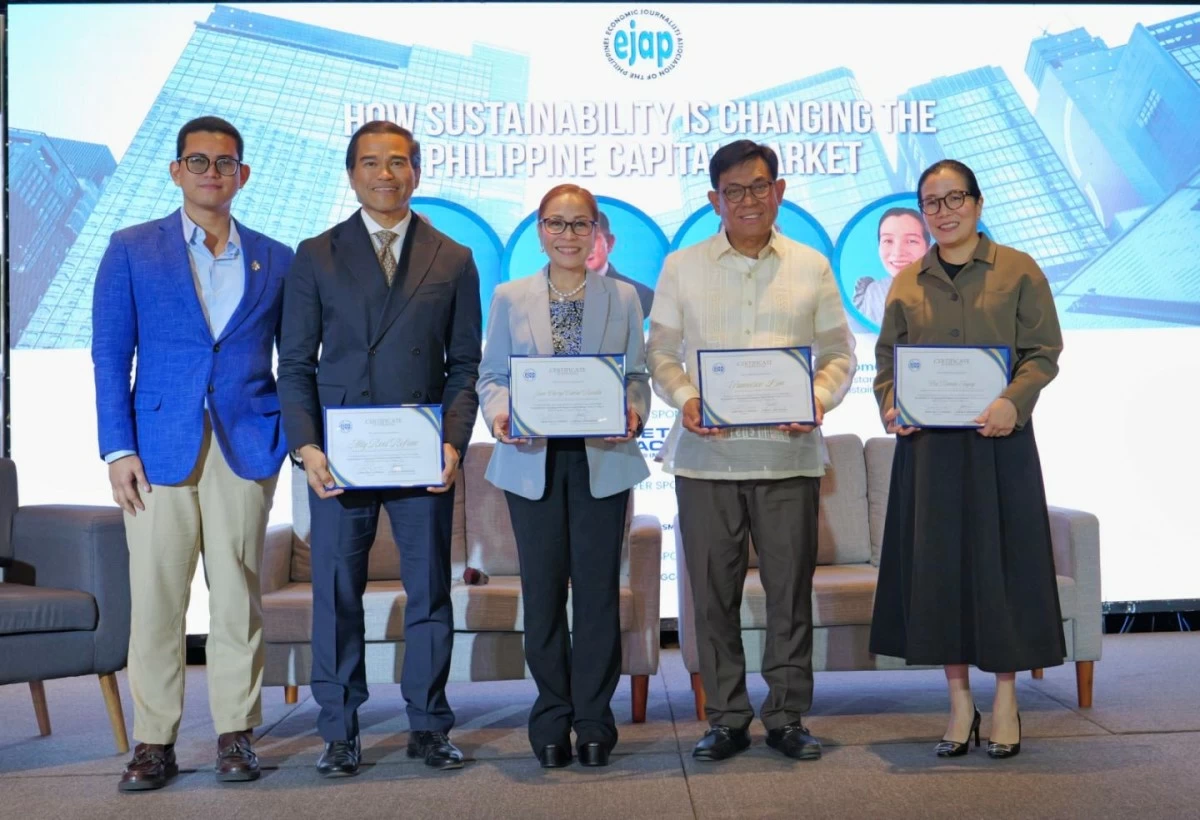
At the inaugural Economic Journalists Association of the Philippines (EJAP) Sustainability Forum last Monday, March 23, participants said sustainability must be embedded into corporate operations, with the quality of reporting now shaping both investment decisions and company valuations.
The forum, held at the Securities and Exchange Commission (SEC) eCenter in Makati City, carried the theme “From Disclosure to Decision: How Sustainability Is Changing the Philippine Capital Market.”
SEC Chairperson Francis E. Lim said sustainability disclosure has moved from the margins to the center of investment decision-making, with climate risk, transition risk, governance weakness, and social fragility now measurable and material.
“Sustainability claims must not run ahead of fact. They must be grounded, measured, and governed with discipline. Anything less does not just weaken disclosure—it weakens the market,” Lim said.
He added that disclosure can no longer function as an aspirational narrative and must instead be evidentiary, comparable, and embedded in governance and strategy.
To improve reporting quality, the SEC issued Memorandum Circular (MC) No. 16 in 2025, adopting an International Sustainability Standards Board (ISSB)-aligned framework under Philippine Financial Reporting Standards (PFRS) S1 and S2. Implementation will be phased from 2026 to 2029, beginning with listed firms with market capitalization exceeding ₱50 billion.
Lim said the regulator is pairing these requirements with capacity-building programs to ensure compliance is feasible.
“Lasting reform is not issued. It is built,” he said.
The banking sector is moving in a similar direction, according to Bangko Sentral ng Pilipinas (BSP) Assistant Governor Pia Roman Tayag, who said 70 percent of banks have integrated sustainability into their strategies, while 90 percent are inclined to support sustainable financing.
“For us at the BSP, when we issue regulations and when banks see these regulations, we all understand that compliance is not the end,” she said. “It is to really fully integrate this—that ESG [environmental, social, and governance] is sound for their business.”
Philippine Stock Exchange (PSE) Senior Vice President Roel Refran said companies that embed sustainability into their decision-making processes are better positioned for long-term success.
“Sustainability is not just about compliance or cost of capital. Sustainability must be embedded into decision-making, not treated as an afterthought. In the end, this is about more than technical standards. It's about ensuring long-term resilience-for businesses, for markets, and for society. And while we don't have all the answers yet, we are learning as we go,” he said.
At the PSE, sustainability performance has been incorporated into employee key performance indicators.
“This is us making sure by 2100, at the turn of the century, we created an impact—that’s what this story is about,” he said.
Metro Pacific Investments Corp. (MPIC) Chief Finance Officer (CFO) and Chief Sustainability Officer June Cheryl Cabal-Revilla said the group has shifted from focusing solely on risk management to prioritizing resilience.
She cited how sustainability efforts and improved reporting translated into gains, with Manila Electric Co. (Meralco) posting a 35-percent increase in share price over the past 12 months and Maynilad Water Services Inc. recording a 30-percent increase since its initial public offering (IPO) in the fourth quarter last year.
“We operate as an open book, which is why we attract and work with newer groups of investors. Overall, our improved performance has been very positive. We are living proof that sustainability works,” she said.
Lim emphasized that transparency and accountability remain critical in sustainability reporting.
“Trust depends on what can be verified. Sustainability claims must not run ahead of facts. They must be grounded, measured, and governed with discipline. Everything less does not just weaken disclosure, it weakens the markets,” he said.
The forum was supported by MPIC as gold sponsor, with SM Investments Corp. (SMIC) and San Miguel Corp. (SMC) as silver sponsors.
GCash, Globe Telecom Inc., Ayala Corp., SM Prime Holdings Inc. (SM Prime), Development Bank of the Philippines (DBP), Maynilad, and GT Capital Holdings Inc. served as bronze sponsors.
EJAP is the country’s premier organization of business and economic reporters, promoting excellence in economic journalism and professional development among its members.