






Manila Bulletin
 Philippines
National
'Wag na magmaang-maangan': Senators tell gov't agencies country already in 'crisis'
Philippines
National
'Wag na magmaang-maangan': Senators tell gov't agencies country already in 'crisis'
Philippines
National
'Wag na magmaang-maangan': Senators tell gov't agencies country already in 'crisis'
'Wag na magmaang-maangan': Senators tell gov't agencies country already in 'crisis'
By Dhel Nazario
Published Mar 24, 2026 12:52 pm
|
Updated Mar 24, 2026 01:19 pm


At A Glance
- Senators on Tuesday, March 24, called on government agencies to act with urgency, stressing that they must recognize the situation as a "crisis" to effectively respond to its impact on Filipinos.
Senators on Tuesday, March 24, called on government agencies to act with urgency, stressing that they must recognize the situation as a “crisis” to effectively respond to its impact on Filipinos.
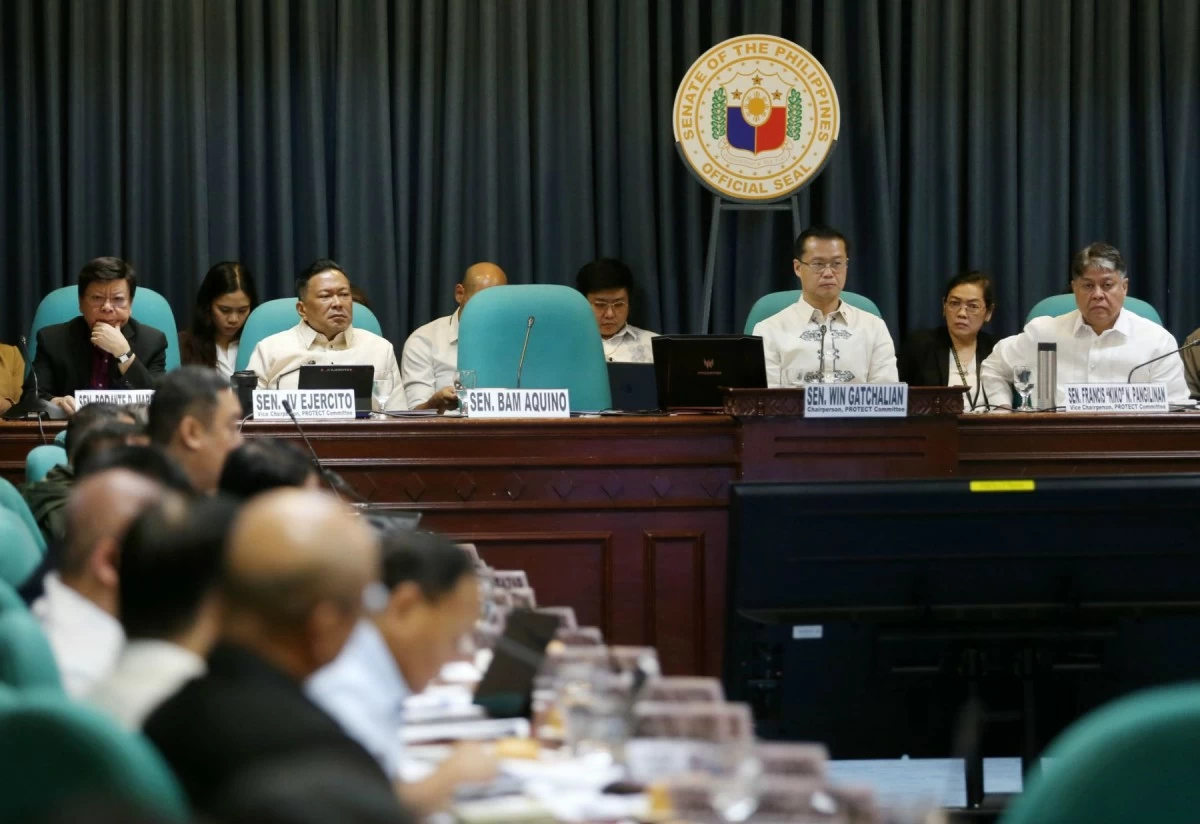
Sen. Win Gatchalian, chairperson of the Senate Committee on Proactive Response and Oversight for Timely and Effective Crisis Strategy (PROTECT), presides over a public hearing on Tuesday, March 24, 2026.
The hearing gathered key government agencies for a briefing on the country’s preparedness and response to issues arising from the ongoing conflict involving the United States, Israel, and Iran, focusing on its potential impact on overseas Filipinos, energy supply, food security, transportation, and the national economy. (Mark Balmores)
During a hearing of the Senate’s Proactive Response and Oversight for Timely and Effective Crisis Strategy (PROTECT) Committee on March 24, Senator Legarda emphasized the need for swift implementation of government plans, particularly those aimed at cushioning the effects of rising fuel prices, food costs, and external pressures such as tensions in the Middle East.
"Huwag na tayo lost in translation or nagmamaang-maangan na may krisis (Let's not get lost in translation or pretend not to know that there's a crisis)," Legarda said.
“Until we define it as a crisis, we will not act in record time to save our people,” she added.
The senator urged agencies to disclose how much funding remains available from the 2025 General Appropriations Act (GAA), including continuing appropriations that can be tapped immediately, as well as allocations under the 2026 national budget that could be redirected to crisis response.
She stressed that these funds must go beyond paper plans and translate into concrete assistance on the ground, particularly for vulnerable sectors such as farmers, fisherfolk, and transport workers.
The senator further called on agencies to identify unused or non-essential budget items that could be realigned, including expenditures she described as “luho,” such as travel and social events, and redirect them toward aid for those most affected by the crisis.
She also pressed key economic agencies, including the Departments of Trade and Industry (DTI), Energy (DOE), and Finance (DOF), as well as the Bureau of Internal Revenue (BIR) and the Energy Regulatory Commission (ERC), to outline concrete measures to bring down the prices of basic commodities and address tax concerns, including the imposition of value-added tax (VAT) on certain items.
Senator JV Ejercito agreed with his colleagues that the country is already in a crisis.
"Hindi na po normal ang sitwasyon (The situation right now is not normal) and what we have to do right now is do the preparations just like during the Covid [pandemic] when there was uncertainty," he said.
Despite rising oil prices, Presidential Communications Office (PCO) Undersecretary Claire Castro said the government does not consider the situation an oil crisis in the Philippines, citing the assessment of Department of Energy (DOE) Secretary Sharon Garin that the country has sufficient fuel supply.
The PROTECT panel is conducting the hearing to assess government readiness and response measures amid mounting economic pressures and their impact on households nationwide.