






Manila Bulletin
 Philippines
National
PCG vows firm stance in WPS, sends vessels amid new Chinese 'threats'
Philippines
National
PCG vows firm stance in WPS, sends vessels amid new Chinese 'threats'
Philippines
National
PCG vows firm stance in WPS, sends vessels amid new Chinese 'threats'
PCG vows firm stance in WPS, sends vessels amid new Chinese 'threats'
Published Mar 24, 2026 02:17 pm


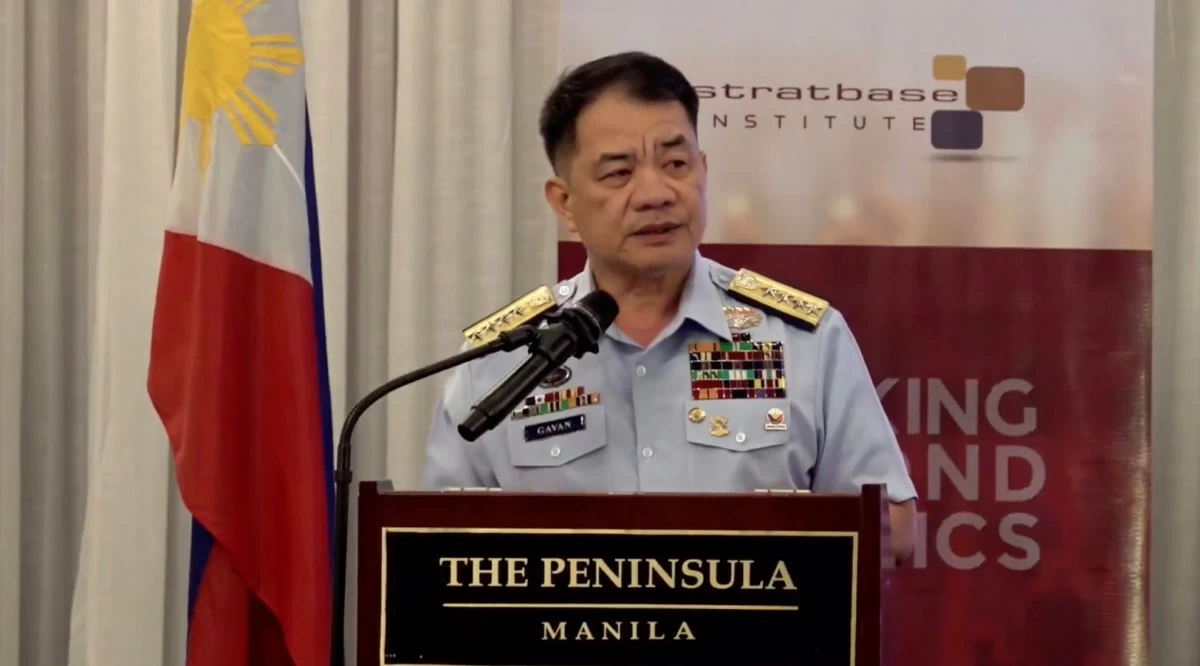
Philippine Coast Guard (PCG) Commandant, Admiral Ronnie Gil Gavan delivers a speech during a forum organized by the Stratbase Institute to mark 70 years of diplomatic normalization between the Philippines and Japan in Makati City on March 24, 2026. (Courtesy of Stratbase Institute)
The Philippine Coast Guard (PCG) declared on Tuesday, March 24, that the country's sovereignty under international law is “non-negotiable” as the government deployed vessels to counter fresh Chinese aggression at Bajo de Masinloc (Scarborough or Panatag Shoal).
PCG Commandant, Admiral Ronnie Gil Gavan emphasized that security at sea is not only a military concern but also a humanitarian one.
“The Philippine Coast Guard has documented, repeatedly and on record, attempts by China to deny our personnel, our ability to exercise rights that belong to us under international law, rights affirmed by the 2016 Arbitral Award, which is also under UNCLOS [United Nations Convention on the Law of the Sea],” he said in his speech during a Stratbase Institute forum in Makati City marking the 70 years of diplomatic relations between the Philippines and Japan.
The PCG chief emphasized that the partnership between Manila and Tokyo was an “existential” bond rooted in shared democratic values.
He noted that Japan has been a steadfast partner in supporting the PCG’s maritime transparency initiatives to expose China’s illegal actions in the WPS, and joint coast guard exercises to enhance both forces’ interoperability.
Prior to this, PCG spokesperson for WPS Rear Admiral Jay Tarriela said a China Coast Guard (CCG) vessel announced via live radio communication heard by Filipino fishermen over the weekend its intention to conduct a “clearing operation” within a specific rectangular area in Bajo de Masinloc.
The coordinates were: Point A: 15°05'N, 118°10'E; Point B: 15°05'N, 118°25'E , Point C: 14°14'N, 118°25'E, and Point D: 14°14'N, 118°10'E.
To counter this threat and protect over 20 Filipino fishing boats harassed by Chinese vessels, the government dispatched two PCG ships and five fishery patrol vessels from the Bureau of Fisheries and Aquatic Resources (BFAR).
A maritime domain awareness (MDA) flight conducted by the PCG also documented a heavy Chinese presence in the area, including six CCG vessels, 20 China maritime militia ships, and one Chinese People’s Liberation Army-Navy (PLA-N) warship.
An ally
Gavan noted that the 2016 Arbitral Award, which invalidated China’s nine-dash line claims in the South China Sea, remains the foundation of Philippine rights in the WPS.
He credited Japan for “not looking away” as the international order comes “under pressure.”
“The most immediate test of [Japan-Philippines] partnership today is in the West Philippine Sea,” Gavan said. “Japan has not looked away from this. It has responded with us through legal and diplomatic channels, through international engagements, and through concrete support to our capabilities.”
He said Japan’s support to the PCG includes the signing of a 2017 memorandum of cooperation, which was further strengthened in 2023, to enhance both forces’ capability on maritime law enforcement, safety, and security against piracy, illegal fishing, and terrorism.
Japan has also provided the PCG with multi-role response vessels and technical training, and Gavan called these “building blocks” of a collective ability to hold the line.
However, Gavan stressed that the work ahead remains demanding as he called on both the Philippine and Japan Coast Guards to continue speaking clearly in international forums about the importance of a free and open Indo-Pacific.
“A free and open Indo-Pacific is not optional,” he said, noting it is a must.