






Manila Bulletin
 Philippines
National
In historic first, Japanese troops to join 'Balikatan' in combat drills
Philippines
National
In historic first, Japanese troops to join 'Balikatan' in combat drills
Philippines
National
In historic first, Japanese troops to join 'Balikatan' in combat drills
In historic first, Japanese troops to join 'Balikatan' in combat drills
Published Mar 24, 2026 01:00 pm


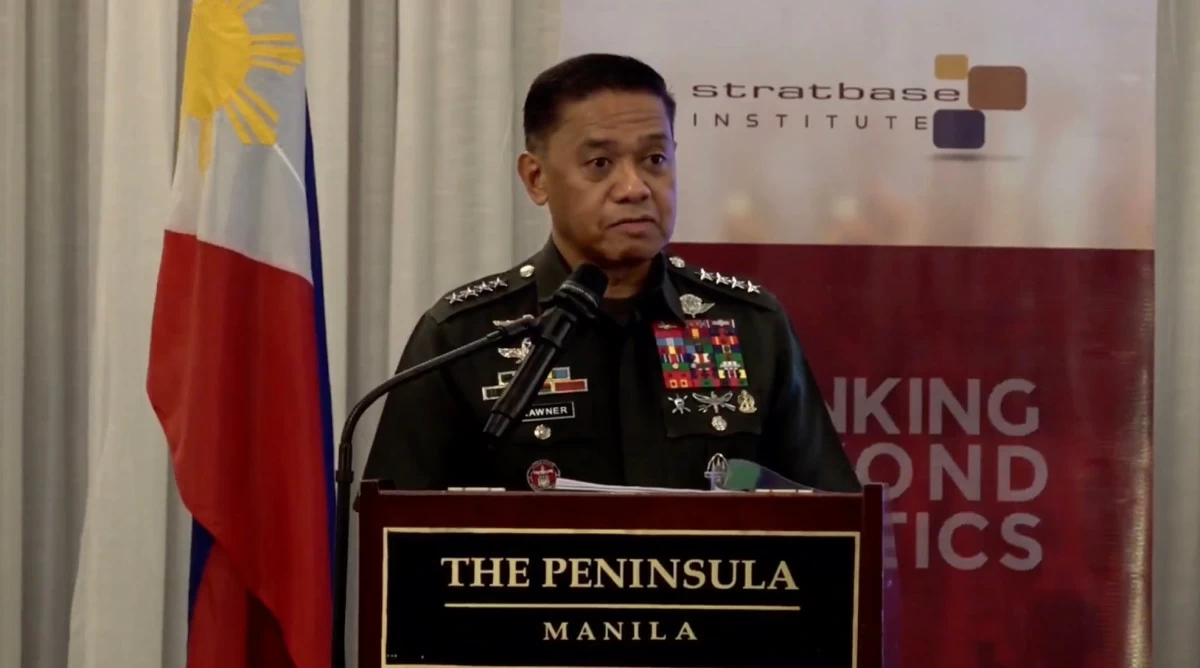
Armed Forces of the Philippines (AFP) Chief of Staff, General Romeo Brawner Jr. delivers a speech during a forum organized by the Stratbase Institute to mark 70 years of diplomatic normalization between the Philippines and Japan in Makati City on March 24, 2026. (Courtesy of Stratbase Institute)
For the first time in the four-decade-old history of the Balikatan Exercises, Japanese troops will participate in the most prominent drills between the Armed Forces of the Philippines (AFP) and United States military, signaling a significant shift in the country’s defense partnership with allies amid an evolving regional security landscape.
AFP Chief of Staff General Romeo Brawner Jr. said Japan will deploy a contingent from the Japan Self-Defense Forces (JSDF) to take part in the drills, moving away from their previous years' role as observers.
“For this year's Balikatan Exercises, we are expecting Japan to send combat troops to join in the exercise, instead of just the usual trainers of HADR [humanitarian assistance and disaster response],” he said at a Stratbase Institute forum marking 70 years of diplomatic normalization between the Philippines and Japan in Makati City on Tuesday, March 24.
The annual Balikatan drills have long been a cornerstone of Manila’s defense cooperation with Washington.
Japan’s participation had previously been limited to non-combat roles and Brawner acknowledged that the latest planned deployment marks a notable expansion of Tokyo’s security engagement in the Indo-Pacific region. Brawner declined to give details on troop numbers, units, or equipment but he noted that Japan would send a “bigger contingent” this year.
This year’s Balikatan Exercises will run from April to May, with the opening set on April 20. Despite ongoing conflict in the Middle East, Brawner said the exercises will proceed at full scale.
Brawner said cyber defense will be a major focus this year, citing lessons from conflicts such as the Russia-Ukraine war and tensions involving Iran.
“We saw the importance of cyber defense. One of the first steps they took was to target the enemy’s networks through cyber warfare,” he noted.
The military is also exploring space-based capabilities to improve operations and noncombatant evacuation operations during the Balikatan Exercises. These simulate the repatriation of Filipinos overseas during crises, including a possible contingency involving Taiwan.
“If something happens in Taiwan, we will need to evacuate our fellow Filipinos,” Brawner said, while stressing that such drills are standard and not tied to any imminent threat.
He said commercial flights remain the most cost-efficient way to bring Filipinos home since military ships and aircraft are more expensive.
Security challenges
The forum, organized by Stratbase ADR Institute and held in Makati City, brought together policymakers and security experts to examine evolving ties between Manila and Tokyo. It also highlighted how both countries are responding to a more contested Indo-Pacific.
“The Philippines-Japan relationship has evolved through periods of challenge and renewal. Over the past two decades, however, it has reached a decisive turning point of emerging as a forward-looking defense relationship,” Brawner said.
The relations between Manila and Tokyo have transformed over the decades as it was once defined by wartime history. In the past 20 years, Tokyo has emerged as a key defense partner of the AFP, supporting Manila through maritime security assistance and equipment transfers, including radar systems, according to Brawner.
Since then, both countries have repeatedly emphasized adherence to international law, particularly the United Nations Convention on the Law of the Sea (UNCLOS), and pushed for peaceful resolution of disputes in the region.
While Manila has a territorial row with China over the West Philippine Sea (WPS), Tokyo has a similar conflict with Beijing over the Senkaku Islands in the East China Sea.
And Brawner said one of the ways these tensions could be best addressed was through sustained military diplomacy, capacity building, and enhanced interoperability, as well as adherence to international law.
“This approach reflects a deliberate strategy, principled restraint coupled with resolve. This is reinforced by our commitment to transparency and strategic communication to ensure that developments at sea are clearly presented, facts are established, and the international community remains informed,” the military chief stressed.
‘Like-minded nations’
For Brawner, Japan is a “like-minded partner” that “reinforces a shared vision of a maritime domain governed by law, not by coercion.
And the defense cooperation between the two nations has expanded beyond equipment and training since it now includes joint and trilateral exercises, as well as agreements such as the Reciprocal Access Agreement (RAA).
“Landmark arrangements, such as the Reciprocal Access Agreement, further demonstrate our commitment to a more responsive and coordinated security posture,” he said.
The RAA, ratified by Manila and Tokyo's legislatures in 2025, enables the entry of troops for joint training and operations.
Brawner also pointed to emerging threats in the region, citing China’s “illegal, coercive, aggressive, and deceptive” (ICAD) actions that “undermine the sovereignty without escalating into open conflict.”
“In this context, sustained coordination, information sharing, and strategic communication are essential to exposing malign influence and reinforcing the rules-based order,” he said.
Despite these challenges, both Manila and Tokyo have committed to avoiding escalation in the region.
“Rather than adopt escalatory approaches, the Philippines and Japan shall demonstrate a path grounded in transparency, restraint, and adherence to international law,” Brawner said.
“Our message is clear: we support a rules-based international order, we uphold freedom of navigation and unimpeded flow of trade, we reject coercion and unilateral attempts to alter the status quo,” he added.