ADVERTISEMENT

Marcos welcomes 343 OFWs in 4th chartered flight from Middle East

Published Mar 23, 2026 10:23 am
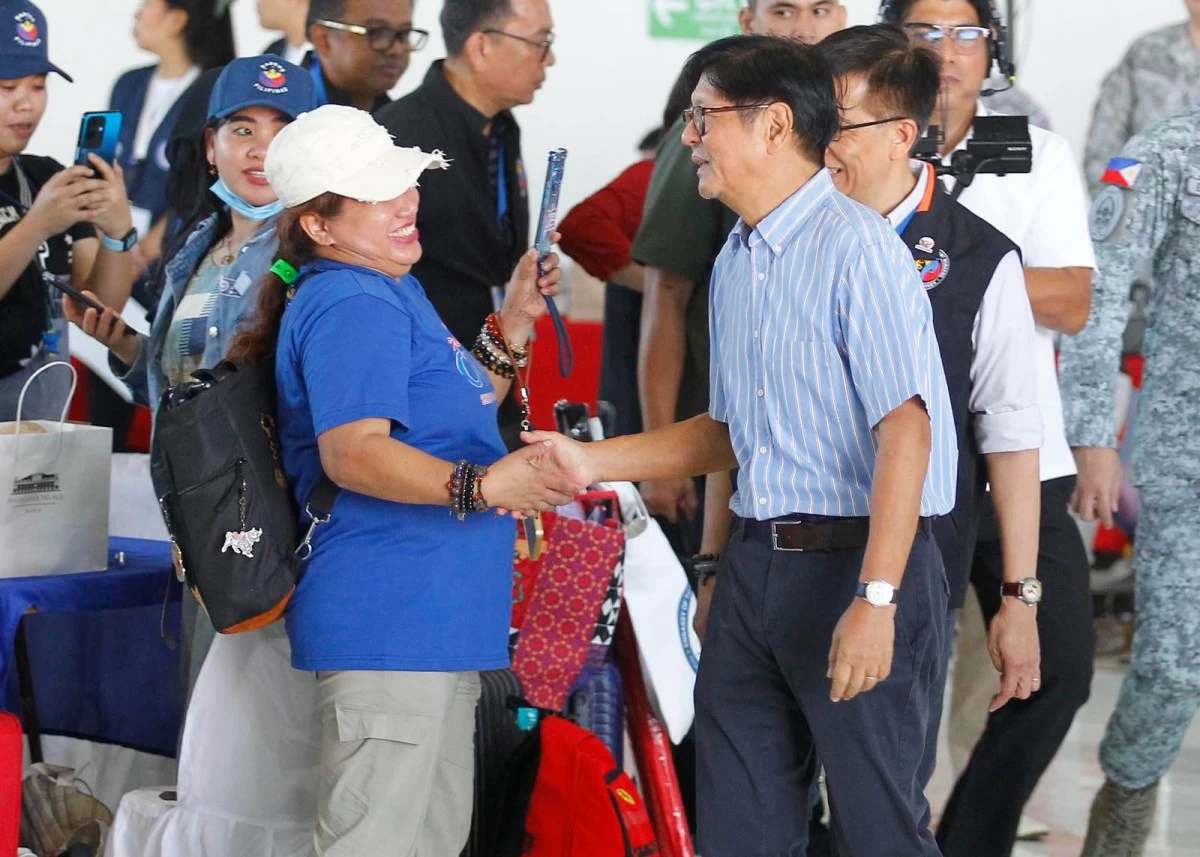
President Ferdinand 'Bongbong' Marcos Jr. welcomes 343 repatriated Filipinos from the Middle East at Villamor Airbase in Pasay City on Monday, March 23, 2026. The group, composed largely of overseas Filipino workers affected by ongoing tensions in the region, arrived safely through government-led repatriation efforts. This marks the fourth batch of Filipinos brought home under the administration’s continuing assistance program for nationals in crisis-affected areas. (Mark Balmores/Manila Bulletin)

President Marcos has welcomed another batch of repatriated overseas Filipino workers (OFWs) from the Middle East, as the government continues its evacuation efforts amid ongoing tensions in the region.

A total of 343 repatriates—317 OFWs and 26 dependents from Kuwait, Bahrain, Qatar, and Saudi Arabia—arrived at Villamor Air Base in Pasay City at around 6:30 a.m. on Monday, March 23, aboard a chartered Philippine Airlines flight.

The President, who did not engage with the media during the event, personally greeted the returning Filipinos and oversaw the distribution of assistance, including financial aid, medical support, and psychosocial services.

Department of Migrant Workers (DMW) Secretary Hans Leo Cacdac said many of the repatriates had to travel by land before boarding the flight due to airspace restrictions in parts of the Middle East.

“Sarado ang airspace in Bahrain and limited or restricted ang airspace sa Kuwait and Qatar. So it was a land-crossing effort (The airspace in Bahrain is closed, and airspace in Kuwait and Qatar is limited or restricted. So it was a land-crossing effort),” Cacdac said.

“It took, on average, about seven to eight hours to get to Riyadh, Saudi Arabia,” he added.

He said 234 OFWs came from Kuwait, Qatar, and Bahrain, while 109 were repatriated directly from Saudi Arabia.

Cacdac also thanked the Saudi government for facilitating the evacuation, noting that the country served as a key transit hub.

The government is preparing to bring home around 1,200 more Filipinos in the coming days, with two additional chartered flights being planned from the United Arab Emirates.

The UAE hosts nearly one million Filipino workers, making it a priority area for evacuation planning.

Assistance, reintegration support

Upon arrival, repatriates received immediate assistance and will be provided with reintegration services, including livelihood support and job opportunities.

The DMW will present available job orders, while the Department of Labor and Employment will offer local employment options.

Other agencies, including the Department of Trade and Industry (DTI), Department of Tourism (DOT), Department of Agriculture (DA), and the Technical Education and Skills Development Authority (TESDA), will also extend support, such as reskilling and retooling programs.

Travel assistance provided

The government is also providing hotel accommodations and domestic flights for OFWs returning to Visayas and Mindanao.

Free bus transportation is being arranged for those traveling within Luzon.

President Marcos also witnessed the send-off of returning OFWs bound for various provinces, with transportation support facilitated by the Overseas Workers Welfare Administration.

Ongoing evacuation efforts

The latest batch marks the fourth government-chartered flight under the repatriation program.

More than 1,400 OFWs and 334 dependents had already been brought home from March 5 to 17.

The third chartered flight, which arrived on March 18, carried 153 OFWs, 114 dependents, and 50 stranded Filipinos.

The President earlier called for “bayanihan” as the country responds to the crisis and assured Filipinos that the government remains ready to assist those affected.

Related Tags

President Marcos Bongbong Marcos repatriation OFWs Middle East conflict
ADVERTISEMENT
.most-popular .layout-ratio{ padding-bottom: 79.13%; } @media (min-width: 768px) and (max-width: 1024px) { .widget-title { font-size: 15px !important; } }

{{ articles_filter_1561_widget.title }}

.most-popular .layout-ratio{ padding-bottom: 79.13%; } @media (min-width: 768px) and (max-width: 1024px) { .widget-title { font-size: 15px !important; } }

{{ articles_filter_1562_widget.title }}

.most-popular .layout-ratio{ padding-bottom: 79.13%; } @media (min-width: 768px) and (max-width: 1024px) { .widget-title { font-size: 15px !important; } }

{{ articles_filter_1563_widget.title }}

{{ articles_filter_1564_widget.title }}

.mb-article-details { position: relative; } .mb-article-details .article-body-preview, .mb-article-details .article-body-summary{ font-size: 17px; line-height: 30px; font-family: "Libre Caslon Text", serif; color: #000; } .mb-article-details .article-body-preview iframe , .mb-article-details .article-body-summary iframe{ width: 100%; margin: auto; } .read-more-background { background: linear-gradient(180deg, color(display-p3 1.000 1.000 1.000 / 0) 13.75%, color(display-p3 1.000 1.000 1.000 / 0.8) 30.79%, color(display-p3 1.000 1.000 1.000) 72.5%); position: absolute; height: 200px; width: 100%; bottom: 0; display: flex; justify-content: center; align-items: center; padding: 0; } .read-more-background a{ color: #000; } .read-more-btn { padding: 17px 45px; font-family: Inter; font-weight: 700; font-size: 18px; line-height: 16px; text-align: center; vertical-align: middle; border: 1px solid black; background-color: white; } .hidden { display: none; }
function initializeAllSwipers() { // Get all hidden inputs with cms_article_id document.querySelectorAll('[id^="cms_article_id_"]').forEach(function (input) { const cmsArticleId = input.value; const articleSelector = '#article-' + cmsArticleId + ' .body_images'; const swiperElement = document.querySelector(articleSelector); if (swiperElement && !swiperElement.classList.contains('swiper-initialized')) { new Swiper(articleSelector, { loop: true, pagination: false, navigation: { nextEl: '#article-' + cmsArticleId + ' .swiper-button-next', prevEl: '#article-' + cmsArticleId + ' .swiper-button-prev', }, }); } }); } setTimeout(initializeAllSwipers, 3000); const intersectionObserver = new IntersectionObserver( (entries) => { entries.forEach((entry) => { if (entry.isIntersecting) { const newUrl = entry.target.getAttribute("data-url"); if (newUrl) { history.pushState(null, null, newUrl); let article = entry.target; // Extract metadata const author = article.querySelector('.author-section').textContent.replace('By', '').trim(); const section = article.querySelector('.section-info ').textContent.replace(' ', ' '); const title = article.querySelector('.article-title h1').textContent; // Parse URL for Chartbeat path format const parsedUrl = new URL(newUrl, window.location.origin); const cleanUrl = parsedUrl.host + parsedUrl.pathname; // Update Chartbeat configuration if (typeof window._sf_async_config !== 'undefined') { window._sf_async_config.path = cleanUrl; window._sf_async_config.sections = section; window._sf_async_config.authors = author; } // Track virtual page view with Chartbeat if (typeof pSUPERFLY !== 'undefined' && typeof pSUPERFLY.virtualPage === 'function') { try { pSUPERFLY.virtualPage({ path: cleanUrl, title: title, sections: section, authors: author }); } catch (error) { console.error('ping error', error); } } // Optional: Update document title if (title && title !== document.title) { document.title = title; } } } }); }, { threshold: 0.1 } ); function showArticleBody(button) { const article = button.closest("article"); const summary = article.querySelector(".article-body-summary"); const body = article.querySelector(".article-body-preview"); const readMoreSection = article.querySelector(".read-more-background"); // Hide summary and read-more section summary.style.display = "none"; readMoreSection.style.display = "none"; // Show the full article body body.classList.remove("hidden"); } document.addEventListener("DOMContentLoaded", () => { let loadCount = 0; // Track how many times articles are loaded const offset = [1, 2, 3, 4, 5, 6, 7, 8, 9, 10]; // Offset values const currentUrl = window.location.pathname.substring(1); let isLoading = false; // Prevent multiple calls if (!currentUrl) { console.log("Current URL is invalid."); return; } const sentinel = document.getElementById("load-more-sentinel"); if (!sentinel) { console.log("Sentinel element not found."); return; } function isSentinelVisible() { const rect = sentinel.getBoundingClientRect(); return ( rect.top < window.innerHeight && rect.bottom >= 0 ); } function onScroll() { if (isLoading) return; if (isSentinelVisible()) { if (loadCount >= offset.length) { console.log("Maximum load attempts reached."); window.removeEventListener("scroll", onScroll); return; } isLoading = true; const currentOffset = offset[loadCount]; window.loadMoreItems().then(() => { let article = document.querySelector('#widget_1690 > div:nth-last-of-type(2) article'); intersectionObserver.observe(article) loadCount++; }).catch(error => { console.error("Error loading more items:", error); }).finally(() => { isLoading = false; }); } } window.addEventListener("scroll", onScroll); });

Sign up by email to receive news.