ADVERTISEMENT

Philippine oil supply crunch poses greater threat than rising prices

Published Mar 17, 2026 02:10 pm
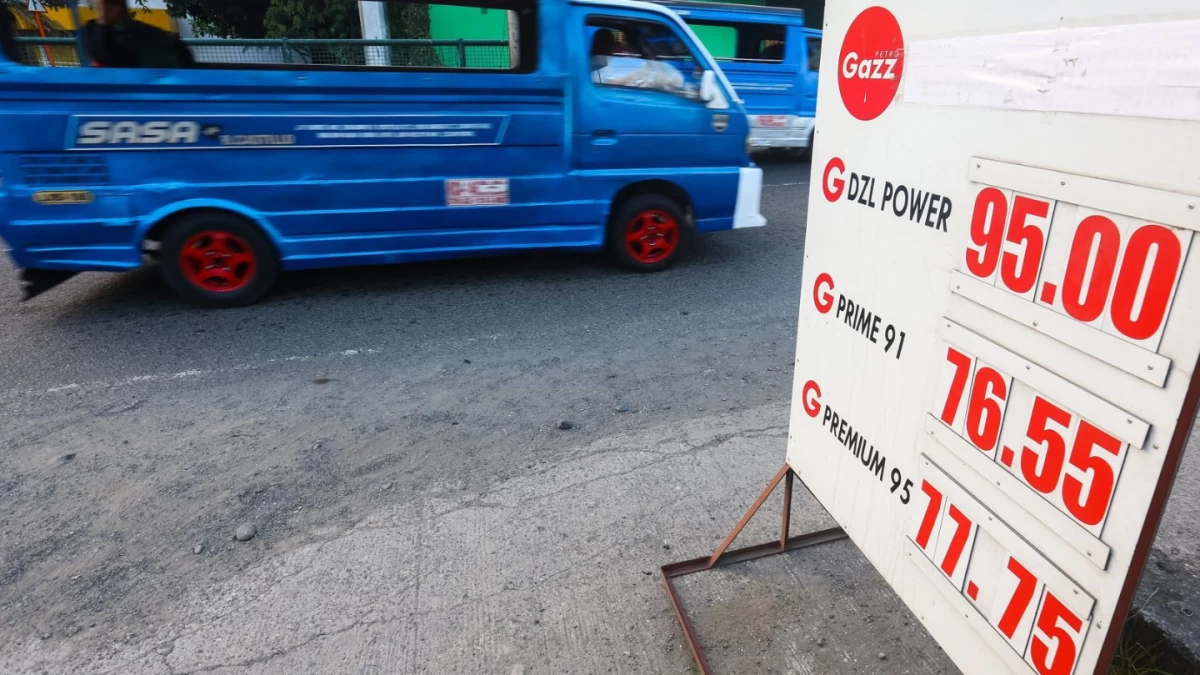
Fuel prices are displayed at a pump in Davao City on Tuesday. The Philippine Department of Energy is urging companies to stagger price increases as the country’s fuel supply buffer narrows to 38 days. (Photo by Keith Bacongco I MB)
For weeks, motorists have chased discounts and lined up for cheaper fuel amid double-digit hikes in gasoline and diesel prices. Now, a new concern is emerging: supply. While consumers can prepare for higher prices, a shortage is far harder to plan for.
A government audit indicated that the national fuel supply has retreated to 38 days of inventory, according to a person familiar with the matter who asked not to be identified. At current consumption rates, that volume would sustain the market only through the final week of April.
While the Department of Energy (DOE) has previously said fuel stocks are sufficient until next month, April is not far off.
Energy Secretary Sharon Garin clarified to Manila Bulletin that, as per regulation, local oil companies and bulk suppliers (except refiners) are mandated to maintain a minimum inventory of at least 15 days of petroleum supply.
The government does not set a specific barrel-volume threshold to determine whether the country’s fuel supply is sufficient; instead, it relies on a days-of-supply measure.
Garin emphasized that supply security is not just a nationwide problem; the whole world is racing towards it.
“As you have seen the news, many countries have taken extra steps already to ensure that their supply are stable and curbing the demand also, and to control [it] to prolong the supply. So the most important thing for today is that we have a supply. There is no need to cause panic among our people,” she said in an ambush interview, stressing the need to lessen hoarding.
Prior to some nations pausing their exports to protect domestic supply, the Philippines sourced its oil from South Korea, China, Japan, and Thailand.
“So, our refineries where we buy from the supplier countries are also constrained,” she added.
The 38-day inventory is gradually nearing the minimum required level, especially as some countries have restricted exports.
A source from the oil industry said that this level can still be considered “secured,” but noted that if this falls below 30 days without any further actions taken (such as securing replacement cargoes), it could risk not only driving prices upward but also paralyzing the transport sector.
“The major worry at the moment and in the coming days, assuming there will be no favorable developments in the Middle East crisis, is the replenishment of supply,” the source told Manila Bulletin, noting that Chinese refineries have gone on force majeure due to export bans. On top of this, the lack of crude feedstock from the Middle East is crippling other suppliers.
According to Ser Peña-Reyes, director at Ateneo Center for Economic Research and Development (ACERD), the shrinking of oil supply would shift the supply curve, noting that “When the supply curve shifts to the left, equilibrium output decreases while equilibrium price increases.”
Chinabank Capital Corporation Managing Director Juan Paolo Colet explained that overreliance on foreign oil has created a domino effect, as the tightening of domestic supply, fueled by hoarding and unjustified profiteering, would hit motorists the hardest.
“The bulk of our transportation modalities depend on oil to keep them running,” he told Manila Bulletin. “A significant reduction in that supply would limit mobility, disrupt supply chains, drive up the cost of goods, and dampen overall economic activity.”
So far, motorists have seen some relief on the budgeting side, as the DOE has urged oil companies to stagger fuel price increases. The government has also rolled out subsidies, while some companies continue to offer pump discounts.
“In terms of subsidies, assistance programs, and other mechanisms in place as also provided by law to mitigate the effects of higher oil prices and inflation, especially on the most vulnerable sectors such as transportation, fisherfolk, farmers, and the poorest of the poor,” said Michael Ricafort, chief economist at the Rizal Commercial Banking Corp.
He also suggested that early adoption of renewable energy and electric vehicles may have provided some relief to commuters and households, slightly reducing reliance on imported fuels.
ADVERTISEMENT
.most-popular .layout-ratio{ padding-bottom: 79.13%; } @media (min-width: 768px) and (max-width: 1024px) { .widget-title { font-size: 15px !important; } }

{{ articles_filter_1561_widget.title }}

.most-popular .layout-ratio{ padding-bottom: 79.13%; } @media (min-width: 768px) and (max-width: 1024px) { .widget-title { font-size: 15px !important; } }

{{ articles_filter_1562_widget.title }}

.most-popular .layout-ratio{ padding-bottom: 79.13%; } @media (min-width: 768px) and (max-width: 1024px) { .widget-title { font-size: 15px !important; } }

{{ articles_filter_1563_widget.title }}

{{ articles_filter_1564_widget.title }}

.mb-article-details { position: relative; } .mb-article-details .article-body-preview, .mb-article-details .article-body-summary{ font-size: 17px; line-height: 30px; font-family: "Libre Caslon Text", serif; color: #000; } .mb-article-details .article-body-preview iframe , .mb-article-details .article-body-summary iframe{ width: 100%; margin: auto; } .read-more-background { background: linear-gradient(180deg, color(display-p3 1.000 1.000 1.000 / 0) 13.75%, color(display-p3 1.000 1.000 1.000 / 0.8) 30.79%, color(display-p3 1.000 1.000 1.000) 72.5%); position: absolute; height: 200px; width: 100%; bottom: 0; display: flex; justify-content: center; align-items: center; padding: 0; } .read-more-background a{ color: #000; } .read-more-btn { padding: 17px 45px; font-family: Inter; font-weight: 700; font-size: 18px; line-height: 16px; text-align: center; vertical-align: middle; border: 1px solid black; background-color: white; } .hidden { display: none; }
function initializeAllSwipers() { // Get all hidden inputs with cms_article_id document.querySelectorAll('[id^="cms_article_id_"]').forEach(function (input) { const cmsArticleId = input.value; const articleSelector = '#article-' + cmsArticleId + ' .body_images'; const swiperElement = document.querySelector(articleSelector); if (swiperElement && !swiperElement.classList.contains('swiper-initialized')) { new Swiper(articleSelector, { loop: true, pagination: false, navigation: { nextEl: '#article-' + cmsArticleId + ' .swiper-button-next', prevEl: '#article-' + cmsArticleId + ' .swiper-button-prev', }, }); } }); } setTimeout(initializeAllSwipers, 3000); const intersectionObserver = new IntersectionObserver( (entries) => { entries.forEach((entry) => { if (entry.isIntersecting) { const newUrl = entry.target.getAttribute("data-url"); if (newUrl) { history.pushState(null, null, newUrl); let article = entry.target; // Extract metadata const author = article.querySelector('.author-section').textContent.replace('By', '').trim(); const section = article.querySelector('.section-info ').textContent.replace(' ', ' '); const title = article.querySelector('.article-title h1').textContent; // Parse URL for Chartbeat path format const parsedUrl = new URL(newUrl, window.location.origin); const cleanUrl = parsedUrl.host + parsedUrl.pathname; // Update Chartbeat configuration if (typeof window._sf_async_config !== 'undefined') { window._sf_async_config.path = cleanUrl; window._sf_async_config.sections = section; window._sf_async_config.authors = author; } // Track virtual page view with Chartbeat if (typeof pSUPERFLY !== 'undefined' && typeof pSUPERFLY.virtualPage === 'function') { try { pSUPERFLY.virtualPage({ path: cleanUrl, title: title, sections: section, authors: author }); } catch (error) { console.error('ping error', error); } } // Optional: Update document title if (title && title !== document.title) { document.title = title; } } } }); }, { threshold: 0.1 } ); function showArticleBody(button) { const article = button.closest("article"); const summary = article.querySelector(".article-body-summary"); const body = article.querySelector(".article-body-preview"); const readMoreSection = article.querySelector(".read-more-background"); // Hide summary and read-more section summary.style.display = "none"; readMoreSection.style.display = "none"; // Show the full article body body.classList.remove("hidden"); } document.addEventListener("DOMContentLoaded", () => { let loadCount = 0; // Track how many times articles are loaded const offset = [1, 2, 3, 4, 5, 6, 7, 8, 9, 10]; // Offset values const currentUrl = window.location.pathname.substring(1); let isLoading = false; // Prevent multiple calls if (!currentUrl) { console.log("Current URL is invalid."); return; } const sentinel = document.getElementById("load-more-sentinel"); if (!sentinel) { console.log("Sentinel element not found."); return; } function isSentinelVisible() { const rect = sentinel.getBoundingClientRect(); return ( rect.top < window.innerHeight && rect.bottom >= 0 ); } function onScroll() { if (isLoading) return; if (isSentinelVisible()) { if (loadCount >= offset.length) { console.log("Maximum load attempts reached."); window.removeEventListener("scroll", onScroll); return; } isLoading = true; const currentOffset = offset[loadCount]; window.loadMoreItems().then(() => { let article = document.querySelector('#widget_1690 > div:nth-last-of-type(2) article'); intersectionObserver.observe(article) loadCount++; }).catch(error => { console.error("Error loading more items:", error); }).finally(() => { isLoading = false; }); } } window.addEventListener("scroll", onScroll); });

Sign up by email to receive news.