ADVERTISEMENT

Middle East war raises global recession risks—Oxford Economics

Published Mar 17, 2026 08:53 am
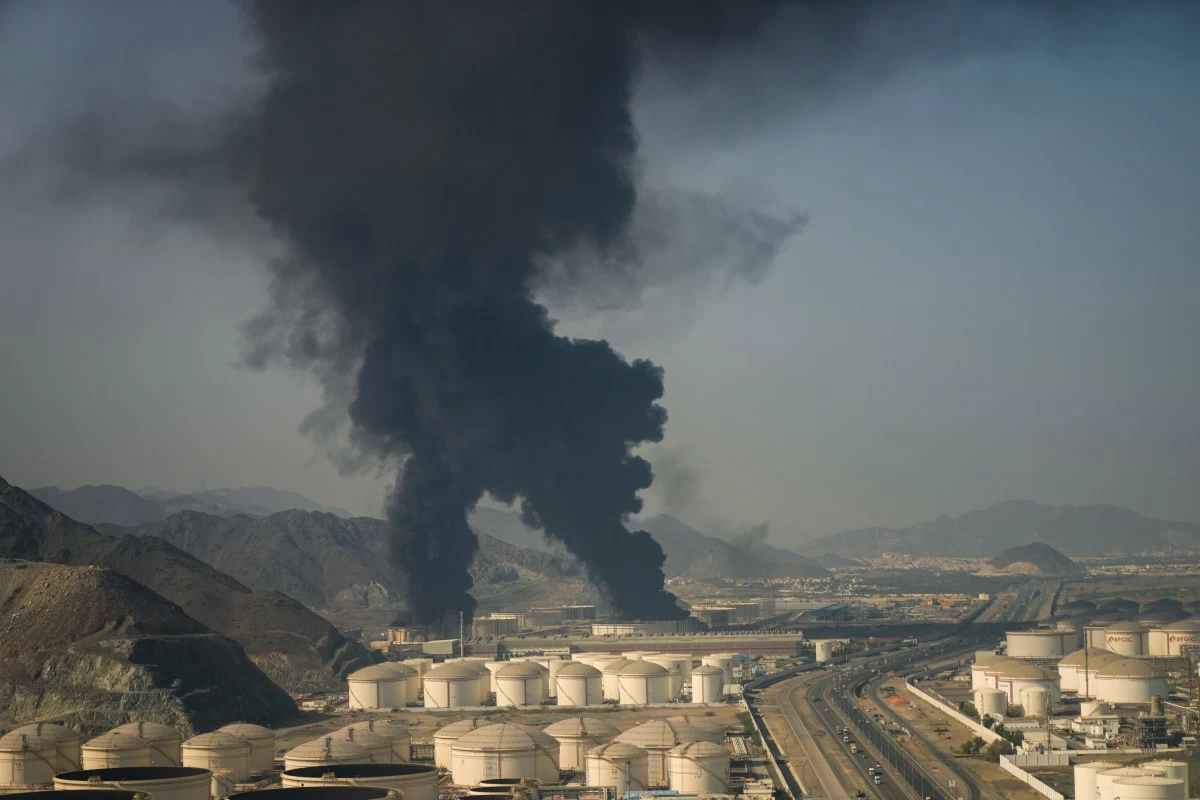
Fire and plumes of smoke rise from an oil facility in Fujairah, United Arab Emirates, Saturday, March 14, 2026. (AP Photo/Altaf Qadri)

Businesses worldwide remain broadly optimistic about global growth despite the ongoing conflict in the Middle East, although fears of a recession have risen, according to a survey by think tank Oxford Economics.

Oxford Economics head of macro scenarios Jamie Thompson said in a report on Monday, March 16, that companies still expect solid global expansion in the coming year even as the war has dented confidence and raised uncertainty about economic prospects.

Based on Oxford Economics’ latest Global Risk Survey, businesses now estimate a roughly one-in-six chance that the global economy could slip into recession this year.

“A sharp rise in Middle East concerns—to an even higher level than at the start of the Israel-Hamas war—has been accompanied by a notable rise in perceived recession risks,” Oxford Economics said.

The survey was conducted from Feb. 26 to March 11 among 174 companies and covered the period just before and after the start of air strikes by the United States (US) and Israel on Iran, as well as the second week of hostilities when oil prices surged above $100 per barrel.

Despite the heightened risks, businesses largely still anticipate steady economic expansion.

“Overall, businesses continue to anticipate a solid pace of global expansion in the year ahead,” Oxford Economics said.

The think tank noted that expected global growth in 2026 has been trimmed only slightly since the conflict erupted, with mean expectations downgraded by just 0.2 percentage point (ppt). This is far smaller than the 1.3-ppt drop in growth expectations recorded after Russia’s invasion of Ukraine in 2022.

Its Global Business Sentiment Index suggests the world economy could grow by about 2.2 percent in 2026, somewhat weaker than the think tank’s baseline forecast but still reflecting continued expansion.

Even so, the war has made businesses more cautious about the economic outlook over the next two years.

“Based on responses over the past week, the proportion of respondents reporting themselves more negative about the outlook over the next two years has roughly doubled, to around three-quarters,” Oxford Economics said.

Still, the share of businesses viewing the outlook as significantly worse remains well below levels seen at the start of the Russia-Ukraine conflict.

The conflict has also shaken confidence in the strength of the US economy, the think tank said.

Before the outbreak of war, more than three-quarters of respondents believed the recent period of “US exceptionalism” would continue. But that figure has fallen to just over half, with fewer businesses expecting the US to remain the fastest-growing economy among the Group of Seven (G-7) this year.

At the same time, concerns about global trade tensions have eased.

Only 27 percent of respondents now view a global trade war as a very significant risk to the world economy over the next two years, down from more than half six months ago.

“Trade war fears are at their lowest level since before [US] President Donald Trump’s election victory,” the report said.

Meanwhile, companies expect limited changes in monetary policy this year. Fewer than one in 10 respondents foresee more than 50 basis points (bps) of interest-rate cuts in 2026 by major central banks, including the Federal Reserve (US Fed), European Central Bank (ECB), and Bank of England (BoE).

Despite the rising geopolitical risks, businesses still see continued economic expansion as the most likely scenario, albeit at a slightly slower pace than earlier anticipated, Oxford Economics said.

ADVERTISEMENT
.most-popular .layout-ratio{ padding-bottom: 79.13%; } @media (min-width: 768px) and (max-width: 1024px) { .widget-title { font-size: 15px !important; } }

{{ articles_filter_1561_widget.title }}

.most-popular .layout-ratio{ padding-bottom: 79.13%; } @media (min-width: 768px) and (max-width: 1024px) { .widget-title { font-size: 15px !important; } }

{{ articles_filter_1562_widget.title }}

.most-popular .layout-ratio{ padding-bottom: 79.13%; } @media (min-width: 768px) and (max-width: 1024px) { .widget-title { font-size: 15px !important; } }

{{ articles_filter_1563_widget.title }}

{{ articles_filter_1564_widget.title }}

.mb-article-details { position: relative; } .mb-article-details .article-body-preview, .mb-article-details .article-body-summary{ font-size: 17px; line-height: 30px; font-family: "Libre Caslon Text", serif; color: #000; } .mb-article-details .article-body-preview iframe , .mb-article-details .article-body-summary iframe{ width: 100%; margin: auto; } .read-more-background { background: linear-gradient(180deg, color(display-p3 1.000 1.000 1.000 / 0) 13.75%, color(display-p3 1.000 1.000 1.000 / 0.8) 30.79%, color(display-p3 1.000 1.000 1.000) 72.5%); position: absolute; height: 200px; width: 100%; bottom: 0; display: flex; justify-content: center; align-items: center; padding: 0; } .read-more-background a{ color: #000; } .read-more-btn { padding: 17px 45px; font-family: Inter; font-weight: 700; font-size: 18px; line-height: 16px; text-align: center; vertical-align: middle; border: 1px solid black; background-color: white; } .hidden { display: none; }
function initializeAllSwipers() { // Get all hidden inputs with cms_article_id document.querySelectorAll('[id^="cms_article_id_"]').forEach(function (input) { const cmsArticleId = input.value; const articleSelector = '#article-' + cmsArticleId + ' .body_images'; const swiperElement = document.querySelector(articleSelector); if (swiperElement && !swiperElement.classList.contains('swiper-initialized')) { new Swiper(articleSelector, { loop: true, pagination: false, navigation: { nextEl: '#article-' + cmsArticleId + ' .swiper-button-next', prevEl: '#article-' + cmsArticleId + ' .swiper-button-prev', }, }); } }); } setTimeout(initializeAllSwipers, 3000); const intersectionObserver = new IntersectionObserver( (entries) => { entries.forEach((entry) => { if (entry.isIntersecting) { const newUrl = entry.target.getAttribute("data-url"); if (newUrl) { history.pushState(null, null, newUrl); let article = entry.target; // Extract metadata const author = article.querySelector('.author-section').textContent.replace('By', '').trim(); const section = article.querySelector('.section-info ').textContent.replace(' ', ' '); const title = article.querySelector('.article-title h1').textContent; // Parse URL for Chartbeat path format const parsedUrl = new URL(newUrl, window.location.origin); const cleanUrl = parsedUrl.host + parsedUrl.pathname; // Update Chartbeat configuration if (typeof window._sf_async_config !== 'undefined') { window._sf_async_config.path = cleanUrl; window._sf_async_config.sections = section; window._sf_async_config.authors = author; } // Track virtual page view with Chartbeat if (typeof pSUPERFLY !== 'undefined' && typeof pSUPERFLY.virtualPage === 'function') { try { pSUPERFLY.virtualPage({ path: cleanUrl, title: title, sections: section, authors: author }); } catch (error) { console.error('ping error', error); } } // Optional: Update document title if (title && title !== document.title) { document.title = title; } } } }); }, { threshold: 0.1 } ); function showArticleBody(button) { const article = button.closest("article"); const summary = article.querySelector(".article-body-summary"); const body = article.querySelector(".article-body-preview"); const readMoreSection = article.querySelector(".read-more-background"); // Hide summary and read-more section summary.style.display = "none"; readMoreSection.style.display = "none"; // Show the full article body body.classList.remove("hidden"); } document.addEventListener("DOMContentLoaded", () => { let loadCount = 0; // Track how many times articles are loaded const offset = [1, 2, 3, 4, 5, 6, 7, 8, 9, 10]; // Offset values const currentUrl = window.location.pathname.substring(1); let isLoading = false; // Prevent multiple calls if (!currentUrl) { console.log("Current URL is invalid."); return; } const sentinel = document.getElementById("load-more-sentinel"); if (!sentinel) { console.log("Sentinel element not found."); return; } function isSentinelVisible() { const rect = sentinel.getBoundingClientRect(); return ( rect.top < window.innerHeight && rect.bottom >= 0 ); } function onScroll() { if (isLoading) return; if (isSentinelVisible()) { if (loadCount >= offset.length) { console.log("Maximum load attempts reached."); window.removeEventListener("scroll", onScroll); return; } isLoading = true; const currentOffset = offset[loadCount]; window.loadMoreItems().then(() => { let article = document.querySelector('#widget_1690 > div:nth-last-of-type(2) article'); intersectionObserver.observe(article) loadCount++; }).catch(error => { console.error("Error loading more items:", error); }).finally(() => { isLoading = false; }); } } window.addEventListener("scroll", onScroll); });

Sign up by email to receive news.