ADVERTISEMENT

Middle East war could trigger inflation, slow Philippine growth—DLSU economists

Published Mar 17, 2026 06:00 pm
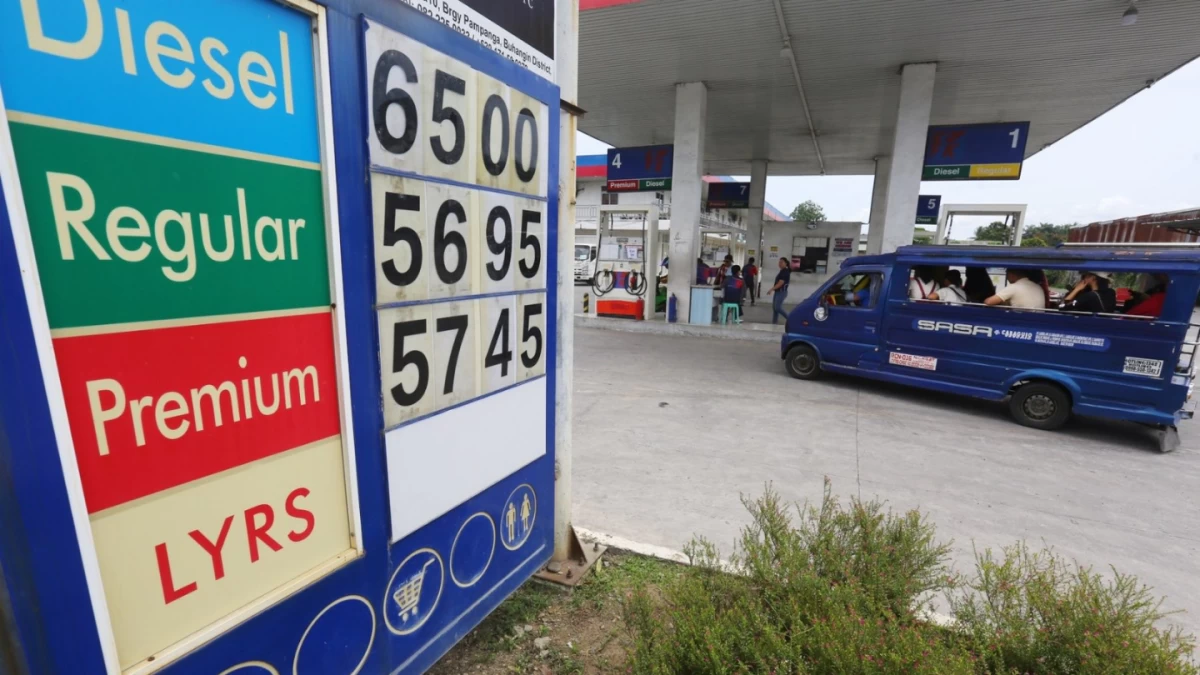
A Gas station in Davao City displays current pump prices as of March 5, 2026, amid warnings of a significant price increase next week. Energy officials and local retailers are monitoring the market closely as geopolitical instability in the Middle East continues to drive up global oil costs. (Photo by Keith Bacongco I MB)

A widening war in the Middle East could significantly disrupt the Philippine economy by fueling inflation, weakening growth prospects, and threatening remittance flows from overseas Filipino workers (OFWs), according to the latest report by economists from De La Salle University (DLSU).

Authored by Jesus Felipe, Mariel Monica Sauler, Gerome Vedeja, and Seth Paolo Paden, the new report warned that the conflict involving the United States (US), Israel, and Iran poses a major external risk to the Philippines due to its heavy dependence on imported energy and overseas labor deployment to the region.

“At present, the ongoing conflict in the Middle East remains the primary source of global external risk,” the economists wrote in DLSU’s report of the Philippine economy for March 2026.

They noted that oil prices have already surged amid fears of supply disruptions and that projections suggest prices could reach extreme levels.

“The per-barrel price of oil has rapidly climbed over the past weeks, with projections that it may reach $140—a level that would drastically alter the inflation outlook and amplify the growth constraints,” the report said.

Higher oil prices would directly increase production costs for businesses, which could eventually be passed on to consumers through higher prices of goods and services.

“This fuel price shock directly feeds into firms’ production costs, dampening business confidence and contributing to the contraction in capital formation. The cost will be passed on to households,” the report added.

DLSU economists warned that rising inflation could further weaken household spending, a key driver of the Philippine economy.

“Beyond its inflationary impact, the heightening tensions endanger many OFWs in the Middle East and their remittance flows amounting to about $30 billion,” they said.

“Threats on this critical consumption line for millions of Filipino households compound their already-deteriorating purchasing power due to foreseen inflation spikes, further undermining the role of private consumption to usher in rapid economic expansion,” they added.

The report highlighted the Philippines’ vulnerability to oil supply disruptions from the Middle East.

“Countries across Southeast Asia, including the Philippines, are particularly exposed to disruptions in Gulf energy flows,” the economists wrote.

They explained that much of the crude oil used by the Philippines originates from major Middle Eastern producers such as Iraq, Kuwait, Saudi Arabia, and the United Arab Emirates (UAE).

“The Philippines’ dependence on Middle Eastern energy operates through two channels,” the report noted. “On the one hand, the country imports crude oil—about 98 percent of which comes from the Middle East. On the other hand, it imports refined fuels such as gasoline, diesel, and jet fuel mainly from Asian refining hubs… Yet these refineries themselves rely heavily on Middle Eastern crude.”

“In practice, therefore, the country remains highly exposed to disruptions in Gulf energy supply,” it pointed out.

At the center of the potential supply shock is the Strait of Hormuz, a strategic chokepoint through which a large share of global energy flows. “Roughly one-fifth of the world’s oil supply passes through this narrow corridor, along with large volumes of refined fuels, petrochemical inputs, fertilizers, and around 20 percent of global liquefied natural gas (LNG),” the report noted, adding that any disruption in this shipping route could quickly ripple through global energy markets.

The economists also warned that the energy shock could complicate monetary policy decisions by the Bangko Sentral ng Pilipinas (BSP), pointing out that the central bank had already begun lowering key interest rates before the conflict escalated.

“If inflation picks up as a result of an increase in oil prices, will the BSP reverse the recent decrease?” they said.

According to the economists, rising oil prices could push inflation higher and even force the central bank to consider tightening policy again. “Baseline inflation projections (that even exclude worst-case oil price scenarios) now support the case for monetary tightening,” they added, referring to interest rate hikes.

“This is due to the possibility of inflation reaching four percent once oil prices hit over $100 per barrel (already there) and remaining at this level for some time.”

The economists added that the Philippine peso’s depreciation could further amplify inflation risks.

The report warned that the combination of slower growth and higher inflation could create a difficult economic environment.

“Unless these qualms are put to rest, a new chapter of uncertainty worsened by external factors commences—and stagflation becomes a looming, inevitable reality.”

The authors also cautioned that monetary policy alone may not be enough to restore economic momentum.

“These constraints highlight a broader point... monetary policy alone is insufficient to restore economic confidence, especially in an environment beset by serious governance issues,” the report said.

Instead, the economists emphasized the need for stronger fiscal policy and credible public investment to help the economy withstand external shocks triggered by the escalating Middle East conflict.

ADVERTISEMENT
.most-popular .layout-ratio{ padding-bottom: 79.13%; } @media (min-width: 768px) and (max-width: 1024px) { .widget-title { font-size: 15px !important; } }

{{ articles_filter_1561_widget.title }}

.most-popular .layout-ratio{ padding-bottom: 79.13%; } @media (min-width: 768px) and (max-width: 1024px) { .widget-title { font-size: 15px !important; } }

{{ articles_filter_1562_widget.title }}

.most-popular .layout-ratio{ padding-bottom: 79.13%; } @media (min-width: 768px) and (max-width: 1024px) { .widget-title { font-size: 15px !important; } }

{{ articles_filter_1563_widget.title }}

{{ articles_filter_1564_widget.title }}

.mb-article-details { position: relative; } .mb-article-details .article-body-preview, .mb-article-details .article-body-summary{ font-size: 17px; line-height: 30px; font-family: "Libre Caslon Text", serif; color: #000; } .mb-article-details .article-body-preview iframe , .mb-article-details .article-body-summary iframe{ width: 100%; margin: auto; } .read-more-background { background: linear-gradient(180deg, color(display-p3 1.000 1.000 1.000 / 0) 13.75%, color(display-p3 1.000 1.000 1.000 / 0.8) 30.79%, color(display-p3 1.000 1.000 1.000) 72.5%); position: absolute; height: 200px; width: 100%; bottom: 0; display: flex; justify-content: center; align-items: center; padding: 0; } .read-more-background a{ color: #000; } .read-more-btn { padding: 17px 45px; font-family: Inter; font-weight: 700; font-size: 18px; line-height: 16px; text-align: center; vertical-align: middle; border: 1px solid black; background-color: white; } .hidden { display: none; }
function initializeAllSwipers() { // Get all hidden inputs with cms_article_id document.querySelectorAll('[id^="cms_article_id_"]').forEach(function (input) { const cmsArticleId = input.value; const articleSelector = '#article-' + cmsArticleId + ' .body_images'; const swiperElement = document.querySelector(articleSelector); if (swiperElement && !swiperElement.classList.contains('swiper-initialized')) { new Swiper(articleSelector, { loop: true, pagination: false, navigation: { nextEl: '#article-' + cmsArticleId + ' .swiper-button-next', prevEl: '#article-' + cmsArticleId + ' .swiper-button-prev', }, }); } }); } setTimeout(initializeAllSwipers, 3000); const intersectionObserver = new IntersectionObserver( (entries) => { entries.forEach((entry) => { if (entry.isIntersecting) { const newUrl = entry.target.getAttribute("data-url"); if (newUrl) { history.pushState(null, null, newUrl); let article = entry.target; // Extract metadata const author = article.querySelector('.author-section').textContent.replace('By', '').trim(); const section = article.querySelector('.section-info ').textContent.replace(' ', ' '); const title = article.querySelector('.article-title h1').textContent; // Parse URL for Chartbeat path format const parsedUrl = new URL(newUrl, window.location.origin); const cleanUrl = parsedUrl.host + parsedUrl.pathname; // Update Chartbeat configuration if (typeof window._sf_async_config !== 'undefined') { window._sf_async_config.path = cleanUrl; window._sf_async_config.sections = section; window._sf_async_config.authors = author; } // Track virtual page view with Chartbeat if (typeof pSUPERFLY !== 'undefined' && typeof pSUPERFLY.virtualPage === 'function') { try { pSUPERFLY.virtualPage({ path: cleanUrl, title: title, sections: section, authors: author }); } catch (error) { console.error('ping error', error); } } // Optional: Update document title if (title && title !== document.title) { document.title = title; } } } }); }, { threshold: 0.1 } ); function showArticleBody(button) { const article = button.closest("article"); const summary = article.querySelector(".article-body-summary"); const body = article.querySelector(".article-body-preview"); const readMoreSection = article.querySelector(".read-more-background"); // Hide summary and read-more section summary.style.display = "none"; readMoreSection.style.display = "none"; // Show the full article body body.classList.remove("hidden"); } document.addEventListener("DOMContentLoaded", () => { let loadCount = 0; // Track how many times articles are loaded const offset = [1, 2, 3, 4, 5, 6, 7, 8, 9, 10]; // Offset values const currentUrl = window.location.pathname.substring(1); let isLoading = false; // Prevent multiple calls if (!currentUrl) { console.log("Current URL is invalid."); return; } const sentinel = document.getElementById("load-more-sentinel"); if (!sentinel) { console.log("Sentinel element not found."); return; } function isSentinelVisible() { const rect = sentinel.getBoundingClientRect(); return ( rect.top < window.innerHeight && rect.bottom >= 0 ); } function onScroll() { if (isLoading) return; if (isSentinelVisible()) { if (loadCount >= offset.length) { console.log("Maximum load attempts reached."); window.removeEventListener("scroll", onScroll); return; } isLoading = true; const currentOffset = offset[loadCount]; window.loadMoreItems().then(() => { let article = document.querySelector('#widget_1690 > div:nth-last-of-type(2) article'); intersectionObserver.observe(article) loadCount++; }).catch(error => { console.error("Error loading more items:", error); }).finally(() => { isLoading = false; }); } } window.addEventListener("scroll", onScroll); });

Sign up by email to receive news.