

ADVERTISEMENT

Why a 'third place' matters in promoting reading

As it celebrates its fourth year, the Philippine Book Festival aims to turn reading into a shared habit

Published Mar 14, 2026 09:15 am
What do Filipinos like to do in their free time? Finding the answer to that question can be a daunting task and will likely produce a lot of different results. To simplify it, the National Book Development Board (NBDB), the country’s agency in charge of developing and supporting the Philippine book publishing industry, asked 300 librarians and learning area coordinators. Their response, according to NBDB Executive Director Charisse Aquino-Tugade, is somewhat reflective of many Filipinos today.
At the top of the list is social media. Second and third are bonding with family and watching movies or shows. Reading comes in fourth, while going to the mall rounds out the top five.
“We all know that the apple doesn’t fall far from the tree,” Charisse said. “We all know that kids will be similar to us, and there’s a high chance that children will be this way.”
As the country’s publishing authority, the NBDB is tasked with promoting the growth of Filipino books and reading culture. Based on the data they have collected, the challenge today is to move family bonding to the top of the list, with reading coming in second as a family’s way of spending time together.
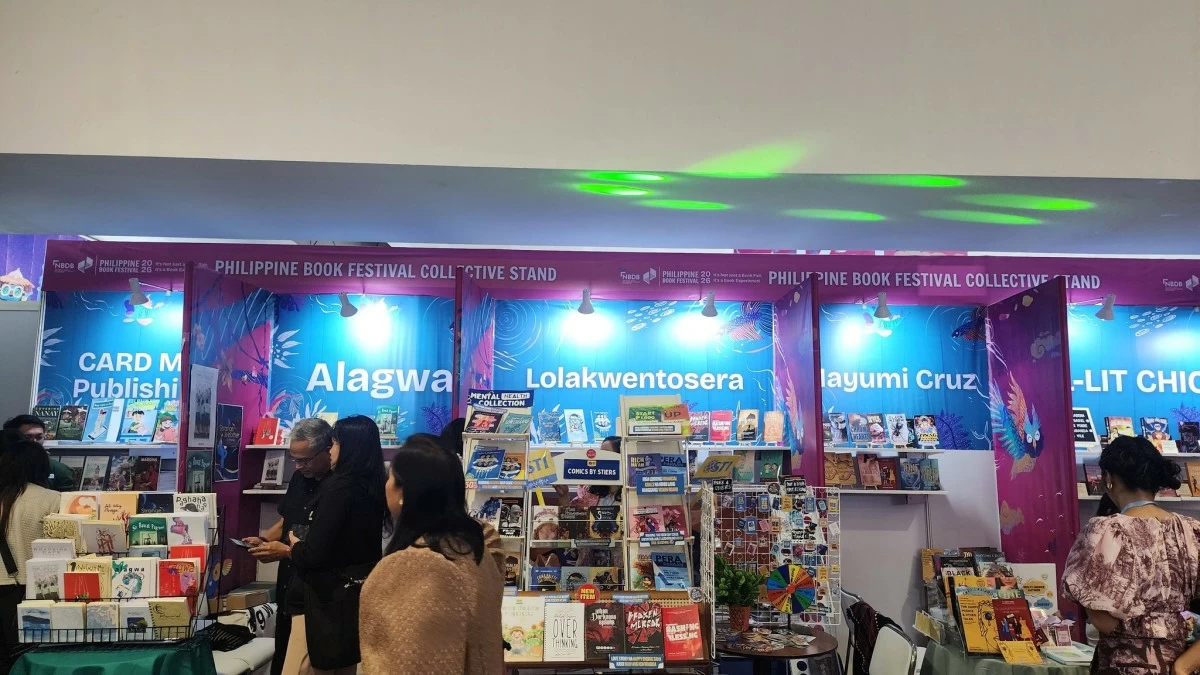
That is something they hope to address through the annual Philippine Book Festival (PBF). Now in its fourth year, the festival is the biggest gathering of Filipino-authored books. But it is not just about showcasing Filipino voices, nor is it merely a marketplace for publishing companies. For the 2026 edition of the festival, the NBDB is once again highlighting the importance of a “third place”—a space with no entry requirement other than showing up, where people mix across usual boundaries and stay because something about the place earns their loyalty.
“A Filipino reader who has never thought of themselves as a reader is more likely to become one in a space that feels alive, that feels like it was made with care and imagination, than in one that simply stocks titles,” Charisse explained during the opening of the fourth PBF on March 12, 2026. “The argument the PBF keeps making, year after year, is that Filipino creative work deserves exactly that kind of space. Not a corner. Not a footnote. A room of its own, for a few days at a time, for as long as it takes for that to stop being something we have to fight for.”
This year, the PBF plays with the theme “Gubat ng Karunungan,” or “Rainforest of Knowledge.” Together with artist and designer Joffrey “Pepot” Atienza, the organizers have transformed the vast venue into a forest filled with Filipino books, reading areas, and cozy nooks where readers can meet their literary heroes.
The festival features its signature areas. Aral Aklat highlights books as tools for learning and discovery, featuring textbooks and teaching guides. Booktopia invites visitors to explore the breadth of Filipino fiction and nonfiction. Kid Lit nurtures early readers through interactive, child-friendly experiences. Komiks celebrates the visual richness of Filipino comics and graphic storytelling.
To elevate the experience this year, the PBF also introduces five new activations. Lugar Lagdaan is the go-to spot for book signings, where readers can meet the people behind the stories they love. Bahay Ilustrador is where illustrators, comic artists, and graphic storytellers demonstrate how images can speak louder than words. Gubat ng Karunungan offers workshops, masterclasses, and learning sessions for curious minds of all ages. Fiesta Stage serves as the main stage—the heartbeat of PBF—where grand performances and panel discussions unfold. Umpukan is the chill zone for intimate talks and idea-sharing sessions where conversations flow freely.
All these efforts aim to ensure that the festival’s mission of creating a third space achieves its goals: to make reading a habit for every member of the family, to bring Filipino literature closer to the masses, and to help the local publishing industry thrive.
“The Philippine Book Festival is positioned not only as a literary event but also as a third place that connects key players in the publishing and education sectors,” Charisse said. “By convening publishers, institutional buyers, educators, and readers in a single venue, the festival supports broader efforts to improve access to quality Philippine books and sustain the local publishing industry.”
The 2026 Philippine Book Festival runs until March 15, 2026, at the Megatrade Hall of SM Megamall in Mandaluyong City.

Related Tags

Luminaries Philippine Book Festival
ADVERTISEMENT
.most-popular .layout-ratio{ padding-bottom: 79.13%; } @media (min-width: 768px) and (max-width: 1024px) { .widget-title { font-size: 15px !important; } }

{{ articles_filter_1561_widget.title }}

.most-popular .layout-ratio{ padding-bottom: 79.13%; } @media (min-width: 768px) and (max-width: 1024px) { .widget-title { font-size: 15px !important; } }

{{ articles_filter_1562_widget.title }}

.most-popular .layout-ratio{ padding-bottom: 79.13%; } @media (min-width: 768px) and (max-width: 1024px) { .widget-title { font-size: 15px !important; } }

{{ articles_filter_1563_widget.title }}

{{ articles_filter_1564_widget.title }}

.mb-article-details { position: relative; } .mb-article-details .article-body-preview, .mb-article-details .article-body-summary{ font-size: 17px; line-height: 30px; font-family: "Libre Caslon Text", serif; color: #000; } .mb-article-details .article-body-preview iframe , .mb-article-details .article-body-summary iframe{ width: 100%; margin: auto; } .read-more-background { background: linear-gradient(180deg, color(display-p3 1.000 1.000 1.000 / 0) 13.75%, color(display-p3 1.000 1.000 1.000 / 0.8) 30.79%, color(display-p3 1.000 1.000 1.000) 72.5%); position: absolute; height: 200px; width: 100%; bottom: 0; display: flex; justify-content: center; align-items: center; padding: 0; } .read-more-background a{ color: #000; } .read-more-btn { padding: 17px 45px; font-family: Inter; font-weight: 700; font-size: 18px; line-height: 16px; text-align: center; vertical-align: middle; border: 1px solid black; background-color: white; } .hidden { display: none; }
function initializeAllSwipers() { // Get all hidden inputs with cms_article_id document.querySelectorAll('[id^="cms_article_id_"]').forEach(function (input) { const cmsArticleId = input.value; const articleSelector = '#article-' + cmsArticleId + ' .body_images'; const swiperElement = document.querySelector(articleSelector); if (swiperElement && !swiperElement.classList.contains('swiper-initialized')) { new Swiper(articleSelector, { loop: true, pagination: false, navigation: { nextEl: '#article-' + cmsArticleId + ' .swiper-button-next', prevEl: '#article-' + cmsArticleId + ' .swiper-button-prev', }, }); } }); } setTimeout(initializeAllSwipers, 3000); const intersectionObserver = new IntersectionObserver( (entries) => { entries.forEach((entry) => { if (entry.isIntersecting) { const newUrl = entry.target.getAttribute("data-url"); if (newUrl) { history.pushState(null, null, newUrl); let article = entry.target; // Extract metadata const author = article.querySelector('.author-section').textContent.replace('By', '').trim(); const section = article.querySelector('.section-info ').textContent.replace(' ', ' '); const title = article.querySelector('.article-title h1').textContent; // Parse URL for Chartbeat path format const parsedUrl = new URL(newUrl, window.location.origin); const cleanUrl = parsedUrl.host + parsedUrl.pathname; // Update Chartbeat configuration if (typeof window._sf_async_config !== 'undefined') { window._sf_async_config.path = cleanUrl; window._sf_async_config.sections = section; window._sf_async_config.authors = author; } // Track virtual page view with Chartbeat if (typeof pSUPERFLY !== 'undefined' && typeof pSUPERFLY.virtualPage === 'function') { try { pSUPERFLY.virtualPage({ path: cleanUrl, title: title, sections: section, authors: author }); } catch (error) { console.error('ping error', error); } } // Optional: Update document title if (title && title !== document.title) { document.title = title; } } } }); }, { threshold: 0.1 } ); function showArticleBody(button) { const article = button.closest("article"); const summary = article.querySelector(".article-body-summary"); const body = article.querySelector(".article-body-preview"); const readMoreSection = article.querySelector(".read-more-background"); // Hide summary and read-more section summary.style.display = "none"; readMoreSection.style.display = "none"; // Show the full article body body.classList.remove("hidden"); } document.addEventListener("DOMContentLoaded", () => { let loadCount = 0; // Track how many times articles are loaded const offset = [1, 2, 3, 4, 5, 6, 7, 8, 9, 10]; // Offset values const currentUrl = window.location.pathname.substring(1); let isLoading = false; // Prevent multiple calls if (!currentUrl) { console.log("Current URL is invalid."); return; } const sentinel = document.getElementById("load-more-sentinel"); if (!sentinel) { console.log("Sentinel element not found."); return; } function isSentinelVisible() { const rect = sentinel.getBoundingClientRect(); return ( rect.top < window.innerHeight && rect.bottom >= 0 ); } function onScroll() { if (isLoading) return; if (isSentinelVisible()) { if (loadCount >= offset.length) { console.log("Maximum load attempts reached."); window.removeEventListener("scroll", onScroll); return; } isLoading = true; const currentOffset = offset[loadCount]; window.loadMoreItems().then(() => { let article = document.querySelector('#widget_1690 > div:nth-last-of-type(2) article'); intersectionObserver.observe(article) loadCount++; }).catch(error => { console.error("Error loading more items:", error); }).finally(() => { isLoading = false; }); } } window.addEventListener("scroll", onScroll); });

Sign up by email to receive news.