






Manila Bulletin
 Business
Trade & Industry
Solar panels and EVs: A smart investment or just panic buying?
Business
Trade & Industry
Solar panels and EVs: A smart investment or just panic buying?
Business
Trade & Industry
Solar panels and EVs: A smart investment or just panic buying?
Solar panels and EVs: A smart investment or just panic buying?
Published Mar 14, 2026 09:11 am


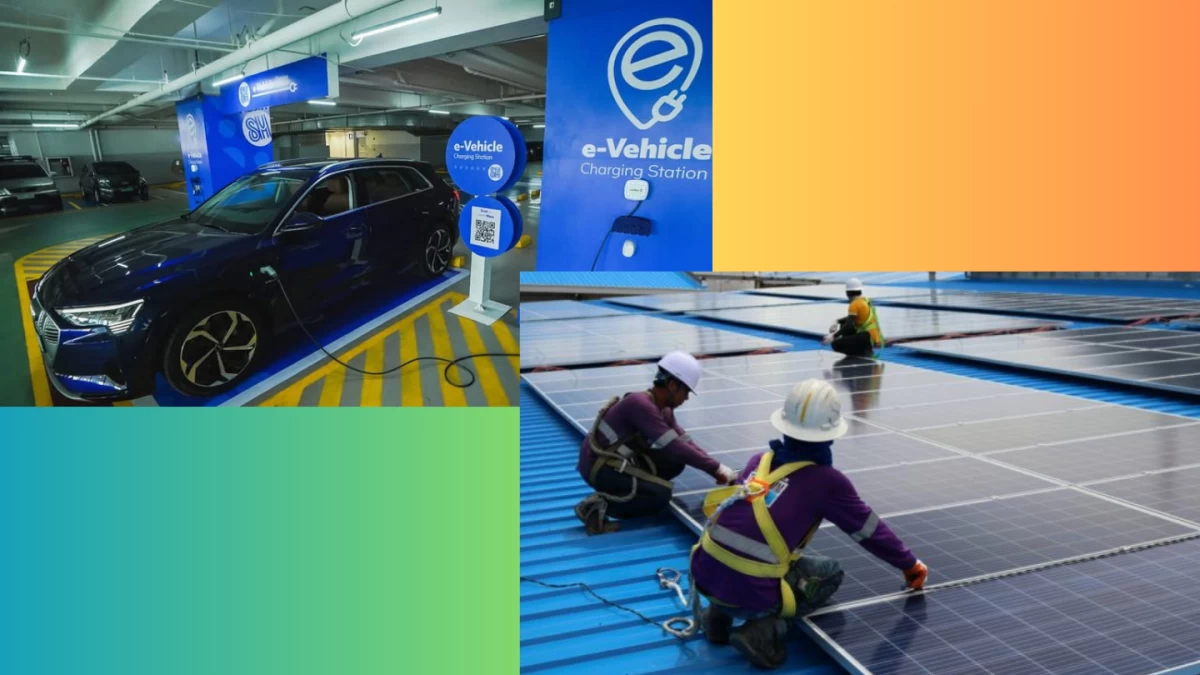
By combining rooftop solar with an electric vehicle, homeowners can essentially insulate themselves from global oil shocks. Industry experts note that while the upfront cost is high, this setup treats energy as a long-term financial asset with a projected five-to-eight-year return on investment.
For the typical motorist, the Tuesday morning fuel hike used to be an annoyance, a topic for brief complaint before the workday began. But as “jumbo” price jumps of ₱22 per liter hit the pumps, the complaint has turned into a financial panic. At ₱14 per kilowatt-hour for electricity and nearly ₱100 per liter for gas, the dream of owning a house with a multi-car garage is starting to look like a liability.
This oil price shock is driving a rush toward the escape hatch of electric vehicles (EVs) and rooftop solar. The logic is simple: if the sun is free and gas is a luxury, why not just buy an EV or slap some solar panels on the roof? But according to Myrna Velasco, a veteran energy journalist who has spent decades watching the gears of the Philippine power industry turn, reacting to headlines is rarely a sound basis for a million-peso investment.
Velasco argues that the current rush to go green is fueled more by adrenaline than by reason. While the conflicts in the Middle East are certainly driving the surge in oil prices, she believes consumers are learning the wrong lesson from the crisis. The true value of switching to renewable energy or EVs shouldn’t be about dodging a temporary price spike; it is about a 10-year financial strategy that treats energy as a long-term asset.
“The Middle East war or the geopolitical risks shouldn’t drive panic buying for EVs,” Velasco says. “Instead, the smart move is to measure ROI [return on investment] for the long term. Electricity prices are generally more stable and cheaper per kilometer than fuel. Over five to 10 years of ownership, you can save thousands of pesos, and those savings increase even more if you charge at home using rooftop solar.”
The cost of entry
Despite the potential savings, the upfront cost of an EV remains a formidable hurdle. For a mainstream model with a decent range, a family is looking at an entry price between ₱1.3 million and ₱1.5 million. In the past, the primary “perk” of buying these cars was the ability to bypass the Metropolitan Manila Development Authority’s (MMDA) number-coding scheme.
But with fuel prices jumping ₱40 in just two weeks, the coding exception has been eclipsed by the “savings gap.” Velasco notes that the narrative has shifted from maneuvering around traffic restrictions to gaining freedom from the weekly torment of the gas station.
However, she cautions that oil prices are notoriously fickle. She points to the 2022 Russia-Ukraine conflict, where oil hit $130 a barrel before settling back to $60 just a few months later. If a consumer buys an expensive car based on a six-month price peak, they might find the math doesn’t look as pretty when the market eventually cools.
This skepticism is shared by those on the front lines of the energy transition. Joseph Yu, SN Aboitiz Power (SNAP), president, views the transition through a more clinical lens. He suggests that if you have both solar and an EV, you are essentially insulated from the global fuel market. To him, a five-year payback on a solar system represents roughly a 15 percent return on investment.
“That’s better than what you get from the stock market,” Yu notes. But he is also quick to add that he hasn’t done the final math on his own roof yet, because every household’s usage is different.
Geography and government
In the Philippines, “going solar” is often a battle against both nature and the government. Take for instance the case of Baguio City, Mayor Benjamin Magalong said they face a unique set of challenges.
The city’s famous “cloud canopy” means that by noon, the sun is often obscured, making solar less efficient than in the lowlands. Furthermore, the steep, winding roads of the Cordilleras are also a nightmare for the battery life of EVs.
“We have a very peculiar situation in Baguio,” Magalong says. “The road networks are elevated, so battery consumption is high. That’s why people here prefer hybrids or plug-in hybrids over pure EVs. The priority is still the gasoline engine for those climbs.”
Even for those in the sunny lowlands of Metro Manila, the path to energy independence is paved with red tape. While the Department of Energy (DOE) claims it has cut the registration process for net metering—where you sell excess solar power back to the grid—down to 20 days, the reality on the ground is different.
Velasco explains that the DOE doesn’t have a say in what happens at the local City Engineer’s office. You still need building permits, electrical permits, and sometimes even zoning clearances if you live in a heritage zone or a flood-prone area. A 20-day process can easily stretch into months depending on which municipality you live in.
Myth of total independence
Perhaps the most persistent misconception is the idea of total “off-grid” independence. Many consumers believe that once they have solar panels, they can say goodbye to power utility distributors forever. This is rarely the case for urban dwellers. Unless you invest in a massive and expensive battery bank to store power for the night, you are still tethered to the grid. And being tethered to the grid means you still have to pay for it.
Velasco also points out that even solar-powered homes are hit with ancillary service charges. These are the fees that pay for grid stability and backup power. “Solar panels generate electricity when sunlight permits,” she says. “But at night or during cloudy days, you still depend on the grid. You’re still footing part of the bill for the grid’s reserve services. What solar truly offsets is the generation charge, but the distribution and grid operator costs remain.”
This is the bitter pill for some to swallow, especially those who believe they are doing the grid a favor by producing their own power. Energy Regulatory Commission (ERC) Chair Francis Saturnino C. Juan acknowledges the financial burden but sees a silver lining for the country as a whole.
Juan notes that increased solar adoption, especially in off-grid areas that rely on expensive diesel, helps ease the pressure on the entire system. He even mentions that he is looking into solar for his own home, noting that payback periods are getting shorter as technology costs drop and utility rates rise.
But for many families, a ₱500,000 solar installation or a ₱1.5 million EV is still a daunting upfront cost. Unlike in the United States or Europe, where the government might offer a rebate or tax credit for going green, Filipino consumers are largely on their own. They have to rely on their own savings or take out bank loans to make the jump.
The most important takeaway from the current crisis is that short-term volatility should not dictate long-term life changes. A three-year ROI for solar is, in Velasco’s view, nearly impossible for a standard household. A more realistic window is five to eight years. If you are buying these systems because you think you’ll “make your money back” by summer, you are going to be disappointed.
However, if you view it as a way to fix your energy costs for the next decade, the argument becomes much stronger. In a world where conflict thousands of miles away can double the price of your commute overnight, there is psychological value in having a fixed cost. It is about taking control of the one thing you can: the roof over your head and the way you get to work.
The current jumbo oil price hikes are a wake-up call, but they shouldn’t be a trigger for a panic purchase. The Philippines is likely to remain a high-cost energy market for years to come, largely because it still relies on coal and imported oil for the bulk of its needs. The transition to a cleaner, more stable system is happening, but it is a marathon, not a sprint.