ADVERTISEMENT

'Red-orange lights': Suspected Chinese rocket streaks across Palawan skies

Published Mar 14, 2026 02:22 pm
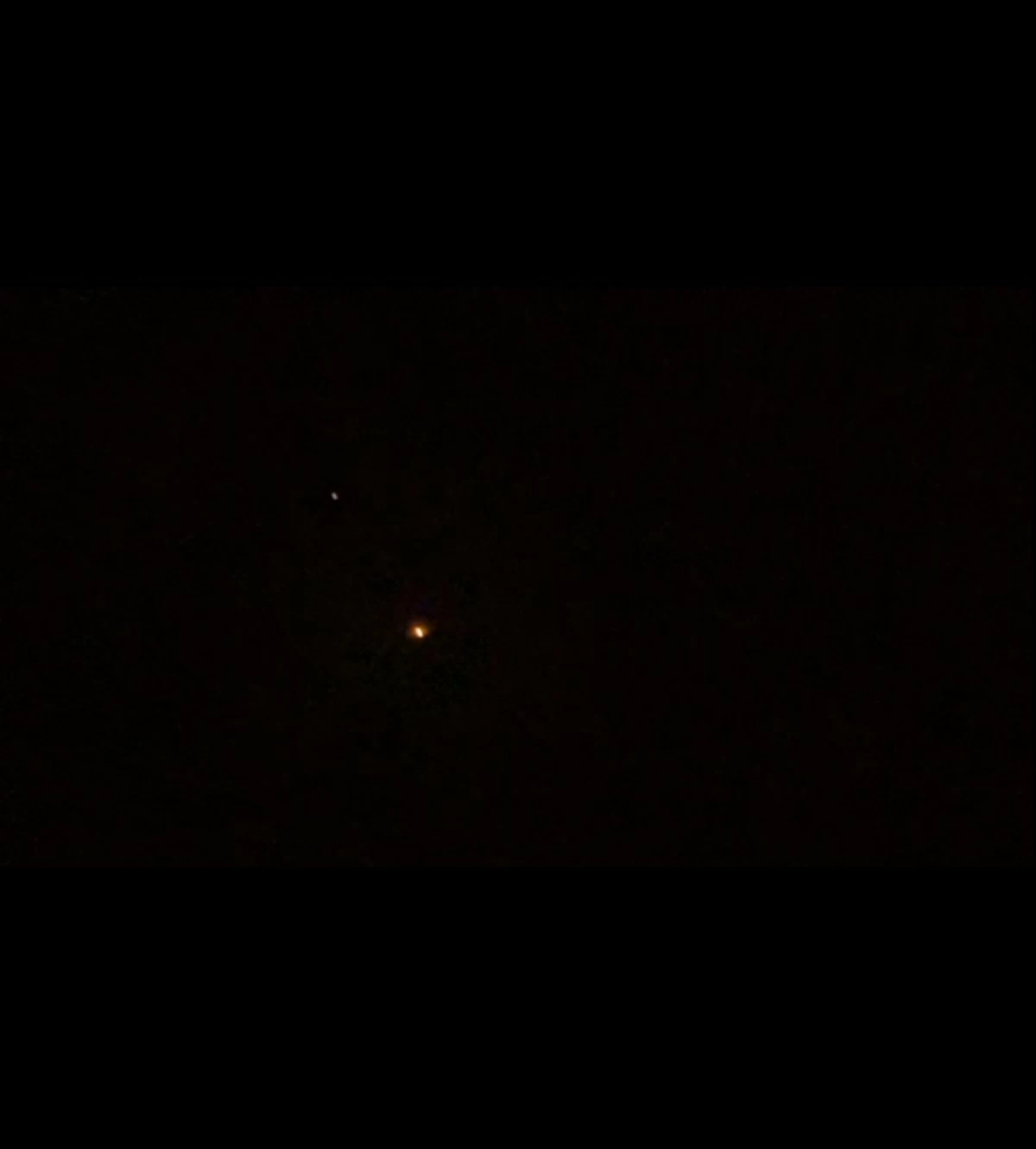
Photo shows two red-orange lights that streaked across Palawan's airspace on March 13, 2026 after China launched its Long March 8A rocket in Hainan Province. (Photo: Naval Western Command)
Security forces went on high alert after a suspected Chinese rocket was observed over the West Philippine Sea (WPS) which crossed Palawan’s airspace on Friday, March 13.
The Western Naval Command (WNC) confirmed the sighting of what is believed to be a People’s Republic of China (PRC) Long March 8A rocket between 3:58 a.m. and 4:02 a.m.
Security personnel deployed in the Kalayaan Island Group (KIG) and Tubbataha Reef Ranger Station captured on video the movement of two bright red-orange lights that illuminated the sky for several seconds, said WNC spokesperson Major Ellaine Rose N. Collado.
“The video shows two bright red-orange lights moving from northwest to southeast. This phenomenon lasted approximately 15 seconds before vanishing from sight,” Collado noted.
“Additionally, personnel from Tubbataha Reef Ranger Station observed a bright red-orange light at 4:02 a.m. PST, which illuminated the sky for six seconds,” she added.
WATCH: Suspected Chinese rocket streaks across Palawan skies
The Philippine Space Agency (PhilSA) earlier said that the Long March 8A rocket was launched by China from the Hainan International Commercial Launch Center in Wenchang, Hainan, China at around 3:49 a.m. Philippine Standard Time (PST) on March 13.
The WNC said the visuals observed over Palawan aligned with pre-launch advisories, indicating potential debris drop zones approximately 101 nautical miles away from Patag Island and 47 nautical miles away from Tubbataha Reefs Natural Park.
The Long March 8A is a newer variant of China’s medium-lift launch vehicles which are designed to deploy satellites into Sun-synchronous orbits. Such launches frequently result in spent rocket stages falling back to Earth, which often pass through or land near Philippine maritime territories
While not projected to fall on land features or inhabited areas, the PhilSA said that falling debris poses danger and potential risk to ships, aircraft, fishing boats, and other vessels that will pass through the drop zone. There is also a possibility for the debris to float around the area and wash toward nearby coasts.
Despite the sighting, Collado said there were no reports of damage or injuries.
“All concerned agencies remain on heightened alert and continue to closely monitor the situation,” she continued.
The WNC also urged residents and coastal communities to remain alert even as it continued surveillance in the area.
“The public is advised to remain vigilant and promptly report any unusual sightings or debris to local authorities,” Collado said.
“The Western Naval Command remains committed to safeguarding the country’s maritime and aerial domains, ensuring public safety, and upholding national sovereignty through continuous monitoring, inter-agency coordination, and timely information dissemination,” she stressed.

Related Tags

Philippine Navy Western Naval Command Chinese rocket Lonch March 8A satellites Palawan WPS
ADVERTISEMENT
.most-popular .layout-ratio{ padding-bottom: 79.13%; } @media (min-width: 768px) and (max-width: 1024px) { .widget-title { font-size: 15px !important; } }

{{ articles_filter_1561_widget.title }}

.most-popular .layout-ratio{ padding-bottom: 79.13%; } @media (min-width: 768px) and (max-width: 1024px) { .widget-title { font-size: 15px !important; } }

{{ articles_filter_1562_widget.title }}

.most-popular .layout-ratio{ padding-bottom: 79.13%; } @media (min-width: 768px) and (max-width: 1024px) { .widget-title { font-size: 15px !important; } }

{{ articles_filter_1563_widget.title }}

{{ articles_filter_1564_widget.title }}

.mb-article-details { position: relative; } .mb-article-details .article-body-preview, .mb-article-details .article-body-summary{ font-size: 17px; line-height: 30px; font-family: "Libre Caslon Text", serif; color: #000; } .mb-article-details .article-body-preview iframe , .mb-article-details .article-body-summary iframe{ width: 100%; margin: auto; } .read-more-background { background: linear-gradient(180deg, color(display-p3 1.000 1.000 1.000 / 0) 13.75%, color(display-p3 1.000 1.000 1.000 / 0.8) 30.79%, color(display-p3 1.000 1.000 1.000) 72.5%); position: absolute; height: 200px; width: 100%; bottom: 0; display: flex; justify-content: center; align-items: center; padding: 0; } .read-more-background a{ color: #000; } .read-more-btn { padding: 17px 45px; font-family: Inter; font-weight: 700; font-size: 18px; line-height: 16px; text-align: center; vertical-align: middle; border: 1px solid black; background-color: white; } .hidden { display: none; }
function initializeAllSwipers() { // Get all hidden inputs with cms_article_id document.querySelectorAll('[id^="cms_article_id_"]').forEach(function (input) { const cmsArticleId = input.value; const articleSelector = '#article-' + cmsArticleId + ' .body_images'; const swiperElement = document.querySelector(articleSelector); if (swiperElement && !swiperElement.classList.contains('swiper-initialized')) { new Swiper(articleSelector, { loop: true, pagination: false, navigation: { nextEl: '#article-' + cmsArticleId + ' .swiper-button-next', prevEl: '#article-' + cmsArticleId + ' .swiper-button-prev', }, }); } }); } setTimeout(initializeAllSwipers, 3000); const intersectionObserver = new IntersectionObserver( (entries) => { entries.forEach((entry) => { if (entry.isIntersecting) { const newUrl = entry.target.getAttribute("data-url"); if (newUrl) { history.pushState(null, null, newUrl); let article = entry.target; // Extract metadata const author = article.querySelector('.author-section').textContent.replace('By', '').trim(); const section = article.querySelector('.section-info ').textContent.replace(' ', ' '); const title = article.querySelector('.article-title h1').textContent; // Parse URL for Chartbeat path format const parsedUrl = new URL(newUrl, window.location.origin); const cleanUrl = parsedUrl.host + parsedUrl.pathname; // Update Chartbeat configuration if (typeof window._sf_async_config !== 'undefined') { window._sf_async_config.path = cleanUrl; window._sf_async_config.sections = section; window._sf_async_config.authors = author; } // Track virtual page view with Chartbeat if (typeof pSUPERFLY !== 'undefined' && typeof pSUPERFLY.virtualPage === 'function') { try { pSUPERFLY.virtualPage({ path: cleanUrl, title: title, sections: section, authors: author }); } catch (error) { console.error('ping error', error); } } // Optional: Update document title if (title && title !== document.title) { document.title = title; } } } }); }, { threshold: 0.1 } ); function showArticleBody(button) { const article = button.closest("article"); const summary = article.querySelector(".article-body-summary"); const body = article.querySelector(".article-body-preview"); const readMoreSection = article.querySelector(".read-more-background"); // Hide summary and read-more section summary.style.display = "none"; readMoreSection.style.display = "none"; // Show the full article body body.classList.remove("hidden"); } document.addEventListener("DOMContentLoaded", () => { let loadCount = 0; // Track how many times articles are loaded const offset = [1, 2, 3, 4, 5, 6, 7, 8, 9, 10]; // Offset values const currentUrl = window.location.pathname.substring(1); let isLoading = false; // Prevent multiple calls if (!currentUrl) { console.log("Current URL is invalid."); return; } const sentinel = document.getElementById("load-more-sentinel"); if (!sentinel) { console.log("Sentinel element not found."); return; } function isSentinelVisible() { const rect = sentinel.getBoundingClientRect(); return ( rect.top < window.innerHeight && rect.bottom >= 0 ); } function onScroll() { if (isLoading) return; if (isSentinelVisible()) { if (loadCount >= offset.length) { console.log("Maximum load attempts reached."); window.removeEventListener("scroll", onScroll); return; } isLoading = true; const currentOffset = offset[loadCount]; window.loadMoreItems().then(() => { let article = document.querySelector('#widget_1690 > div:nth-last-of-type(2) article'); intersectionObserver.observe(article) loadCount++; }).catch(error => { console.error("Error loading more items:", error); }).finally(() => { isLoading = false; }); } } window.addEventListener("scroll", onScroll); });

Sign up by email to receive news.