ADVERTISEMENT

Philippine economic resilience tested

Published Mar 14, 2026 12:05 am  |  Updated Mar 13, 2026 06:03 pm
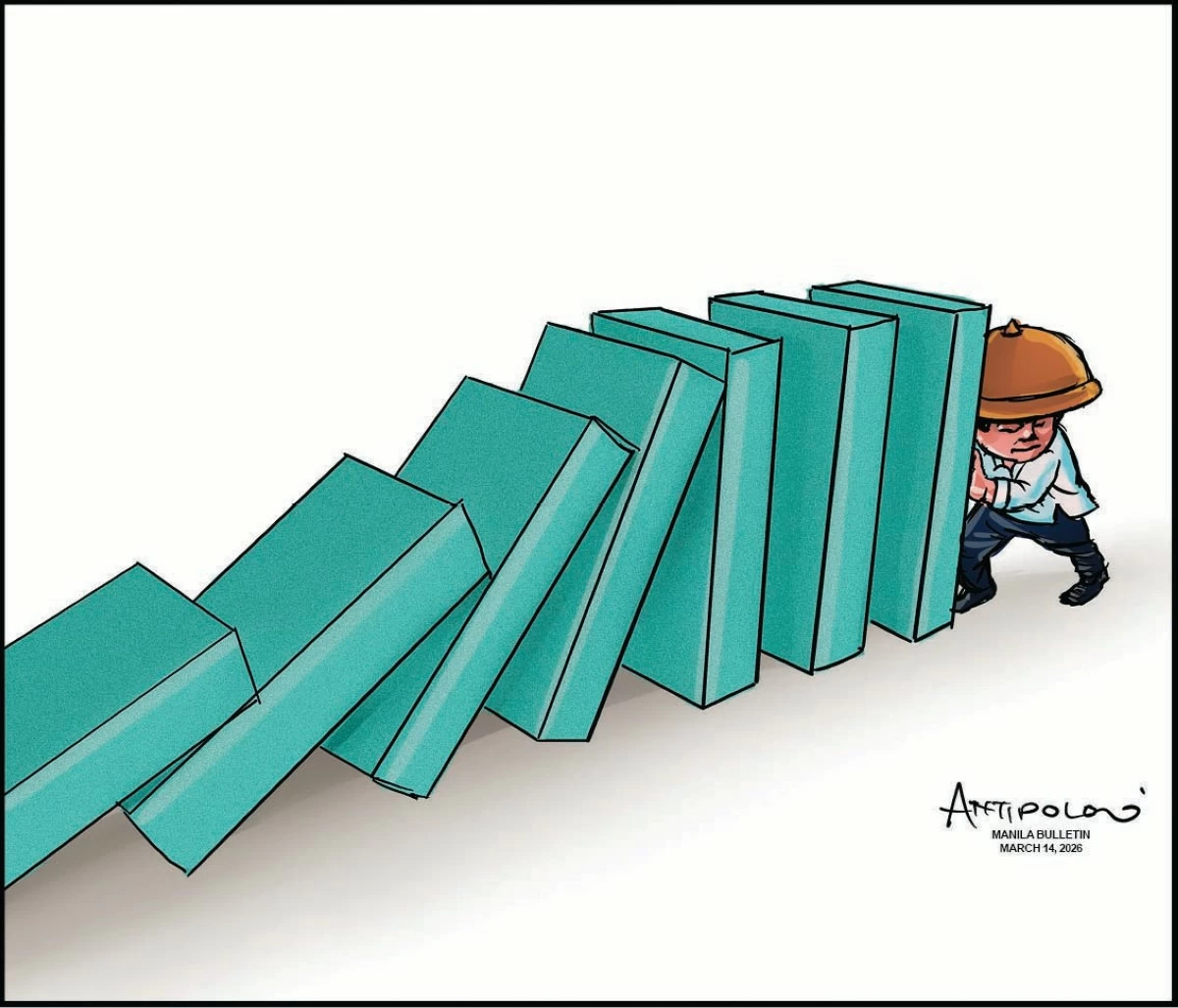
President Marcos’ economic managers may face a substantial recalibration of their 2026 macroeconomic targets as Department of Economy, Planning, and Development (DEPDev) Secretary Arsenio Balisacan warned that a “doomsday” energy scenario could send inflation as high as 7.5 percent.
Balisacan’s warning only underscored the precarious position of a consumer-driven economy that remains structurally tethered to the volatility of global oil markets.
With geopolitical friction between the United States (US), Israel, and Iran threatening to choke essential supply corridors, the Marcos administration’s inflation ceiling of four percent is now under immediate threat. The top economic planner’s assessment suggested that the Philippines is currently caught in a pincer movement between external supply shocks and domestic price sensitivity.
According to Balisacan’s projections, even a moderate stress test would see crude oil hitting $100 per barrel. In this scenario, consumer price growth is expected to accelerate to 5.1 percent by the conclusion of the first quarter.
Such a breach of the government’s target range would likely shave 0.2 percentage points off gross domestic product (GDP). The fallout intensifies significantly if prices escalate to $140 per barrel. At that level, the inflationary pressure would permeate the manufacturing and transport sectors with such force that it could trim as much as 0.3 percentage points from the country’s total economic output.
The policy dilemma for President Marcos centers on a difficult trade-off between maintaining fiscal discipline and providing a social safety net for a population highly sensitive to the cost of living. Balisacan’s suggestion to potentially cut fuel excise taxes represents a departure from the government’s traditional revenue-first stance. While such a move would provide immediate relief at the pump and dampen the second-round effects on food and transport costs, it also threatens to widen the national budget deficit at a time when debt management remains the priority for credit rating agencies.
The administration is currently mobilizing resources to mitigate these price shocks, though the window for proactive intervention is narrowing. Because energy costs function as the foundational input for the economy, the spike in fuel prices acts as an invisible tax on every household.
It raises the operational overhead of industrial plants, increases the logistics cost of bringing farm produce from the provinces to the capital, and erodes the disposable income that fuels the nation’s retail and service sectors.
If the more severe projections materialize, the resulting 7.5 percent inflation rate would represent the most significant challenge to the Bangko Sentral ng Pilipinas (BSP) price stability mandate in recent memory.
For an administration that has staked its reputation on infrastructure development and attracting foreign direct investment, the prospect of an energy-led slowdown serves as a reminder of the country’s vulnerability to Middle Eastern geopolitics.
The ripple effects of $140-per-barrel oil go beyond mere statistics on a spreadsheet. In a country where logistics costs already account for a disproportionate share of food prices, an unmitigated surge in fuel would likely trigger a broader cost-of-living crisis.
This would inevitably force the BSP to adopt a more aggressive monetary stance, potentially raising interest rates to levels that could further damp private investment and housing starts.
As the first quarter of 2026 progresses, the government’s ability to implement fiscal cushions will serve as the primary determinant of whether the year is defined by sustained growth or an inflationary retreat.
The message from the country’s top planner is a call for urgency. While global supply chains remain constricted by conflict, the domestic response must be characterized by agility. The cost of standing still, as the data suggests, may soon become far more expensive than the cost of intervention.
ADVERTISEMENT
.most-popular .layout-ratio{ padding-bottom: 79.13%; } @media (min-width: 768px) and (max-width: 1024px) { .widget-title { font-size: 15px !important; } }

{{ articles_filter_1561_widget.title }}

.most-popular .layout-ratio{ padding-bottom: 79.13%; } @media (min-width: 768px) and (max-width: 1024px) { .widget-title { font-size: 15px !important; } }

{{ articles_filter_1562_widget.title }}

.most-popular .layout-ratio{ padding-bottom: 79.13%; } @media (min-width: 768px) and (max-width: 1024px) { .widget-title { font-size: 15px !important; } }

{{ articles_filter_1563_widget.title }}

{{ articles_filter_1564_widget.title }}

.mb-article-details { position: relative; } .mb-article-details .article-body-preview, .mb-article-details .article-body-summary{ font-size: 17px; line-height: 30px; font-family: "Libre Caslon Text", serif; color: #000; } .mb-article-details .article-body-preview iframe , .mb-article-details .article-body-summary iframe{ width: 100%; margin: auto; } .read-more-background { background: linear-gradient(180deg, color(display-p3 1.000 1.000 1.000 / 0) 13.75%, color(display-p3 1.000 1.000 1.000 / 0.8) 30.79%, color(display-p3 1.000 1.000 1.000) 72.5%); position: absolute; height: 200px; width: 100%; bottom: 0; display: flex; justify-content: center; align-items: center; padding: 0; } .read-more-background a{ color: #000; } .read-more-btn { padding: 17px 45px; font-family: Inter; font-weight: 700; font-size: 18px; line-height: 16px; text-align: center; vertical-align: middle; border: 1px solid black; background-color: white; } .hidden { display: none; }
function initializeAllSwipers() { // Get all hidden inputs with cms_article_id document.querySelectorAll('[id^="cms_article_id_"]').forEach(function (input) { const cmsArticleId = input.value; const articleSelector = '#article-' + cmsArticleId + ' .body_images'; const swiperElement = document.querySelector(articleSelector); if (swiperElement && !swiperElement.classList.contains('swiper-initialized')) { new Swiper(articleSelector, { loop: true, pagination: false, navigation: { nextEl: '#article-' + cmsArticleId + ' .swiper-button-next', prevEl: '#article-' + cmsArticleId + ' .swiper-button-prev', }, }); } }); } setTimeout(initializeAllSwipers, 3000); const intersectionObserver = new IntersectionObserver( (entries) => { entries.forEach((entry) => { if (entry.isIntersecting) { const newUrl = entry.target.getAttribute("data-url"); if (newUrl) { history.pushState(null, null, newUrl); let article = entry.target; // Extract metadata const author = article.querySelector('.author-section').textContent.replace('By', '').trim(); const section = article.querySelector('.section-info ').textContent.replace(' ', ' '); const title = article.querySelector('.article-title h1').textContent; // Parse URL for Chartbeat path format const parsedUrl = new URL(newUrl, window.location.origin); const cleanUrl = parsedUrl.host + parsedUrl.pathname; // Update Chartbeat configuration if (typeof window._sf_async_config !== 'undefined') { window._sf_async_config.path = cleanUrl; window._sf_async_config.sections = section; window._sf_async_config.authors = author; } // Track virtual page view with Chartbeat if (typeof pSUPERFLY !== 'undefined' && typeof pSUPERFLY.virtualPage === 'function') { try { pSUPERFLY.virtualPage({ path: cleanUrl, title: title, sections: section, authors: author }); } catch (error) { console.error('ping error', error); } } // Optional: Update document title if (title && title !== document.title) { document.title = title; } } } }); }, { threshold: 0.1 } ); function showArticleBody(button) { const article = button.closest("article"); const summary = article.querySelector(".article-body-summary"); const body = article.querySelector(".article-body-preview"); const readMoreSection = article.querySelector(".read-more-background"); // Hide summary and read-more section summary.style.display = "none"; readMoreSection.style.display = "none"; // Show the full article body body.classList.remove("hidden"); } document.addEventListener("DOMContentLoaded", () => { let loadCount = 0; // Track how many times articles are loaded const offset = [1, 2, 3, 4, 5, 6, 7, 8, 9, 10]; // Offset values const currentUrl = window.location.pathname.substring(1); let isLoading = false; // Prevent multiple calls if (!currentUrl) { console.log("Current URL is invalid."); return; } const sentinel = document.getElementById("load-more-sentinel"); if (!sentinel) { console.log("Sentinel element not found."); return; } function isSentinelVisible() { const rect = sentinel.getBoundingClientRect(); return ( rect.top < window.innerHeight && rect.bottom >= 0 ); } function onScroll() { if (isLoading) return; if (isSentinelVisible()) { if (loadCount >= offset.length) { console.log("Maximum load attempts reached."); window.removeEventListener("scroll", onScroll); return; } isLoading = true; const currentOffset = offset[loadCount]; window.loadMoreItems().then(() => { let article = document.querySelector('#widget_1690 > div:nth-last-of-type(2) article'); intersectionObserver.observe(article) loadCount++; }).catch(error => { console.error("Error loading more items:", error); }).finally(() => { isLoading = false; }); } } window.addEventListener("scroll", onScroll); });

Sign up by email to receive news.