







Toying with tropes of fiction genres
Published Mar 13, 2026 05:33 pm


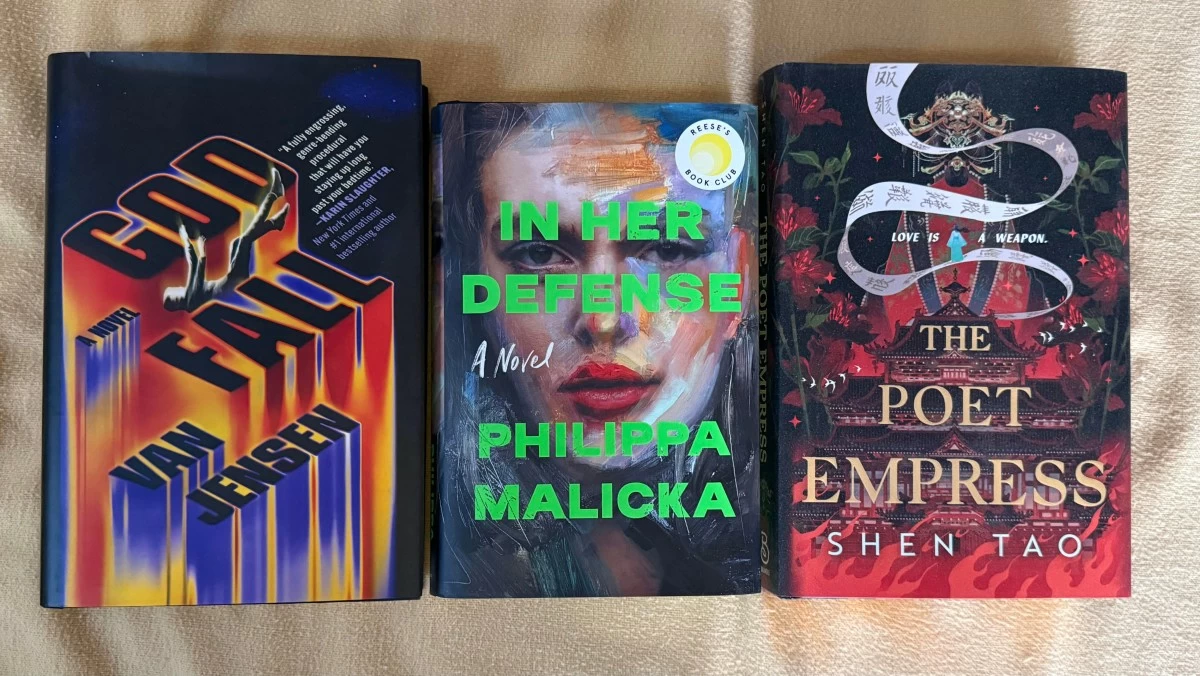
The three novels today highlight authors who take genre fiction to particular heights, toying with the tropes associated with the different genres. Enjoy!
"Godfall" by Van Jensen
Already optioned by Ron Howard and Imagine for a Limited Series, Jensen blends a small-town sci-fi alien invasion in Nebraska with a police procedural that has to do with a serial killer who claims he’s doing the murders on the instructions of the landed alien. The strange part is that said alien is about three miles tall, and landed with a spire attached through his ‘body’. Seemingly dead, the alien nicknamed Gulliver now acts like a rock formation on the outskirts of Little Springs. A whole development has sprung up around the walled perimeter that the military has installed around the alien. David Blunt is the sheriff of Little Springs, and when his cousin Jason is sliced up by the killer, he moves to get to the bottom of the mystery - even if he’s been explicitly told that the investigation is strictly FBI jurisdiction.
It’s easy to get excited about this being turned into a TV series, as several of the chapters do operate as cliffhangers. The flashbacks also help set the tone for constant discovery, and it was difficult for this reader to set the book down - you needed to know what would happen next. There’s a strong nexus of family portrayed in this novel - as would befit a rural, small town setting, with cousins overlapping in the plot, and attending to grandparents in a retirement home, plus uncles who become the band of your professional choices. The military presence and the secrecy surrounding Gulliver are reminiscent of what we know about Area 51 in Nevada and how much is kept from the prying eyes of the media and even the public that they’re serving. Enough clues are dropped along the way so see the logic behind the eventual big reveal. A more than satisfying read!
"In Her Defense" by Philippa Malicka
Here is what, on the surface, is a courtroom drama, but turns into a fascinating psychological portrait of fame and family relationships turned sour. Anna Finbow is a TV star and England’s national treasure. She’s a former punk musician who has evolved to be a Martha Stewart-type personality. She has a daughter named Mary that she’s estranged from, and Anna blames the therapist Jean Guest for poisoning and brainwashing her daughter. She explicitly says this on a social media post and has been brought to court by Guest. Jean’s defense is that there are things that can be traced to Mary’s stint at a prestigious art school in Rome behind the breakdown in her relationship with her mother. And there’s Augusta Bird, Gus, a former employee of Anna, who’s at the courthouse and serves as our narrator - not just an unreliable narrator, as Gus has her own dark secrets.
Gus becomes a central figure, as while she is initially a bystander and relative nobody, she is the one who has connected with all three - Anna, Mary, and Jean. Will or won’t she speak up, given that we’re made aware that she alone knows what really happened in Rome, and who is controlling or manipulating whom? The thorny issue is that if she speaks up, she also ends up implicating herself, as she is not an innocent bystander, but has dirty hands as well. A sharp psychological love story, this novel is also about power and control and how they can be exploited in a manner that can seem indecent and with far-ranging consequences. Is Jean Guest the caring therapist she claims to be, or is she a sadistic, mean-spirited individual? Is Anna the doting but free-spirited mother she likes to think she is, or has she irreparably ruptured her relationship with her one and only daughter? And how do we judge Gus as she gets involved with the lives of the other three?
"The Poet Empress" by Shen Tao
A first novel by Shen Tao, she has mentioned that while inspired by the Tang Dynasty, and even if it has been categorized as a romantasy, it is not a historical China she is depicting here, but a window into her own brand of world-building. An Azalea Dynasty, in its waning days, is conjured up, and with the Emperor dying, a search for a concubine for the next Emperor, Prince Terren, commences. Wei Yin, from a poor village, offers herself in order to save her family from starvation and bring education to her brothers. What she discovers upon arriving at the palace is that Terren is, in fact, the second son. There is Maro, the eldest, but at some point in his training as one who can compose and cast spells, Terren had proved to be the more effective and favored by the Emperor and his allies. The problem is that for some reason, Terren has turned into a Prince notorious for warfare, cruelty, and his use of blades - blades that would appear like magic, nestled in ceilings and corners - ready at the drop of a pin to do his bidding.
And these two heirs are just the first part of Wei Yin’s problems. Coming from a poor village, she is looked down upon by the other women and girls vying to be a concubine, or the Empress In Waiting, if the Prince doesn’t just select you, but marries you as well. It’s a courtly intrigue of the type that’s vicious, given how high the stakes are being played for. When Wei Yin finds out that a poem of love can also be a spell to kill, she embarks on a quest to learn how to read and acquire the power of poetry magic. This she has to do in deep secrecy, as it is forbidden. Against all odds, or perhaps just to spite all those in the court, and play by his own rules, Terren announces he will marry Wei Yin over the rich city girls and daughters of his allies. In terms of world-building, this is indeed a wonderful feat - there’s fantasy, and there’s magic, and it’s set in a China that seems historical and familiar, while existing on its own terms. And ultimately, it’s a story of a young woman facing cruelty; of discovering the reasons and traumas behind this behavior - and deciding on her own whether to forgive.