







Shared sacrifice crucial in time of crisis
Published Mar 13, 2026 12:05 am
|
Updated Mar 12, 2026 05:50 pm


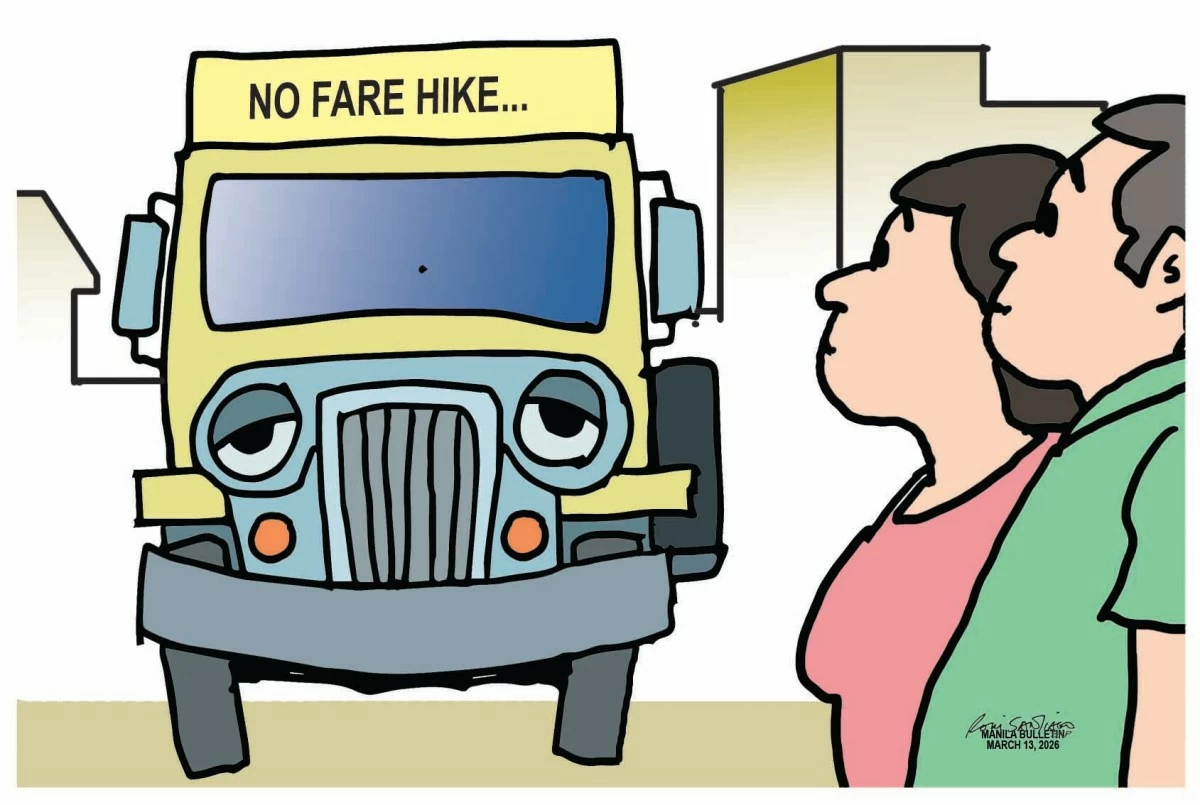
The assurance from transport groups that they will refrain from seeking a fare increase—at least for now—deserves both recognition and reflection. It comes at a time when every peso counts and the price of fuel threatens to ripple across the entire economy,
The commitment made by Samahang Manibela, Mananakay at Nagkakaisang Terminal ng Transportation (Manibela) and the Liga ng Transportasyon at Operators (LTOP) not to push for higher jeepney fares, provided the government delivers meaningful support, is a welcome development in an otherwise troubling economic moment. It is a gesture that reveals both restraint and responsibility from a sector that itself is struggling to stay afloat.
Jeepney drivers are not insulated from the relentless surge in fuel prices. In fact, they are among the most vulnerable to it. As Manibela president Mar Valbuena pointed out, many drivers are already losing at least ₱400 from their average ₱800 daily earnings due to soaring diesel costs. That is a stark portrait of livelihoods slowly eroding under the weight of circumstances beyond their control.
Under such conditions, asking for a fare hike would have been understandable. Yet transport leaders have chosen to treat it as a last resort rather than an immediate demand. Their message is clear. If the government steps in with support—through fuel subsidies and the suspension or reduction of excise taxes—drivers are willing to hold the line on fares.
This posture reflects an important principle often forgotten during economic strain: shared sacrifice.
The government, for its part, appears to be moving in the right direction. The planned ₱5,000 fuel subsidy for public utility vehicle and tricycle drivers offers immediate relief, even if temporary. Meanwhile, the proposed suspension or reduction of excise taxes on fuel products—already approved on second reading in the House of Representatives—could significantly lower pump prices by as much as ₱6 per liter for diesel and ₱10 for gasoline.
These measures, if implemented swiftly and efficiently, would not only ease the burden on transport workers but also help protect commuters from additional financial strain.
But the responsibility of cushioning the impact of the oil crisis should not fall solely on the government and the transport sector.
Other sectors must also recognize the moment and act with the same spirit of restraint and solidarity. Businesses dealing with electricity generation, food distribution, and other essential goods and services should resist the reflex to immediately pass rising operational costs to consumers. While economic realities cannot be ignored, timing and moderation matter, especially when millions of households are already stretching thin their budgets just to meet daily needs.
The oil crisis, after all, triggers widespread ripple effects. When fuel prices climb, transportation costs increase, electricity prices feel pressure, and the cost of delivering food and basic commodities rises. Without coordinated efforts, the result is a chain reaction of price hikes that ultimately punishes the most vulnerable members of society.
That is why the example set by the transport groups is worth amplifying. Their willingness to delay a fare increase—despite the hardship they face—demonstrates a recognition that economic crises demand cooperation rather than unilateral action.
Now is the moment for the government and the private sector to deepen that cooperation. Policymakers must ensure that assistance programs are delivered quickly and transparently. Businesses must show prudence and social responsibility. And regulators must remain vigilant in preventing opportunistic price increases.
Economic storms test the character of institutions and industries alike. The decision of jeepney drivers and operators to hold off on fare hikes, while seeking fair support, shows that compassion and practicality can coexist.
If other sectors follow that example, the burden of the oil crisis will not disappear—but it will be shared more fairly by all.