







PhilSA confirms rocket debris fell near Palawan, Sulu Waters
Published Mar 13, 2026 08:18 am


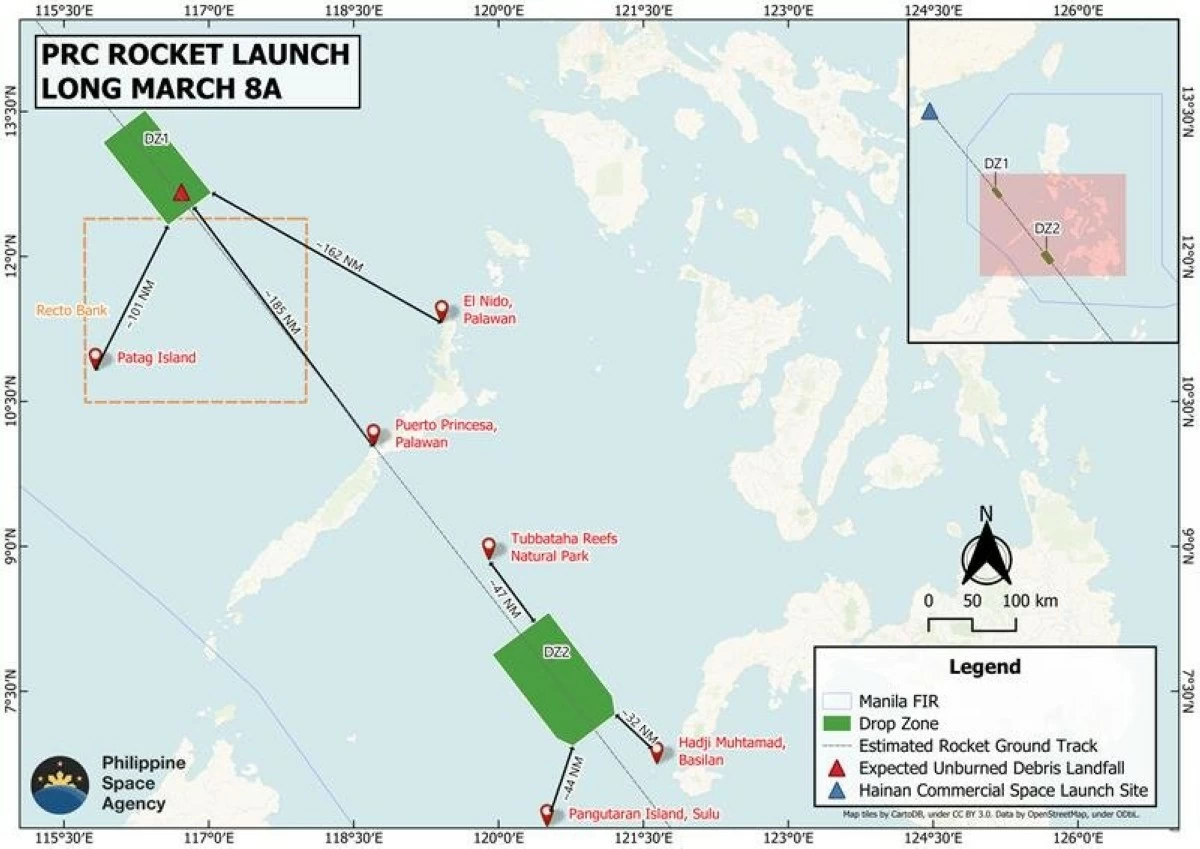
The Philippine Space Agency (PhilSA) has confirmed that debris from China's Long March 8A rocket launch fell within two drop zones inside Philippine maritime territory, including areas near Palawan and the Sulu Sea.
The rocket lifted off from the Hainan International Commercial Launch Center in Wenchang, Hainan at approximately 3:49 AM Philippine Standard Time on March 13, 2026.
Two Drop Zones Inside Philippine Waters
PhilSA identified two debris drop zones from the launch. The first (DZ 1) falls within the Philippine Exclusive Economic Zone (EEZ), roughly 162 nautical miles from El Nido, Palawan, 185 nautical miles from Puerto Princesa, Palawan, and 101 nautical miles from Patag Island. The second (DZ 2) is within Philippine archipelagic waters, situated approximately 32 nautical miles from Hadji Muhtamad, Basilan, 44 nautical miles from Pangutaran Island, Sulu, and 47 nautical miles from Tubbataha Reefs Natural Park.
Details of the drop zones were disclosed through a Notice to Airmen (NOTAM) citing an "aerospace flight activity." PhilSA said it had already disseminated a pre-launch advisory to relevant government agencies prior to the launch.
Debris Poses Risk to Vessels and Coastal Areas
While PhilSA said the debris was not projected to land on inhabited areas or land features, the agency warned that unburned rocket components — including boosters and fairings that are jettisoned as the vehicle ascends — pose hazards to ships, aircraft, fishing boats, and other vessels transiting the drop zones.
The agency also noted that debris could float and drift toward nearby coastlines, and that an uncontrolled atmospheric re-entry of the rocket's upper stages could not be ruled out.
What the Public Should Do
PhilSA is advising the public to report any suspected rocket debris to local authorities immediately. The agency is also cautioning against approaching or handling such materials, which may contain remnants of toxic rocket fuel.