






Manila Bulletin
 Philippines
National
US War official describes Marcos as 'model leader', cites 'vital' PH-US alliance
Philippines
National
US War official describes Marcos as 'model leader', cites 'vital' PH-US alliance
Philippines
National
US War official describes Marcos as 'model leader', cites 'vital' PH-US alliance
US War official describes Marcos as 'model leader', cites 'vital' PH-US alliance
Published Mar 12, 2026 07:18 am


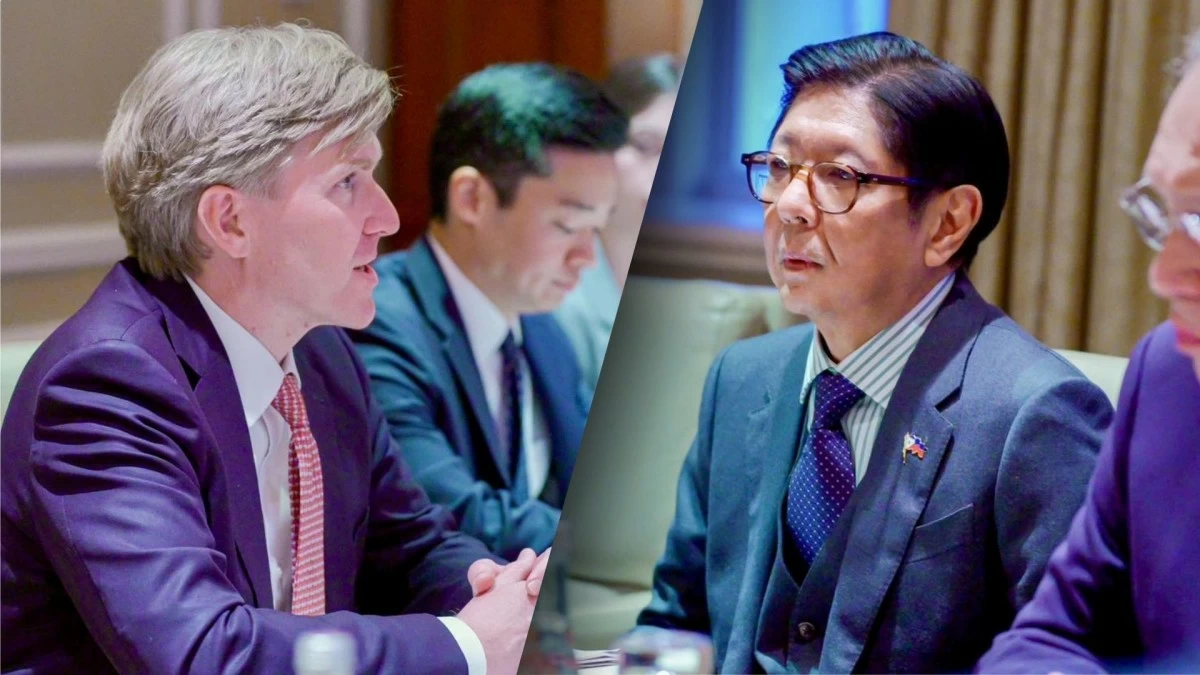
US Undersecretary of War for Policy Elbridge Colby and President Ferdinand 'Bongbong' Marcos Jr. (PCO photos)
A senior United States War official described the Philippines as a key partner in collective defense following a meeting with President Marcos during the latter’s working visit to New York.
In a post on X, US Undersecretary of War for Policy Elbridge Colby said he had a “very productive discussion” with Marcos on strengthening the alliance between the two countries.
“It was a great personal honor to meet with Philippine President Marcos this week in New York during his visit to the United Nations,” he wrote early Thursday, March 12 (Manila time).
“President Marcos is a model leader in leaning forward to address collective defense,” he added.
Colby said their discussion emphasized the “vital importance” of the alliance between the Philippines and the United States and ways to further strengthen defense cooperation between the two countries.
The Presidential Communications Office (PCO) earlier said that the meeting between Marcos and Colby centered on efforts to accelerate the Philippines–United States defense partnership.
“The meeting focused on strengthening deterrence in the Indo-Pacific and improving interoperability between the Armed Forces of the Philippines and the United States military through joint operations such as Exercise Balikatan, which will begin next month,” it said.
“Both sides also reaffirmed their mutual commitment to the Mutual Defense Treaty and to continuing to work together for a stable and secure Indo-Pacific region,” it added.
The Philippines and the United States maintain what both governments describe as an “ironclad” alliance anchored on the Mutual Defense Treaty. Under the treaty, the two countries commit to support each other in case of an armed attack in the Pacific area, forming the foundation of their long-standing security partnership.
Defense cooperation between Manila and Washington has further expanded in recent years through agreements such as the Enhanced Defense Cooperation Agreement, which allows US forces access to selected Philippine military bases for joint training, humanitarian assistance, and disaster response.
The alliance also includes regular joint military exercises, including the annual Balikatan drills conducted by the Armed Forces of the Philippines and the US military.
Philippine and US officials have repeatedly described their security partnership as critical to maintaining stability, freedom of navigation, and a rules-based order in the Indo-Pacific region.
President Marcos has just concluded his two-day working visit to New York, which he described as “very productive.”
In a press briefing, the President said the trip helped advance the Philippines’ campaign for a seat on the United Nations Security Council, promote women’s empowerment, and encourage American investors to explore opportunities in the country.
During the visit, the President delivered the Philippine national statement at the 70th session of the Commission on the Status of Women at the United Nations headquarters, where he shared that the nation's “true progress is measured by the status and empowerment of its women.”
Marcos likewise emphasized the importance of expanding access to education, strengthening unity in confronting violence against women, and ensuring women’s participation in decision-making across sectors.
The President also met with UN Secretary-General António Guterres, where he reaffirmed the Philippines’ commitment to multilateral cooperation and the United Nations. He likewise addressed the 193 member states of the UN during a special session of the UN General Assembly, stressing the importance of the rule of law, multilateralism, and the peaceful settlement of disputes.
Marcos reiterated the Philippines’ bid for a non-permanent seat on the UN Security Council for the 2027–2028 term. He said the Philippines aims to represent the voice of the Indo-Pacific region, including developing countries, climate-vulnerable nations, and middle-income economies.
On the sidelines of the visit, the President also met with business leaders and investors to promote economic cooperation with the Philippines.
Among them were officials of the US Medical Glove Company, which is considering building a medical glove manufacturing facility in the country that could generate more than 2,000 jobs.
Marcos also met with executives of J.P. Morgan to discuss global economic developments and financial market conditions.
The discussion covered geopolitical tensions and their potential impact on global oil prices and financial markets.
“Sa pagtatapos ng ating pagbisita sa New York, ipagpapatuloy natin ang paglilingkod sa bayan nang mas mulat sa mga bagong kaalaman, pamamaraan, at mga ugnayan (As we conclude our visit to New York, we will continue serving the nation with greater awareness of new knowledge, approaches, and partnerships),” the President said.
Marcos added that the Philippines’ participation in multilateral forums complements efforts to strengthen bilateral ties with countries around the world while promoting regional solidarity, particularly within the Association of Southeast Asian Nations (ASEAN).