






Manila Bulletin
 Philippines
National
PH ready to be part of solution, Marcos says as he seeks UN Security Council seat
Philippines
National
PH ready to be part of solution, Marcos says as he seeks UN Security Council seat
Philippines
National
PH ready to be part of solution, Marcos says as he seeks UN Security Council seat
PH ready to be part of solution, Marcos says as he seeks UN Security Council seat
Published Mar 11, 2026 09:50 am
|
Updated Mar 11, 2026 02:14 pm


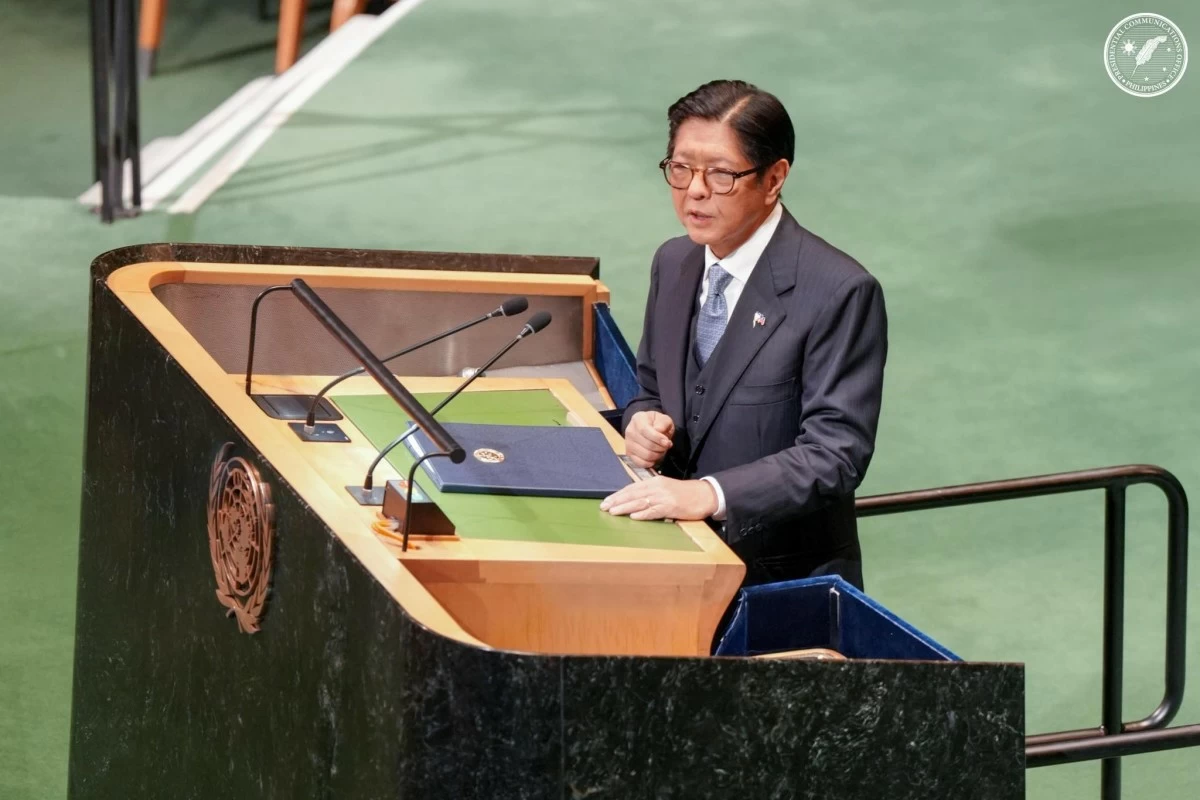
President Ferdinand R. Marcos Jr. seeks support for the Philippines' bid for a non-permanent seat at the United Nations Security Council during his special address at the United Nations General Assembly in New York on March 10, 2026. (Photo courtesy of PCO)
President Marcos has addressed the United Nations General Assembly (UNGA) to campaign for the Philippines' bid for a non-permanent seat at the UN Security Council, stressing that the country "is ready to be part of the solution."
In his special address to the UNGA before concluding his working visit in New York on Tuesday, March 10 (New York time), Marcos sought support for the country's candidature for the UNSC, which will be decided in an election on June 3 this year.
The President underscored that the country stands ready to contribute to the council in the service of humanity.
In his lengthy speech, he cited the various contributions of the Philippines since the founding of the United Nations in 1945, saying
"Our contributions across the whole spectrum of UN work, since its inception, are borne out by history."
"Always ready to be part of the solution, the Philippines has regularly proven itself to be an independent, trusted partner, an innovative pathfinder, and a committed peacemaker," he said.
"In the midst of mounting challenges and uncertainties, our United Nations need steady, committed, experienced hands; and we humbly offer ours - to serve in the UN Security Council for 2027 to 2028," he added.
Marcos said the Philippines lodged its candidature, mindful that a non-permanent seat on the UN Security Council is not a right of any State, but a privilege earned through consistent, dedicated, meaningful, and concrete partnership, in the service of the United Nations, and so of humanity.
"The Philippines stands ready once again, to contribute – to help calm voices of division, provide a voice of balance; to shun ambition, for service and always as a voice for principled peace," Marcos said. "And thus, I stand before you to humbly petition for your support for the Philippines in the elections on the 3rd of June 2026."
Strengthening his arguments of the country’s commitment to international peace and security, the President noted the Philippines was among the first nations to respond to the UN’s call for assistance in the Korean War, in which more than 7,400 Filipinos served under the United Nations Command.
In 1963, responding to the call of the UN and the Congolese government, the Philippine Air Force mounted its first international operation, deploying to Congo on a peacekeeping mission.
Marcos added that since the Philippine mission in Congo, the country has deployed 15,000 troops to 22 peacekeeping missions in Africa, the Middle East, the Caribbean, and Asia-Pacific.
And amid the UN’s liquidity crisis, the Philippines paid its regular budget assessments in full within the 30-day due period in January and was included in the UN’s Honor Roll
Are we failing our ancestors?
In his speech, the President called for urgent action for peace in the Middle East and other parts of the world that remain in conflict.
Marcos joined calls for restraint, de-escalation, and cessation of hostilities, respect for international law, including the UN Charter and humanitarian law, and for all concerned to return to the negotiating table for peace.
"Then and now, we stand ready to do our part to stay the forces of war, to end conflict, to ease suffering. We call for urgent and much-needed action for peace in the Middle East, in Ukraine, in Sudan, the DRC, the Sahel, Yemen, and Myanmar. Their people continue to live in fear and in despair," Marcos said.
"These tragedies need to stop. Innocents must be protected, and their basic needs immediately provided," he added.
Citing the United Nations Charter, Marcos said nations vowed that "never again shall we be cursed by such a global catastrophe."
But he questioned whether the states are succeeding or failing their ancestors, who founded the UN to fulfill peace.
"But watching events in Gaza, the Ukraine, Sudan, the Middle East, and in many other places, I cannot help but ask, are we succeeding? Or are we failing our ancestors who, in 1945, forged this assembly out of shared anxiety, shared hope, and endeavor, to fulfill humanity’s aspirations for peace? Are we failing those who will succeed us?" he reflected.
Marcos stressed that the future generations also deserve to inherit a world where safety, security, dignity, and a healthy planet are assured for all of humanity.
Opportunity to contribute more
In a post-working visit press briefing, Marcos said having a seat at the UNSC is another opportunity to contribute more.
"We see now an opportunity to contribute even more. And that, I think, will serve to the advantage of the Philippines in this candidature," he said.
"It's very hard to assess what the chances are. We have some solid expressions of support, but it is a silent ballot, so a secret ballot rather. So you know we just have to keep talking to our friends and hope that they provide us their support," he added when asked to assess the Philippines' candidacy over rival country, Kyrgyzstan.
He also stressed that the country has an advantage considering that it has "a very strong record of partnership with the UN over the years."
"It is not about the Philippines. For example, yung mga peacekeeping na tinutulungan natin ang UN (we help the UN in peacekeeping) under the auspices of the UN," he said.
"Mukha namang maganda naman ang pag-asa natin. Sana naman matuloy at tayo’y maging non-permanent member na (The prospects look good for us. Hopefully it pushes through and we become a non-permanent member)," he added.
Luncheon reception for UN permanent representatives
Marcos hosted a luncheon reception for Permanent Representatives of the United Nations member states to gather support for the Philippines’ UNSC bid.
The President’s diplomatic push is part of the Philippines’ effort to secure a non-permanent seat at the UNSC for the 2027-2028 term. The UNSC election is scheduled for June 3, 2026.
“I was also able to meet, just now, high-level representatives of the other UN member states at the diplomatic reception,” Marcos said during the press briefing.
"I hosted this to galvanize support for our Security Council candidature and to showcase once again that the Philippines has always been, since the very beginning of the United Nations in 1945, part of the solution to addressing global challenges and conflicts as a trusted and independent partner, pathfinder, and peacemaker," he added.
If the Philippines successfully becomes a non-permanent member of the UNSC, it will sit on the Security Council, the United Nations’ guiding body that addresses global security issues and sets the agenda for matters discussed by the UN General Assembly.
Securing a seat will also enable the Philippines to strengthen its partnership with the UN, which has been working with the country since 1945 on many of the most important issues.