







PEF welcomes new Philippine Eagle chick 'Bayani'
Published Mar 11, 2026 03:33 pm


BAYANI
DAVAO CITY – The Philippine Eagle Foundation (PEF) reported on Tuesday, March 10, the successful hatching of Philippine Eagle chick No. 32 named “Bayani” (hero).
The announcement of the new chick coincided with the adoption of the three-month old Philippine Eagle by Nico Herth, owner and chief executive officer of Procon Grumbach, a German manufacturer of high-precision electronics systems.
Bayani, whose name was chosen by its adopter, is the offspring of Philippine Eagles ‘’Dakila’’ and ‘’Sinag.’’
The chick was produced through cooperative artificial insemination as part of the PEF’s conservation breeding program.
Dr. Jayson Ibañez, PEF Director of Operations, said that Bayani is the fifth chick that hatched at the National Bird Breeding Sanctuary (NBBS) at the hinterlands of Toril District here.
Ibañez added that semen was collected from the Philippine Eagle Center (PEC) in Barangay Malagos and taken to the NBBS, about 40 kilometers away or an hour-and-half of travel.
The specimen was placed inside a portable refrigerator when transported to the NBBS, he said.
“The technology that the Liberec Zoo in the Czech Republic has shared is a big help to the PEF’s conservation program,” Ibañez said.
Karel Hejč, ambassador of the Czech Republic to the Philippines, highlighted how international cooperation strengthens conservation efforts across borders.
“Protecting endangered species such as the Philippine Eagle is a responsibility that extends beyond national boundaries. Through international cooperation, the sharing of knowledge, technology, and expertise, we can strengthen conservation efforts and support the remarkable work being done here in the Philippines. The Czech Republic is proud to stand with partners who are committed to ensuring that this magnificent bird continues to soar in the wild for generations to come,” Hejč said.
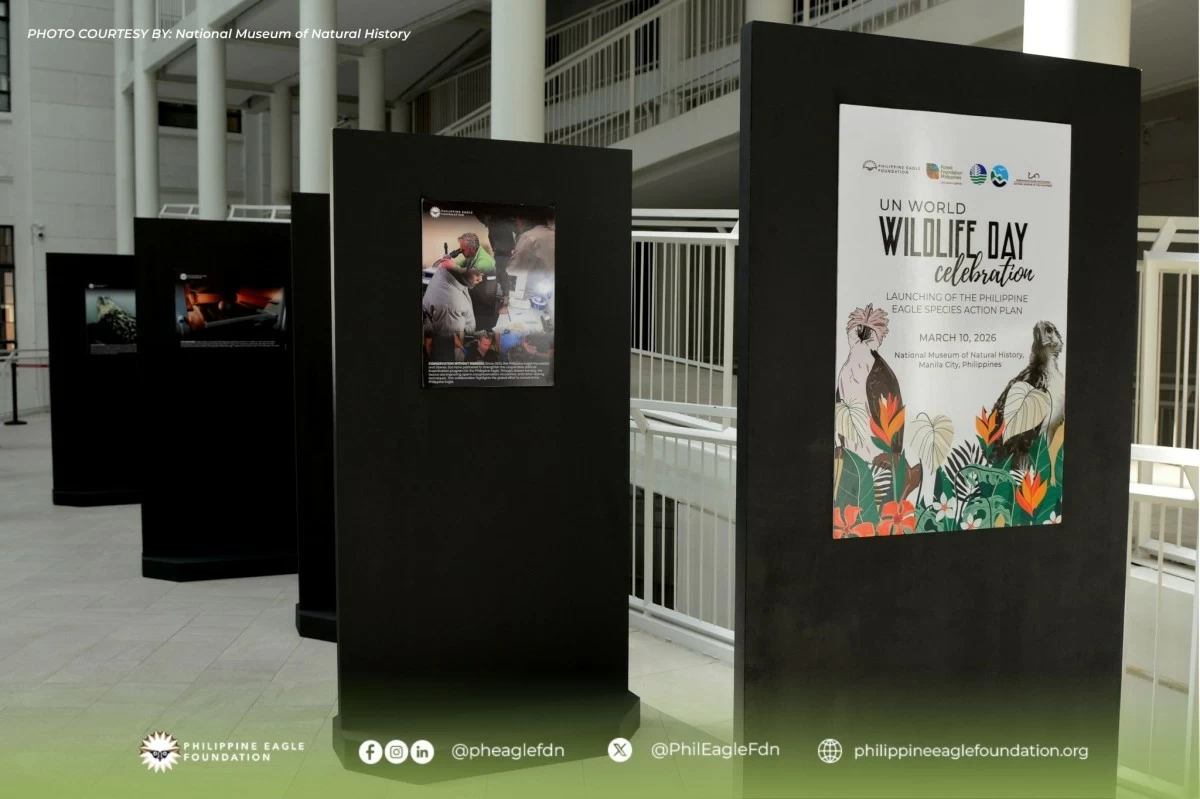
A PHILIPPINE Eagle Foundation exhibit featuring the Philippine Eagle. (PEF FB)
Bayani hatched on Dec. 5, 2025 at the NBBS through a “help out method” by seasoned animal keeper Domingo Tadena and assisted by PEF biologists. Tadena, NBBS manager, assisted Bayani in emerging from its shell.
Opened in 2024, the NBBS is a dedicated facility of the PEF for conservation breeding program. Since then, five chicks have been produced in the facility. However, four did not survive due to several factors.
Ibañez said that several lessons have been learned from this and some of their protocols have been revised and applied in nurturing Bayani.
He added that Bayani is considered a success in the conservation program as they were able to produce eggs in the early days of the facility.
“It speaks a lot on the suitability of the NBBS for breeding because just like in the wild, the site has the same elevation, temperature, and even the forest cover,” Ibañez said.
Under captive breeding, female eagles can be induced to breed two to three times in one breeding season, he said. In the wild, the seasoned conservationist said that female eagles could only lay an egg once every two years.
Ibañez said Bayani weighs about four kilos and has yet to undergo deoxyribonucleic acid testing to determine gender.
Bayani will be transferred to a bigger cage once it starts branching and flapping its wings.
The PEF is appealing for donations to build additional cages inside the NBBS to cater to additional breeding eagles. PEF estimates that there are about 400 pairs of eagles left in the wild.
With the hatching of Bayani, PEF said that it is a milestone achievement in its conservation breeding program and a big boost in the effort to save the critically-endangered Philippine Eagle.