








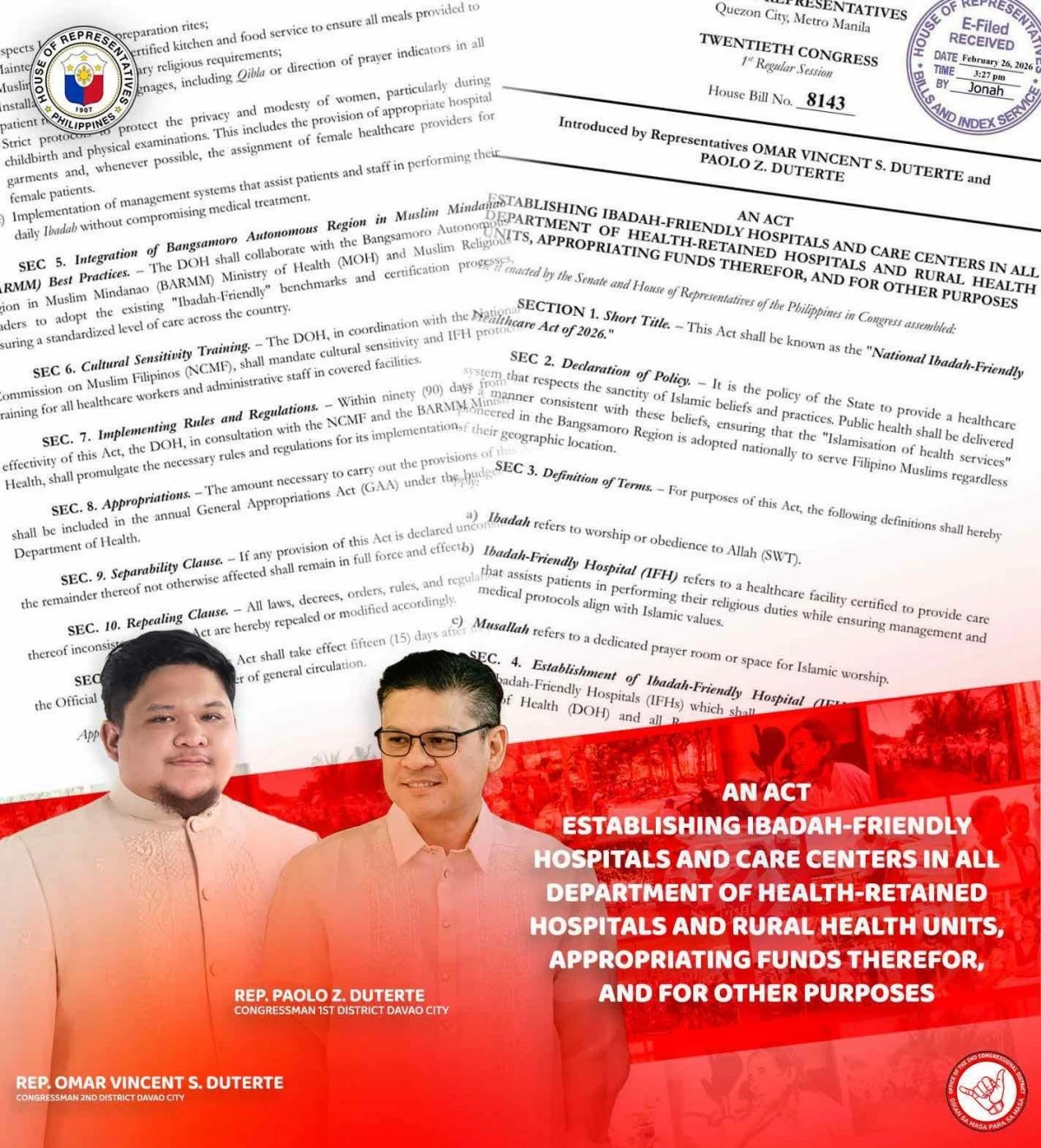
DAVAO CITY – Davao City Reps. Paolo Z. Duterte and Omar Vincent S. Duterte recently filed a legislative measure to implement the Ibadah-friendly hospital model in all government-run hospitals and rural health units nationwide.
The proposed National Ibadah-Friendly Healthcare Act aims to replicate nationwide the healthcare approach recently practiced in the Bangsamoro Autonomous Region in Muslim Mindanao.
The two lawmakers said hospital services in the BARMM are designed to accommodate the religious practices of Muslim patients while they receive medical care.
The lawmakers said the measure seeks to ensure that healthcare services respect Islamic beliefs and practices, particularly for millions of Filipino Muslims living in different parts of the Philippines, including in Davao City.
“Ibadah means worship and obedience to Allah (SWT). Healing is a holistic process that involves the spirit as much as the body,” the Duterte lawmakers said in a statement.
Omar said the proposed measure seeks to provide consistent, culturally sensitive care for Muslim patients nationwide, ensuring they receive the same level of care as in the Bangsamoro region.
Under the bill, all hospitals retained by the Department of Health and rural health units will be required to adopt Ibadah-friendly healthcare standards.
Key provisions of the measure include the establishment of Musallahs (prayer rooms) and Wudu facilities for ablution in healthcare institutions, the bill said.
The bill also requires public hospitals to maintain Halal-certified kitchens to ensure that food served to Muslim patients complies with Islamic dietary laws.
The measure also includes rules to protect women’s modesty during childbirth and medical exams, and adds Qibla indicators in patient rooms to help Muslim patients know the direction of prayer.
Paolo said the proposed legislation draws on the “Islamization of health services” framework, which integrates healthcare management with support for patients’ religious practices during treatment.
Under the proposal, the DOH will coordinate with the Bangsamoro Ministry of Health and the National Commission on Muslim Filipinos to certify healthcare facilities that meet the required standards.
“Our goal is to ensure that no Filipino Muslim feels like a stranger in our public hospitals,” Paolo said, adding that the measure aims to uphold respect for religious practices even during times of illness.
The lawmakers emphasized that this is about dignity, respect, and the fundamental right to practice one’s faith even in the most challenging times of illness.